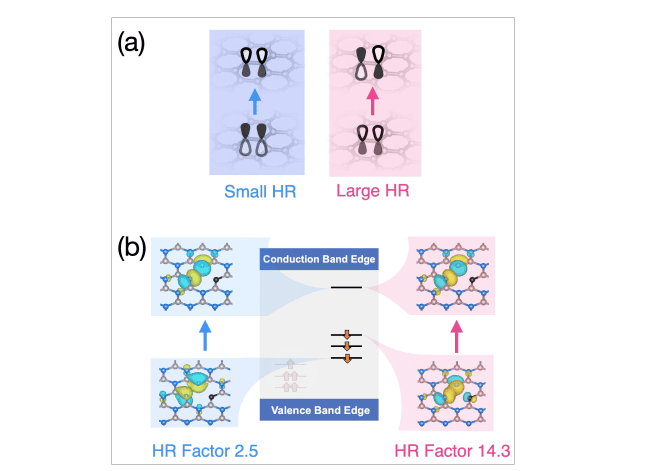
Understanding how defects in materials interact with vibrations, quantified by the Huang-Rhys factor, proves critical for developing advanced quantum technologies and efficient light emitters. Fatimah Habis and Yuanxi Wang, from the University of North Texas, present a new approach that simplifies the calculation of these crucial factors, overcoming longstanding computational challenges. Their research demonstrates that the bonding character of a defect, determined from readily available ground state data, accurately predicts its vibrational behaviour, eliminating the need for complex excited-state calculations and extensive phonon modelling. This breakthrough offers a powerful tool for rapidly screening materials and identifying promising candidates for spin qubits and single-photon emitters, accelerating progress in quantum information science and materials engineering.
Huang-Rhys Factors and Phonon Interactions
This supplemental information details methods and validation for calculations performed to understand defects in materials, specifically hexagonal boron nitride and diamond with nitrogen-vacancy centers. The goal is to demonstrate the reliability of calculated Huang-Rhys (HR) factors, which describe how defects interact with vibrations and, therefore, their optical properties. The authors address potential concerns about calculation accuracy, given the computational demands of more sophisticated methods. The Huang-Rhys factor quantifies the strength of interaction between electrons and vibrations, called phonons.
A larger HR factor indicates a stronger interaction, leading to broader spectral lines and increased probability of phonon emission or absorption during optical transitions. Accurate HR factors are essential for predicting how defects will behave optically. The configuration coordinate diagram simplifies modeling this interaction by assuming vibrational motion can be described by a single coordinate. The force constants embedding method is a computational technique used to calculate HR factors for defects in large material models, reducing computational cost. The team employed the Crystal Orbital Hamiltonian Population method as an alternative way to estimate forces on atoms during vibrations, validating whether this approach introduces significant errors. Larger material models are needed to accurately represent defects, but increase computational demands. They demonstrate that any errors in estimated forces do not significantly impact the calculated HR factors, as these errors primarily affect high-frequency vibrations with minimal contribution to the overall spectral lineshape.
Bonding Descriptor Estimates Huang-Rhys Factors
Scientists have developed a new method to estimate Huang-Rhys (HR) factors, a crucial metric for characterizing defects intended for use as qubits and light emitters. This approach circumvents computationally intensive calculations by combining a ground-state orbital descriptor with a deformation technique, eliminating the need for both excited-state relaxation and full phonon calculations traditionally performed using density functional theory. To test this, the team engineered a descriptor based on bonding character differences, measured using crystal orbital Hamilton populations derived from ground-state orbitals. This descriptor estimates excited-state forces and subsequently calculates HR factors, initially calibrated against calculations performed using a more complex method.
The study then introduced a unique deformation technique to obtain excited-state relaxation displacements, effectively bypassing the need for computationally demanding full-phonon calculations. This innovative combination requires only a single ground-state relaxation, significantly accelerating the process of HR factor estimation and enabling high-throughput screening of potential defect candidates. Experiments employed this approach on four defect systems in hexagonal boron nitride and diamond. The team demonstrated that this descriptor accurately predicts HR factors, offering a computationally efficient alternative to traditional methods and positioning HR factor calculations earlier in the screening process. This advancement allows researchers to identify ideal candidates for spin qubits and single-photon emitters more effectively, even those with small HR factors and potentially high defect formation energies.
Ground State Theory Predicts Huang-Rhys Factors
Scientists have developed a new method for accurately estimating Huang-Rhys (HR) factors, a crucial metric determining the excited-state dynamics of defects relevant to applications as qubits and emitters. This work addresses the longstanding challenge of calculating HR factors from first principles, often hampered by convergence issues and computationally expensive phonon calculations. The core of this achievement lies in a novel descriptor for HR factors constructed using bonding character differences obtained from ground-state density functional theory, measured using crystal orbital Hamilton populations. Tests demonstrate that forces estimated using this descriptor closely match actual forces obtained from more complex calculations, with results showing good agreement in predicting HR factors.
Quantitative measures of estimation errors in partial HR factors confirm the accuracy of the approach. To further streamline calculations, researchers introduced the Ground-Excited Reflective Deformation (GERD) method, which determines the excited-state equilibrium without requiring excited-state relaxation. By imposing initial excited-state forces on the ground-state equilibrium, the GERD method efficiently deforms the defect structure to find the excited-state equilibrium. Validation of the combined approach reveals that the resulting HR factors align well with those obtained from full-phonon calculations, achieving good agreement for HR factors spanning the range observed for defects in hexagonal boron nitride and diamond. This efficient method delivers accurate HR factors while significantly reducing computational demands, paving the way for high-throughput screening of ideal candidates for spin qubits and single-photon emitters.
Bonding Changes Predict Excited-State Dynamics
This research establishes a new approach to calculating Huang-Rhys (HR) factors, a crucial metric for understanding the excited-state dynamics of defects in materials. Scientists have developed an orbital-based descriptor that efficiently estimates HR factors by analyzing changes in bonding character between the initial and final states of an electronic transition. This method circumvents the need for computationally expensive excited-state relaxation and full phonon calculations, traditionally required for accurate HR factor determination. The team demonstrated the effectiveness of this descriptor across several defect systems, including those found in hexagonal boron nitride and diamond.
Results show a strong correlation between small HR factors and minimal changes in bonding character during optical transitions, confirming the underlying principle that transitions maintaining bonding or antibonding character exhibit lower HR values. This advancement offers a pathway for high-throughput screening of materials, potentially accelerating the identification of optimal candidates for spin qubits and single-photon emitters. The authors acknowledge that their current descriptor focuses on single-particle states and that extending it to correlated excitations would require further analysis of electron-hole amplitudes. Future work could explore the application of this method to a wider range of defect systems and materials, refining the descriptor and validating its predictive power.
👉 More information
🗞 Bonding Character as a Descriptor for Huang-Rhys Factors in Optically Active Defects
🧠 ArXiv: https://arxiv.org/abs/2510.24689