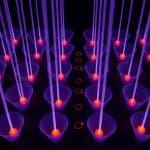
The National Energy Research Scientific Computing Center (NERSC) at Berkeley Lab is launching a pioneering program to provide researchers with access to one of the first publicly accessible quantum computers based on neutral atom technology. Through its partnership with QuEra Computing, NERSC’s Quantum Computing Access @ NERSC (QCAN) program offers a unique opportunity to work with Aquila, a 256-qubit analog quantum simulator developed by QuEra Computing.
This cutting-edge technology boasts distinct advantages in terms of scale and coherence time, making it an attractive platform for researchers across various fields. The QCAN program is open to proposals from all areas of quantum information science, including quantum simulation, characterization, optimization, machine learning, and algorithm development. Successful applicants will gain access to up to 25 hours of quantum computer time on Aquila, as well as potential allocations of NERSC resources, including storage and compute time on Perlmutter.
Quantum Computing Access @ NERSC: Unlocking Neutral Atom Technology
The National Energy Research Scientific Computing Center (NERSC) at Berkeley Lab has launched a call for user proposals as part of its Quantum Computing Access @ NERSC (QCAN) program, offering researchers the opportunity to conduct research on one of the first publicly accessible quantum computers based on neutral atom technology. This innovative program is made possible through NERSC’s partnership with QuEra Computing, a pioneer in neutral atom analog quantum computing.
Neutral atom quantum computers offer distinct advantages over other types of quantum computers, including scalability and longer coherence times. The Aquila system, developed by QuEra Computing, is a 256-qubit analog quantum simulator that can simulate time evolution under the many-body Rydberg Hamiltonian. This technology has the potential to revolutionize various fields, including condensed matter physics, high-energy physics, materials science, and quantum chemistry.
Research Opportunities in Quantum Information Science
The QCAN program encourages proposals from all areas of quantum information science, including but not limited to:
- Quantum simulation for condensed matter physics, high-energy physics, materials science, and quantum chemistry
- Quantum characterization, verification, and validation
- Quantum optimization (including native independent set problems) or Monte-Carlo sampling
- Quantum machine learning (e.g., quantum reservoir learning)
- Development and testing of quantum algorithms and protocols tailored to neutral atom analog hardware
Selected proposals will be awarded up to 25 hours of quantum computer time on the Aquila system, equivalent to 270k shots. Successful applicants may also request an allocation of NERSC resources, including storage and compute time on Perlmutter.
Technical Background and Resources
To facilitate research, QuEra Computing has made available a white paper, online learning platform, and training sessions (first recording and second recording) that provide technical background on the Aquila system. The application programming interface for Aquila is based on Python, either through the AWS Braket or Bloqade API.
Furthermore, users can leverage CUDA-Q, NVIDIA’s high-performance quantum-classical computing platform, with QuEra’s Aquila processor. The upcoming integration of CUDA-Q with Aquila will offer unified access to CPUs, GPUs, and QPUs (Quantum Processing Units), enabling developers to explore scalable quantum solutions.
Award Criteria and Project Execution
Proposals will be evaluated on feasibility, alignment with the capabilities of the neutral atom quantum hardware resources available, and benefits to current or future DOE Office of Science research objectives. Projects must be executed within a nine-month performance period starting on October 1, 2024, and ending on July 1, 2025.
Selected teams will be required to meet with NERSC staff on a regular, biweekly basis and provide a summary at the end of the nine-month term. This deep engagement is designed to ensure project goals are met and to facilitate knowledge sharing between researchers and NERSC staff.
Eligibility and Application Process
This open call is not limited to current NERSC users. NERSC is a Department of Energy Office of Science national user facility for open scientific research, and all research results must be published in open scientific journals or presented in open forums. Projects must also abide by the usual NERSC Appropriate Use Policies.
Applications are currently being accepted until September 6, 2024. Selected teams will be notified by September 20, 2024, and expected to start their project on October 1, 2024. Due to limited availability, NERSC can only support a select number of proposals this year, and expects users to be fully committed to carrying out their projects.
External Link: Click Here For More