

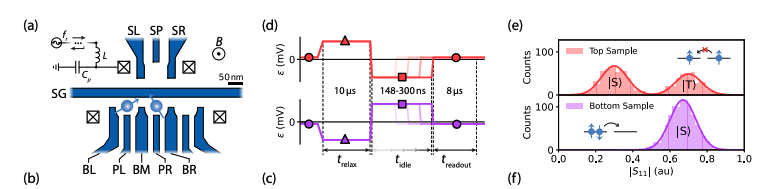
Automated tuning of spin qubits in semiconductor devices achieves a median tuning time of fifteen minutes, identifying qubits at twelve charge transitions within seventeen hours. The routine autonomously characterises key qubit parameters, including exchange interaction, dephasing time and quality factor, varying with charge configuration, enabling systematic circuit exploration.
The development of scalable quantum computation hinges on the ability to precisely control and read out the state of individual qubits, the quantum analogue of classical bits. Semiconductor-based spin qubits, utilising the intrinsic angular momentum of electrons confined within nanoscale structures, represent a promising avenue for realising this technology. However, optimising the complex control voltages required to address these qubits remains a significant practical impediment.
Researchers at the University of Oxford, the Institute of Science and Technology Austria, and Politecnico di Milano have now demonstrated an automated tuning procedure utilising radio-frequency charge detection to rapidly identify optimal operating regimes for spin qubits. In a study detailed in their article, Automated All-RF Tuning for Spin Qubit Readout and Control, Cornelius Carlsson, Jaime Saez-Mollejo, Federico Fedele, Stefano Calcaterra, Daniel Chrastina, Giovanni Isella, Georgios Katsaros, and Natalia Ares present a system capable of identifying and characterising spin qubits across multiple charge transitions in a single automated run, significantly reducing the time required for device calibration and paving the way for more systematic exploration of semiconductor quantum circuits.
Recent research details an automated methodology for the
Recent research details an automated methodology for the identification and characterisation of qubits within semiconductor double quantum dot systems, representing a notable refinement in quantum computing technology. The process traditionally relies on painstaking manual tuning, but this new approach utilises radio frequency (RF) detection to accelerate qubit assessment, successfully characterising twelve qubits in under twenty-four hours.
A significant aspect of this work centres on the identification and characterisation of ‘spurious dots’, unintended quantum dots that emerge during the tuning process. These parasitic structures generate false signals, complicating the accurate identification of functional qubits. Their presence distorts the expected ‘checkerboard’ pattern observed in charge stability diagrams, graphical representations of the electrostatic potential landscape governing electron behaviour within the device. These diagrams are crucial for locating and defining the qubits themselves.
The automated system effectively maps the gate-voltage dependence of several key qubit parameters. Exchange interaction, a measure of the coupling strength between electrons forming the qubit, is precisely determined. Furthermore, the system quantifies dephasing time, which dictates how long a qubit maintains its quantum information before losing coherence, and the quality factor, a metric directly related to qubit coherence. Accurate determination of these parameters is essential for optimising qubit performance and controlling quantum operations.
The increased efficiency afforded by this automated approach
The increased efficiency afforded by this automated approach represents a substantial advancement towards building larger, more complex quantum processors. By reducing the time and effort required for qubit characterisation, it facilitates the development of scalable quantum computing systems. The ability to identify and account for imperfections arising from the fabrication process, specifically the presence of spurious dots, improves the reliability and predictability of qubit behaviour, a critical factor in realising practical quantum computation.
🗞 Automated All-RF Tuning for Spin Qubit Readout and Control
🧠 DOI: https://doi.org/10.48550/arXiv.2506.10834


