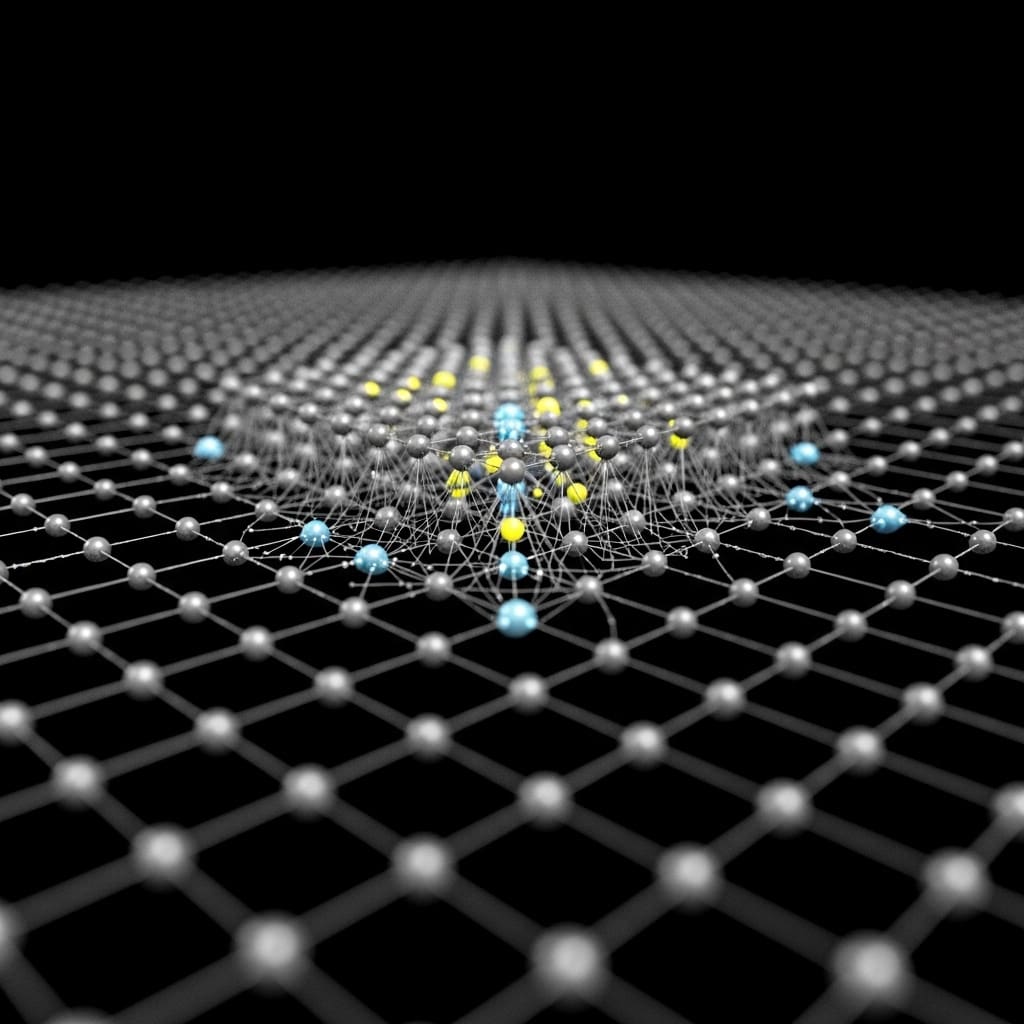
Researchers are continually striving to accurately model the behaviour of nanoscale devices, and the Non-equilibrium Green’s function (NEGF) formalism represents a powerful tool for simulating transport properties in these systems. Mathieu Luisier, Nicolas Vetsch, and Alexander Maeder, all from the Integrated Systems Laboratory ETH Zurich, alongside Vincent Maillou, Anders Winka, and Leonard Deuschle et al., present significant advances in accelerating atomistic NEGF calculations. Their work details algorithmic improvements, effective parallelisation strategies, and the innovative application of machine learning techniques to overcome computational bottlenecks. This research is particularly noteworthy as it brings density functional theory plus NEGF simulations closer to realistically sized and functional systems, paving the way for more accurate and efficient design of next-generation nanoscale technologies.
Scaling DFT+NEGF simulations to investigate larger nanoscale systems requires significant computational resources
Researchers have achieved a significant advance in the simulation of nanoscale devices, overcoming a critical barrier in materials science and engineering. Accurately modelling these devices is essential for the development of more efficient and powerful electronics, yet existing simulation methods often struggle with both size and physical realism.
This work details a breakthrough in density functional theory plus Non-equilibrium Green’s function (DFT+NEGF) simulations, enabling the modelling of nanoscale devices containing up to a few thousands atoms. This represents a substantial increase in the complexity of systems that can be accurately investigated using these methods.
The core of this achievement lies in algorithmic improvements and parallelization strategies applied to the computationally intensive DFT+NEGF approach. Traditionally, simulating nanoscale devices with realistic interactions, such as those between electrons and phonons, has been limited to very small systems.
This research demonstrates the successful scaling of these simulations to handle systems composed of a few thousands atoms, while simultaneously incorporating complex electron-phonon and electron-electron scattering effects. The ability to include these interactions is crucial for predicting the behaviour of real-world nanoscale devices, where they can significantly influence performance.
This advancement builds upon decades of work combining density functional theory and Non-equilibrium Green’s function methods. Efficient numerical algorithms and widespread parallelization, alongside access to high-performance computing resources, have been instrumental in reaching this new scale. The research introduces a novel, open-source package called QuaTrEx, designed to facilitate these complex simulations.
Furthermore, the study explores the potential of leveraging graph neural networks and machine learning techniques to accelerate the computationally demanding process of generating Hamiltonian matrices from first-principles calculations. The implications of this work extend to a wide range of applications, from designing novel transistors and photodiodes to developing advanced memory cells.
By accurately simulating the quantum transport properties of nanoscale materials, researchers can optimise device performance and explore new functionalities. This capability is particularly important as the semiconductor industry continues to push the boundaries of miniaturisation, where quantum effects become increasingly prominent and require accurate modelling for successful device design.
Computational procedure for nanoscale device electronic structure and transport properties involves self-consistent field methods
A combination of density functional theory (DFT) and Non-equilibrium Green’s function (NEGF) formalism underpins the simulation of nanoscale devices within this study. Researchers initially established the Hamiltonian matrix of the system using DFT, leveraging packages capable of employing localized basis sets or transforming plane-wave data into maximally localized Wannier functions.
This initial step defines the electronic structure of the nanostructure, providing a foundation for subsequent transport calculations. The core of the methodology involves an iterative scheme to compute the non-equilibrium Green’s functions for electrons, specifically the retarded and lesser/greater functions.
Accurate determination of these functions necessitates the evaluation of scattering self-energies, accounting for electron-phonon and electron-electron interactions. Phonon and screened Coulomb Green’s functions are therefore calculated, requiring prior knowledge of the phonon self-energy and polarization function.
All these quantities are represented as matrices dependent on energy or frequency, detailing correlations between points within the nanostructure. Efficient computation of these matrices relies on solving linear systems of equations with open boundary conditions and performing energy convolutions through fast Fourier transforms.
A parallel implementation strategically stores matrix entries to optimize performance, either prioritizing access to all entries for a limited number of energy points or focusing on a few entries across multiple energy points. Data transposition, facilitated by all-to-all communication operations, enables switching between different data representations to suit specific computational needs. Through these algorithmic advancements, simulations were scaled up to handle systems composed of a few thousands atoms, representing a substantial increase in the complexity of nanoscale devices that can be accurately modelled.
Efficient nanoscale simulation via massively parallel DFT plus NEGF calculations requires significant computational resources
Researchers have successfully scaled density functional theory plus Non-equilibrium Green’s function (DFT+NEGF) simulations to encompass systems composed of a few thousands of atoms. This achievement represents a substantial increase in the complexity of nanoscale devices that can be accurately modelled using this method.
The work details key algorithmic advancements bringing DFT+NEGF simulations closer to the dimensions and functionality of realistic systems. A silicon nano-ribbon, with cross-section dimensions mirroring experimental setups, served as a test case for these advancements. Initial simulations were performed on a nano-ribbon 52.1nm in length, comprising a total of 25,344 atoms, each represented in a Maximally Localized Wannier Function (MLWF) basis.
Leveraging a parallelization approach and a distributed NEGF solver, the researchers achieved a weak scaling parallel efficiency of 80% when extending the simulation from one to 9,400 nodes on the Frontier supercomputer. This was accomplished while including electron-electron interactions within the GW approximation.
Further analysis involved reducing the nano-ribbon length to 21.7nm, maintaining the same cross-section, and applying a 0.2V potential difference. Results indicated that incorporating electron-electron interactions slightly increased the nano-ribbon band gap, consistent with expectations from a self-consistent GW scheme.
The electron concentration was observed to be in the order of 1e16cm−3, which reduced the impact of carrier-carrier scattering on the band gap correction. The electronic current distribution remained largely conserved throughout the device, validating the implementation of the model. To further accelerate simulations, an equivariant graph neural network (EGNN) was developed capable of predicting the Hamiltonian matrix of devices containing thousands of atoms.
This methodology allows for the prediction of multiple Hamiltonian matrices from a single training set, demonstrated using a valence change memory (VCM) cell. While the average error in the machine-learned Hamiltonian entries was approximately 2 meV, ongoing work aims to improve the accuracy and fully reproduce the transmission function behaviour.
Realistic modelling of nanoscale devices via advanced DFT+NEGF simulations requires significant computational resources
Researchers have substantially advanced density functional theory plus Non-equilibrium Green’s function (DFT+NEGF) simulations, enabling the modelling of nanoscale devices containing up to thousands of atoms. This achievement incorporates complex interactions such as electron-phonon and electron-electron scattering, representing a significant step forward in computational nanotechnology.
The enhanced methodology facilitates a more realistic and detailed examination of nanoscale device behaviour than previously possible. This work is important because accurate simulation of nanoscale devices is crucial for the development of more efficient and powerful electronic components. By overcoming limitations in existing simulation methods, this research allows for the inclusion of realistic physical effects and larger system sizes, paving the way for improved device design and performance.
The simulations were successfully scaled to handle systems comprising a few thousand atoms, demonstrating a considerable increase in the complexity of accurately modelled nanoscale devices. Although current machine-learning approaches to accelerate these simulations exhibit errors of approximately 2 meV in predicted Hamiltonian entries, this remains a promising area for further development.
Future research may focus on refining these machine-learning techniques to achieve even greater accuracy and further reduce the computational cost of simulating complex nanoscale systems. The integration of machine learning offers opportunities to partially bypass computationally intensive DFT calculations, potentially unlocking even larger and more realistic device simulations.
👉 More information
🗞 Acceleration of Atomistic NEGF: Algorithms, Parallelization, and Machine Learning
🧠 ArXiv: https://arxiv.org/abs/2602.03438