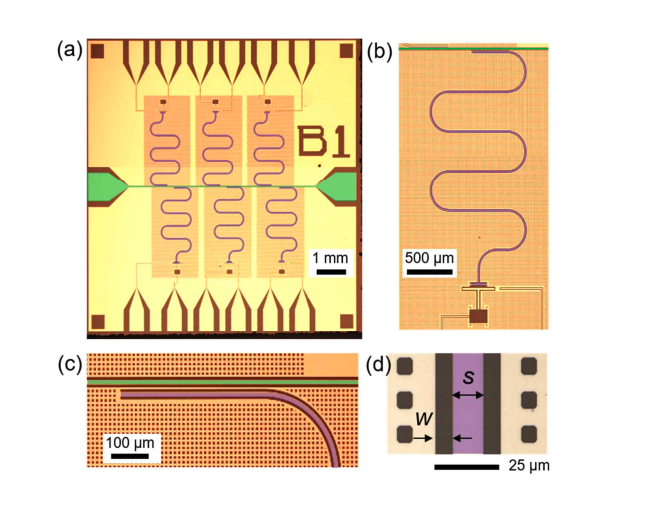
Superconducting circuits represent a promising pathway towards powerful quantum computers, but their performance hinges on minimising energy loss within the system. Bongkeon Kim and Yong-Joo Doh, both from the Gwangju Institute of Science and Technology, investigate the sources of these losses in superconducting resonators made from niobium titanium, a material particularly suited to operate in challenging conditions. The team meticulously characterised how these resonators lose energy due to tiny, unwanted quantum states known as two-level systems, focusing on the impact of material interfaces. Their findings reveal that niobium titanium resonators built on silicon dioxide offer a robust platform for future quantum circuits, paving the way for more stable and reliable quantum computation.
Two-level system (TLS) losses, particularly at material interfaces, represent a critical limitation for gatemon and topological qubits operating at low temperatures and in high magnetic fields. Niobium titanium (NbTi), a superconducting alloy possessing a high upper critical field, enables superconducting coplanar waveguide (SCPW) resonators resilient to these challenging conditions.
NbTi Resonators Demonstrate Ultra-Low Energy Loss
This research details the fabrication and characterization of high-quality superconducting coplanar waveguide (SCPW) resonators made from Niobium Titanium (NbTi) on sapphire substrates. The goal is to minimize energy loss in these resonators, crucial for applications in quantum computing and sensitive detectors. The team achieved remarkably high internal quality factors, exceeding 10 6 at extremely low temperatures and low input power, indicating minimal energy loss within the resonators. They identified and modelled the contribution of two-level systems (TLS) to the overall loss, characterizing a TLS-limited quality factor and its dependence on microwave power. Researchers carefully controlled the kinetic inductance fraction to optimize resonator performance, and thoroughly investigated the temperature dependence of both quality factor and resonance frequency to gain insights into the underlying loss mechanisms. This work demonstrates that NbTi is a promising material for high-performance resonators, offering a good balance of superconducting properties and ease of fabrication.
Niobium Titanium Boosts Resonator Performance Significantly
Superconducting coplanar waveguide (SCPW) resonators are essential components for advancing quantum computing and sensing technologies, and researchers have now demonstrated a significant improvement in their performance using a novel material. These resonators, which enable qubit readout and quantum sensor applications, are limited by microwave losses, particularly those stemming from two-level systems (TLS) at material interfaces. The team focused on minimizing these TLS losses, crucial for gatemon and topological qubits operating at extremely low temperatures and in high magnetic fields. Their work introduces niobium titanium (NbTi), a superconducting alloy with a high upper critical magnetic field, as a promising material for building resilient SCPW resonators.
Researchers fabricated NbTi SCPW resonators on silicon dioxide substrates and meticulously characterized their quality factors, a measure of microwave loss, as functions of temperature and microwave power. The experiments revealed that NbTi resonators exhibit significantly improved performance compared to those made from conventional materials like niobium or aluminum. This breakthrough delivers a substantial improvement in resonator performance, paving the way for more stable and reliable quantum devices.
NbTi Resonators Achieve Record Quality Factors
This study successfully fabricated and characterised niobium titanium (NbTi) superconducting coplanar waveguide (SCPW) resonators on silicon dioxide substrates. Researchers systematically investigated the resonators’ performance at low temperatures, focusing on losses limited by two-level systems. The results demonstrate quality factors ranging from 5. 14 x 10 4 to 9. 21 x 10 4 , representing the highest values reported to date for this type of resonator on these substrates. These findings indicate that NbTi resonators offer a promising platform for developing advanced quantum devices, including gatemon and topological qubits, which require high-performance superconducting circuits.
🗞 Two-level system loss characterization of NbTi superconducting resonators on Si/SiO2 substrates
🧠 ArXiv: https://arxiv.org/abs/2509.01447