Comparing physical quantities inevitably involves limitations in measurement precision, yet standard metrological approaches often treat values as single numbers, overlooking the inherent uncertainty. Anindita Sarkar, Paranjoy Chaki, and Priya Ghosh, along with Ujjwal Sen, all from the Harish-Chandra Research Institute, now present a new framework that directly addresses this challenge by comparing ranges of possible values rather than single points. This method utilises percentiles to define the extent of measurement uncertainty, offering a universally applicable solution even when standard statistical measures fail, particularly with asymmetric errors. The team illustrates the power of this approach by introducing the concept of finite-precision cooling, demonstrating that cooling can occur even within the limits of measurement accuracy in complex quantum systems, such as a three-qubit refrigerator, across a wide range of operating conditions.
Finite Precision Comparisons And Distinguishability Measures
Researchers propose a new framework for comparing physical quantities when measurements have limited precision, a common challenge in real-world experiments. This approach defines a statistical measure, termed ‘relative distinguishability’, which quantifies the difference between the distributions of measured values in different setups, considering both average values and the spread of the distributions. This allows determination of whether physical quantities in different setups are effectively the same, even with limited measurement precision, establishing a criterion for equivalence. The team illustrates the utility of this framework by applying it to the problem of cooling in quantum processes, where comparing the thermal states of different quantum systems is crucial. The analysis reveals that this method provides a more accurate and reliable assessment of cooling efficiency than traditional approaches, particularly when measurement precision is limited.
Quantum Refrigeration and Thermometry Performance Limits
This work presents a comprehensive exploration of quantum thermodynamics, specifically focusing on quantum refrigerators and thermometry. Researchers are investigating how to design and analyze quantum refrigerators, understanding the principles behind cooling quantum systems and exploring different designs, including those with three qubits and various interactions with their environment. A significant portion of the work deals with measuring temperature at the quantum level, crucial for controlling quantum systems. The research covers concepts like the Cramér-Rao bound and quantum Fisher information, which define the limits of precision in quantum thermometry, and explores the use of quantum probes and the impact of measurement resolution.
The framework relies heavily on the theory of open quantum systems, essential because real quantum systems interact with their environment, leading to decoherence and dissipation, described by the Lindblad master equation. Optimization and convex optimization techniques are used to solve problems related to refrigerator design and thermometry. Researchers utilize the maximum entropy method for estimating probability distributions and dealing with incomplete information, and employ statistical distances, such as Wootters distance, to measure the distinguishability between quantum states. Specific research directions include the analysis of three-qubit refrigerators, investigating different types of system-bath interactions, and exploring the use of disordered spin models for robust refrigerators.
Researchers are also investigating Kerr-type nonlinear baths to enhance cooling performance, and exploring subspace cooling to improve refrigerator efficiency. The Mpemba effect, where cooling can occur faster under certain conditions, is also being investigated in quantum refrigerators. Researchers are addressing the practical limitations of temperature measurement due to finite measurement resolution, and investigating the impact of coarse-grained measurements on the accuracy of quantum thermometry. Repeated measurements are being used to purify the state of the system and improve refrigeration performance. Potential areas of focus include scalability to larger systems, robustness to imperfections, theoretical limits on efficiency, practical implementation challenges, comparison with classical refrigerators, and potential applications in quantum computing, sensing, and materials science. In summary, this work represents a comprehensive exploration of quantum refrigeration and thermometry, covering both theoretical foundations and practical considerations, focusing on designing efficient and robust quantum refrigerators and developing accurate methods for measuring temperature at the quantum level.
Percentiles Define Finite Precision Comparisons
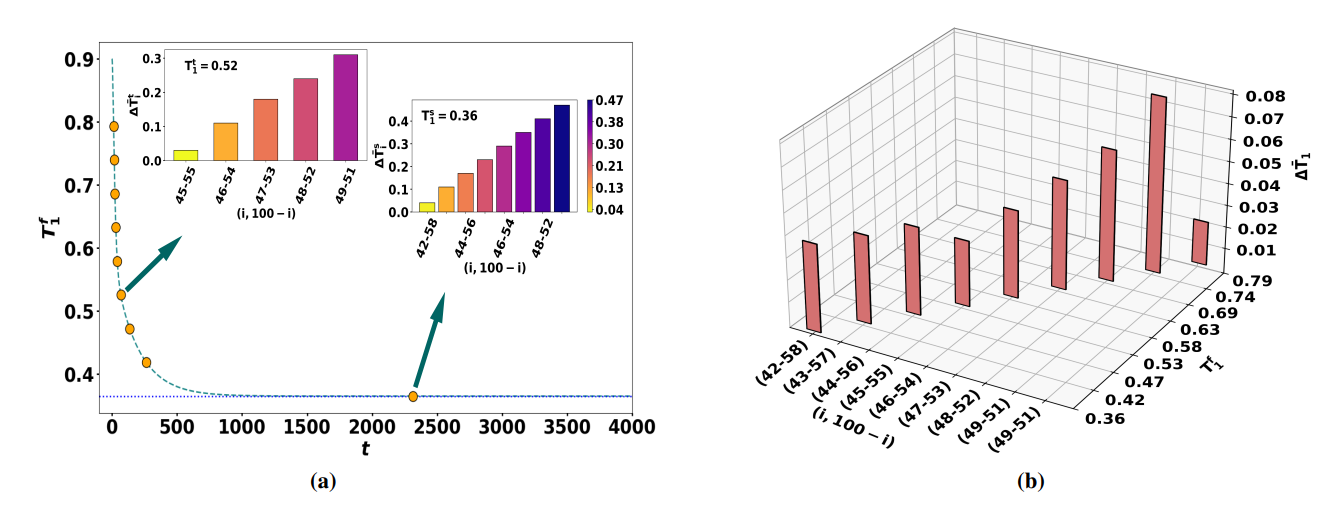
This work presents a new framework for comparing physical quantities when dealing with finite precision, a crucial consideration in realistic experimental scenarios. Researchers developed a method to move beyond comparing single numerical values, acknowledging that estimations naturally produce a range of possible values rather than a precise point, defining the extent of this range using percentiles of the probability distribution of the estimator. The team applied this methodology to investigate cooling within a three-qubit quantum absorption refrigerator, examining both strong and weak interactions between the qubits. Through numerical analysis spanning transient and steady-state regimes, they consistently observed cooling within the limits of finite precision, demonstrating the potential of the new framework to provide meaningful insights into quantum processes and extending the scope of quantum metrology to comparative physical problems. While the analysis focused on a specific refrigerator model, the researchers emphasize the general applicability of their methodology to a broader range of quantum systems and comparative measurements.
🗞 Comparing physical quantities with finite-precision: beyond standard metrology and an illustration for cooling in quantum processes
🧠 ArXiv: https://arxiv.org/abs/2510.24484