Understanding the internal structure of protons presents a significant challenge in high-energy physics, and recent work by Akbari Jahan and Diptimonta Neog, both from the North Eastern Regional Institute of Science and Technology, addresses this fundamental problem. Their research focuses on parton distribution functions, which describe how momentum and energy are distributed among the fundamental constituents of protons, and are crucial for interpreting experiments at facilities like the Large Hadron Collider. The team numerically evaluates Mellin moments of these parton densities, providing a new approach to analysing the internal structure of hadrons and improving our understanding of the strong force that binds them together. This work advances the field by offering a refined method for extracting key information about the building blocks of matter and their behaviour at extreme energies.
Mellin Transformations Reveal Proton’s Internal Structure
Scientists developed a rigorous methodology to explore the internal structure of protons, focusing on parton distribution functions (PDFs) which detail how momentum is distributed within these fundamental particles. This approach enables researchers to precisely determine the momentum fraction carried by each parton, quarks and gluons, at various energy scales, gaining a clearer picture of the proton’s internal dynamics and improving the accuracy of their calculations. The study pioneered the use of Mellin transformations to analyse PDFs in moment space, simplifying complex equations governing parton interactions. The team harnessed established DGLAP equations, a set of equations describing how quarks and gluons interact and transform within a proton, influencing the overall momentum distribution.
To solve these complex equations, scientists adopted the Mellin transformation method, converting them into a more manageable form suitable for numerical analysis, simplifying the calculations and allowing for precise evaluation of PDFs at different momentum fractions. The resulting data provides crucial insights into the proton’s internal structure and the behaviour of its constituent particles. Researchers verified the accuracy of their results by applying several theoretical constraints and sum rules, ensuring the total momentum carried by all partons equals one and that the proton’s quark composition, two up quarks and one down quark, is maintained. Furthermore, the team utilised valence sum rules to confirm the proton’s internal structure and the Bjorken sum rule to examine the spin structure of nucleons. These checks provide crucial validation of the calculated PDFs and ensure consistency with established physical principles. The methodology allows scientists to determine at least seven independent functions, three quark, three antiquark distributions, and the gluon distribution, at an initial energy scale, from which PDFs at all other scales can be obtained using the DGLAP evolution equations.
Mellin Moments Constrain Proton Structure Functions
This work presents a detailed analysis of parton distribution functions (PDFs), crucial for understanding the internal structure of protons. Researchers employed the Mellin transformation method to numerically evaluate and analyse these functions in moment space, providing insights into how momentum is distributed among the proton’s constituent quarks and gluons. The study rigorously examines several momentum sum rules, confirming the expected behaviour of these distributions and providing constraints on their form even where direct experimental data is unavailable. By analysing these moments, scientists can better understand the underlying physics governing the proton’s internal structure.
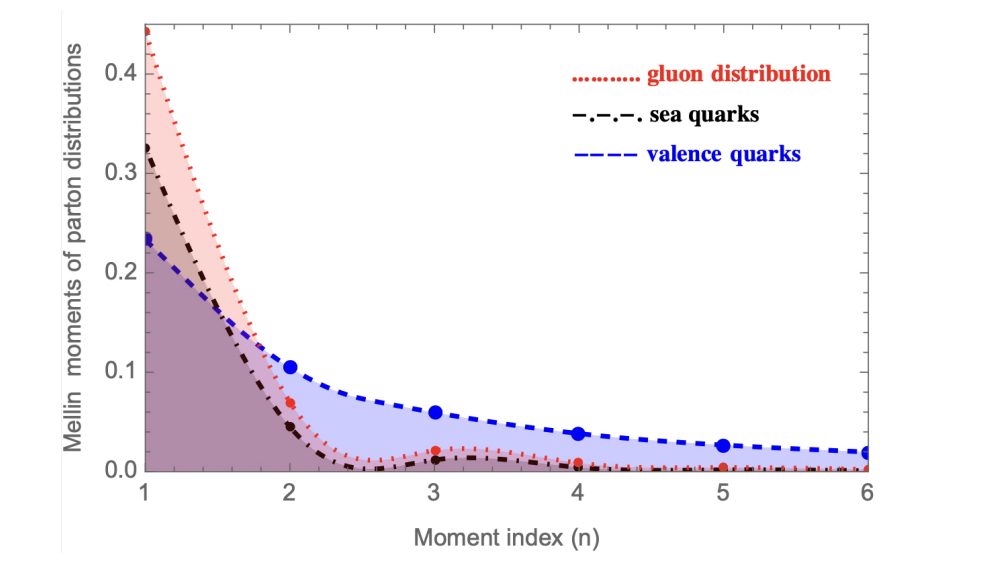
The team calculated Mellin moments, mathematical representations of the PDFs, for gluons, sea quarks, and valence quarks. These moments, which represent integrals of the PDFs multiplied by powers of x, were found to decrease gradually as the moment index ‘n’ increased. For instance, with one set of parameters, the first moment (n=1) for gluons was measured at 0. 443139, while the corresponding value for sea quarks was 0. 326337 and for valence quarks 0.
- Further calculations revealed that the second moment (n=2) for gluons was 0. 069993, for sea quarks 0. 045012, and for valence quarks 0. 104746.
Researchers explored different parameter sets to define the behaviour of PDFs at both large and small values of x, the fraction of the proton’s momentum carried by a parton. These calculations confirm that the sum of valence quarks in a proton is three, consistent with the known composition of two up quarks and one down quark. The study demonstrates the power of the Mellin transformation method for analysing PDFs and provides a valuable framework for interpreting experimental results from high-energy physics.
Parton Distributions and Mellin Moment Behaviour
This research presents a detailed evaluation of Mellin moments of parton distribution functions, offering new insights into the internal structure of protons. The team successfully computed these moments across a range of values, revealing key behaviours of both gluon and sea quark contributions, particularly at small values of x, a region crucial for understanding high-energy collisions. These calculations demonstrate that gluon contributions decrease more rapidly with increasing moment index than previously anticipated, suggesting a need for refinement in existing models of proton structure. By carefully analysing these moments, scientists can refine their understanding of the proton’s internal dynamics.
The findings enhance the understanding of parton distributions and provide a robust framework for future analyses aimed at improving predictions at hadron colliders. While acknowledging the challenges inherent in modelling non-perturbative QCD, the researchers highlight the importance of their approach in addressing gaps in current knowledge, complementing recent studies utilising lattice QCD. The team emphasizes that their simplified calculations serve as a valuable foundation for more complex models and encourage further research integrating experimental data and advanced computational techniques, ultimately aiming to refine our understanding of proton structure within the framework of perturbative QCD.
🗞 Numerical evaluation of parton distribution Mellin moments
🧠 ArXiv: https://arxiv.org/abs/2509.20176