Distinguishing between entangled states, known as Bell state analysis, represents a crucial operation for many quantum information processing protocols. Zi-Long Yang, Shi-Wen He, and Lin-Cheng Wang from Dalian University of Technology, alongside Si-Tong Jin, Liu Lv, and Xiao-Ming Xiu from Bohai University, now demonstrate a theoretical scheme for achieving perfect Bell state analysis using the combined properties of orbital angular momentum and light’s path. This new approach employs a linear optics-based architecture, which overcomes the limitations of traditional nonlinear methods and significantly improves resilience to environmental noise, a major obstacle in building practical quantum technologies. By integrating hyperentanglement, combining polarization, orbital angular momentum, and path, the team achieves a 100% success probability, offering a deterministic method for Bell state analysis and paving the way for high-performance quantum information processing in photonic systems.
Bell State Measurement and Qudit Entanglement
This compilation of research papers details significant advances in quantum information science, focusing on Bell state measurements (BSM), high-dimensional entanglement, and the experimental realization of quantum gates and communication protocols. The work explores methods for creating and measuring Bell states, moving beyond traditional qubits to utilize qudits, quantum systems with more than two levels, to increase information capacity and improve communication robustness. Researchers investigated various degrees of freedom for encoding quantum information, including the twist of light (orbital angular momentum), polarization, spatial paths of photons, and the timing or frequency of photons. Many studies detail the implementation of fundamental quantum gates and protocols, such as teleportation and superdense coding, using these advanced techniques.
A common strategy employed throughout the research involves auxiliary entanglement, where pre-shared entanglement enhances the fidelity of quantum operations. The papers also highlight the crucial optical components and techniques used to manipulate light and create quantum states, including waveplates, liquid crystal devices, Mach-Zehnder interferometers, spatial light modulators, and metasurfaces. Initial work established the theoretical foundations and built basic tools, followed by investigations into high-dimensional encoding schemes. Researchers then focused on utilizing auxiliary entanglement to achieve complete BSM, essential for many quantum protocols. Later work explored more sophisticated techniques to improve performance and scalability, addressing challenges like environmental noise and system stability to build more robust and reliable quantum systems. This body of work demonstrates the field’s move beyond qubits, the challenges of experimental realization, the dominance of optical techniques, and the critical importance of fidelity and robustness.
Hyperentanglement Enables Deterministic Bell State Analysis
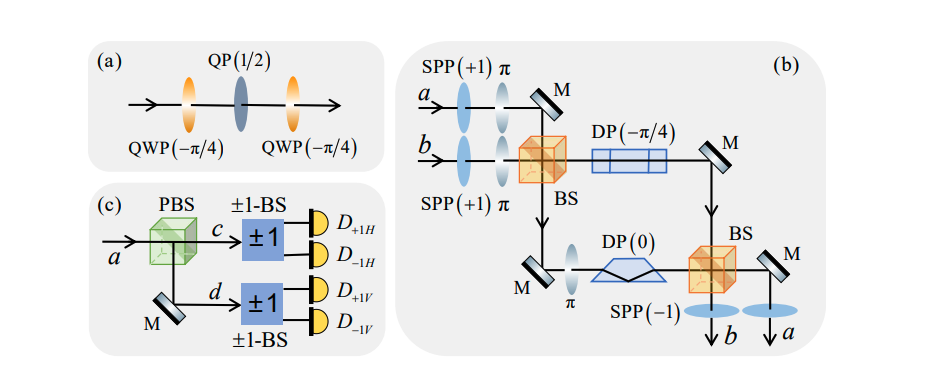
Scientists have developed a novel approach to Bell state analysis (BSA), a crucial operation for quantum information processing, by harnessing orbital angular momentum (OAM) and path entanglement as auxiliary degrees of freedom. This work pioneers a linear-optics-based architecture that overcomes the limitations of nonlinear optical processes and enhances robustness against environmental noise. The team engineered a scheme where complete BSA is achieved through single-photon projective measurements performed on these auxiliary degrees of freedom, deterministically identifying Bell states without requiring additional quantum resources. Researchers meticulously integrated hyperentanglement, combining polarization, OAM, and path degrees of freedom, to achieve a theoretical success probability of 100%, realizing deterministic BSA.
This innovative method avoids the need for auxiliary photons or atoms, which often introduce noise or limit coherence times, and instead relies on inherent properties of the quantum system itself. By carefully controlling the OAM and path entanglement, scientists achieved a framework compatible with photonic quantum networks, paving the way for fully deterministic entanglement manipulation. This approach not only enhances the discrimination efficiency and scalability of BSA, but also establishes a feasible route toward practical, high-performance quantum information processing in photonic systems.
Deterministic Bell State Analysis via Hyperentanglement
This research presents a new theoretical scheme for performing Bell state analysis, a crucial operation in quantum information processing. The team successfully demonstrated a fully deterministic method for distinguishing polarization-encoded Bell states by integrating orbital angular momentum and path degrees of freedom within a linear optical framework. This approach overcomes limitations inherent in previous protocols, which often relied on inefficient nonlinear processes or required external quantum resources. By utilizing hyperentanglement and avoiding these constraints, the researchers achieved a theoretical success probability of 100%, exceeding the 50% limit of standard linear optical schemes. The resulting architecture is not only pragmatic and experimentally feasible for current photonic quantum technology, but also exhibits strong scalability for more complex, high-dimensional quantum systems and multi-photon interactions. This work establishes a foundational framework for robust, efficient, and scalable quantum information processing tasks and offers a viable pathway towards large-scale photonic quantum network implementations.
🗞 Bell state analysis using orbital angular momentum and path degrees of freedom
🧠 ArXiv: https://arxiv.org/abs/2511.17011