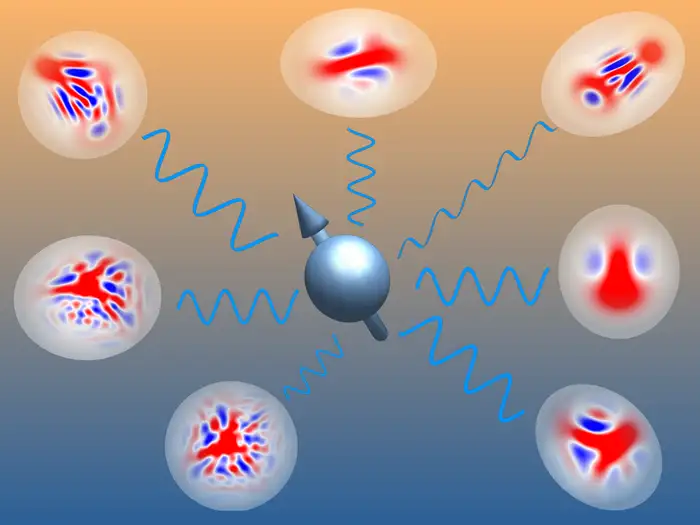
Researchers from the University of Amsterdam, QuSoft, and Centrum Wiskunde & Informatica have developed a new method to efficiently configure quantum devices. The team, including physicists Liam Bond, Arghavan Safavi-Naini, and Jiří Minář, have found a way to describe systems composed of quantum bits (qubits) and bosons using non-Gaussian states. This approach allows for the preparation of quantum states in a way that outperforms traditional protocols, potentially benefiting applications such as quantum simulation and error correction. The method has been demonstrated for a single quantum bit, with plans for further development.
Quantum Devices and the Complexities of Spin-Boson Systems
Quantum devices, which leverage the unique properties of quantum particles, have the potential to outperform classical machines in various tasks, including computing, simulation, sensing, communication, and metrology. These devices can take numerous forms, such as superconducting circuits or a lattice of atoms or ions held in place by lasers or electric fields. Regardless of their physical form, quantum devices are typically described in simplified terms as a collection of interacting two-level quantum bits or spins. However, these spins also interact with other elements in their surroundings, such as light in superconducting circuits or oscillations in the lattice of atoms or ions. These interactions complicate calculations and pose challenges for the development and optimization of quantum devices.
The Role of Spins and Bosons in Quantum Devices
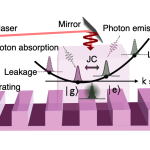
In quantum devices, spins, also known as quantum bits or qubits, interact with light and vibrations, known as bosons. While spins have only two energy levels, ‘0’ and ‘1’, bosons have an infinite number of levels. This difference in energy levels between spins and bosons complicates the computational description of spin-boson systems. Particles of light (photons) and vibrational modes of a lattice (phonons) are examples of bosons. The interaction between spins and bosons is a critical aspect of quantum devices, and understanding this interaction is key to optimizing these devices.
Non-Gaussian States: A New Approach to Describing Spin-Boson Systems
Physicists Liam Bond, Arghavan Safavi-Naini, and Jiří Minář of the University of Amsterdam, QuSoft, and Centrum Wiskunde & Informatica have developed a new approach to describing systems composed of spins and bosons. They use non-Gaussian states, which are combinations (superpositions) of simpler Gaussian states. This approach allows them to retain the powerful mathematical machinery that exists for Gaussian states while enabling them to describe a more diverse set of quantum states. This method identifies the most important patterns and ignores the others, allowing for the study and design of new ways of preparing interesting quantum states.
Implications and Future Directions of Non-Gaussian States in Quantum Devices
The new approach developed by Bond, Safavi-Naini, and Minář can be used to efficiently prepare quantum states in a way that outperforms other traditionally used protocols. Fast quantum state preparation could be useful for a wide range of applications, such as quantum simulation or even quantum error correction. The researchers also demonstrated that they could use non-Gaussian states to prepare ‘critical’ quantum states, which correspond to a system undergoing a phase transition. These states can greatly enhance the sensitivity of quantum sensors. While these results are promising, they represent only the first step towards more ambitious goals. Future research will focus on including many spins and many bosonic modes at the same time and accounting for the effects of the environment disturbing the spin-boson systems.
External Link: Click Here For More