Scientists from Ames National Laboratory have discovered the first unconventional superconductor found in nature, a mineral called miassite. This discovery challenges the belief that unconventional superconductivity is not a natural phenomenon. Unconventional superconductors, unlike conventional ones, can function at higher temperatures. The team, including Ruslan Prozorov and Paul Canfield, found that miassite behaves like an unconventional superconductor, potentially leading to more sustainable and economical superconductor-based technology. Superconductors, which conduct electricity without energy loss, have applications in medical MRI machines, power cables, and quantum computers.
Unconventional Superconductivity in Miassite: A Natural Phenomenon
Scientists from Ames National Laboratory have discovered an unconventional superconductor that shares its chemical composition with a naturally occurring mineral, miassite. This discovery challenges the prevailing belief that unconventional superconductivity is not a natural phenomenon. The properties of miassite are akin to high-temperature superconductors, which could potentially lead to more sustainable and cost-effective superconductor-based technologies in the future.
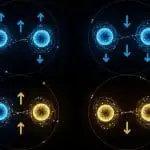
Superconductivity refers to the ability of a material to conduct electricity without energy loss. It has a wide range of applications, including medical MRI machines, power cables, and quantum computers. Conventional superconductors, while well understood, have low critical temperatures, which is the highest temperature at which a material can act as a superconductor. Unconventional superconductors, discovered in the 1980s, often have much higher critical temperatures.
Miassite: A Rare Natural Superconductor
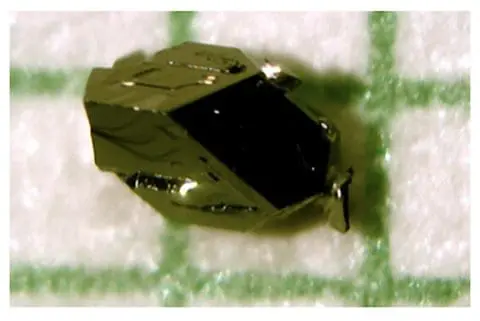
Miassite (Rh17S15) is a rare mineral discovered near the Miass River in Chelyabinsk Oblast, Russia. It is one of only four minerals found in nature that act as a superconductor when grown in the lab. The complex chemical formula of miassite makes it an interesting subject for study. Despite its complex composition, which one might assume is a result of deliberate laboratory creation, miassite exists naturally.
Paul Canfield, a scientist at Ames Lab and Distinguished Professor of Physics and Astronomy at Iowa State University, synthesized high-quality miassite crystals for this project. The process of growing these crystals was part of a larger effort to discover compounds that combine very high melting elements (like Rh) and volatile elements (like S).
Advanced Techniques to Study Superconductors
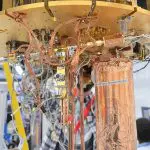
The team at Ames Lab used advanced techniques to study superconductors at low temperatures. The material needed to be as cold as 50 millikelvins, which is about -460 degrees Fahrenheit. They used three different tests to determine the nature of miassite’s superconductivity. The main test, called the “London penetration depth,” determines how far a weak magnetic field can penetrate the superconductor bulk from the surface. This test showed that miassite behaves as an unconventional superconductor.
Another test involved introducing defects into the material by bombarding it with high-energy electrons. This process creates defects in the crystal structure, which can cause changes in the material’s critical temperature. In miassite, the team found that both the critical temperature and the critical magnetic field behaved as predicted in unconventional superconductors.
Implications for Future Superconductor Applications
Understanding unconventional superconductors is key to developing economically viable applications of superconductors. The discovery of miassite’s unconventional superconductivity could potentially lead to more sustainable and cost-effective superconductor-based technologies in the future. This research is a significant step towards uncovering the mechanisms behind unconventional superconductivity.
The research, titled “Nodal superconductivity in miassite Rh17S15,” is published in Communications Materials. The work was supported by the DOE Office of Science (Office of Basic Energy Sciences) and used resources of the Advanced Photon Source, a U.S. Department of Energy (DOE) Office of Science User Facility.
External Link: Click Here For More