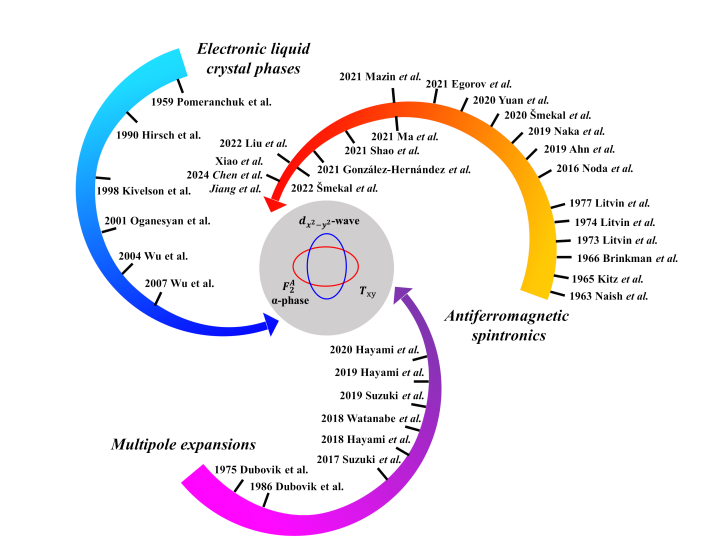
The interplay between magnetism and superconductivity continues to drive innovation in materials science, and recent work by Zhao Liu, Hui Hu, and Xia-Ji Liu from the Centre for Quantum Technology Theory at Swinburne University of Technology explores a surprising connection between these phenomena through the concept of spin-momentum locking. This research reveals how seemingly disparate areas of condensed matter physics, electronic liquid crystals, multipole expansions, and a newly identified magnetic order called altermagnetism, share a fundamental underlying mechanism. The team demonstrates that this shared principle not only explains the behaviour of altermagnets, materials with uniquely distributed magnetic moments, but also unlocks a pathway to unconventional superconductivity, potentially giving rise to novel states like finite-momentum pairing and topologically protected Fermi surfaces. This work provides both an accessible overview of altermagnetism and a conceptual framework for researchers seeking to engineer advanced superconducting materials for future technologies.
Spin-Momentum Lock Unifies Condensed Matter Concepts
This article explores the deep interconnections among three seemingly unrelated concepts in condensed matter physics: electronic liquid crystal phases, multipole expansions, and altermagnetism. At the heart of these phenomena lies a shared foundation: spin-momentum lock. The investigation reveals a historical progression of ideas, beginning with the understanding of electronic liquid crystals and their anisotropic properties, extending to the application of multipole expansions which describe complex charge and spin distributions, and ultimately focusing on altermagnetism, a novel magnetic state with potential links to unconventional superconductivity. The study highlights how these concepts, initially developed separately, converge through spin-momentum locking, offering new perspectives on correlated electron systems.
Spin-momentum locking, originally proposed to explain electronic liquid crystals, was later incorporated into the formalism of multipole expansions, effectively describing altermagnets with localized magnetic moments distributed over multiple atomic sites. The research examines superconducting phenomena stemming from this shared mechanism, focusing on superconductivity in systems with spin-momentum locked Fermi surfaces and highlighting a rich variety of unconventional superconducting states, including those with unique pairing symmetries and topological properties.
Altermagnetism Drives Unconventional Superconductivity Emergence
This research investigates how unconventional magnetism, specifically altermagnetism and related odd-parity magnetic states, can give rise to novel superconductivity. Altermagnetism features magnetic moments ordering in a non-collinear fashion, breaking time-reversal symmetry without affecting spatial inversion symmetry, a key distinction from conventional ferromagnets. Odd-parity magnetism, closely linked to altermagnetism, also contributes to unique electronic properties, driving unconventional superconductivity which deviates from standard theory and often involves non-s-wave pairing symmetries.
Researchers are exploring the fundamental mechanisms driving altermagnetism and odd-parity magnetism, focusing on how these states arise from electronic structure, orbital ordering, and spin-orbit coupling. They are also investigating how these magnetic states can be stabilized and manipulated, considering the role of symmetry and crystal structure, and how these states can induce or enhance superconductivity, focusing on non-s-wave pairing symmetries and the role of magnetic fluctuations in mediating the pairing process, alongside the interplay between superconductivity and topological effects.
Further investigations delve into more complex superconducting states arising from higher-order multipole orderings, exploring unconventional pairing mechanisms beyond simple s-wave or p-wave symmetries. Researchers are also exploring the creation of hybrid structures combining altermagnetic or odd-parity magnetic materials with superconductors, a promising approach for realizing novel superconducting states and functionalities, and are utilizing light to manipulate these magnetic states, potentially enabling new functionalities and devices, while exploring the interplay between magnetism, superconductivity, and topology to realize topological superconductors with protected edge states.
This body of research represents a cutting-edge area of condensed matter physics, aiming to discover new materials and mechanisms that could lead to higher-temperature superconductors, topological quantum computing, and novel electronic devices, increasingly considering the role of multiple electronic orbitals in determining magnetic and superconducting properties, and emphasizing the importance of symmetry in stabilizing these unconventional states and determining their properties.
Spin Locking Unifies Superconductivity and Liquid Crystals
This work establishes deep connections between electronic liquid crystal phases, multipole expansions, and altermagnetism, revealing a shared underlying mechanism of spin-momentum locking. Researchers demonstrate that this principle explains unconventional superconductivity, predicting a variety of states including finite-momentum pairing, spin-triplet superconductivity, and topological Bogoliubov Fermi surfaces, offering a conceptual framework for understanding and potentially harnessing these phenomena in future technologies, bridging previously disparate areas of condensed matter physics.
The team investigated the influence of different pairing potentials on superconducting states, specifically examining both conventional s-wave and d-wave interactions within two-dimensional systems. They show that the interplay between altermagnetic spin splitting and these pairing potentials can lead to unique configurations and pairing nodes, dependent on the relative orientation of the spin-momentum locking and the pairing symmetry, allowing researchers to selectively promote specific pairing channels, such as extended s-wave or dx2−y2-wave pairing, influencing the resulting superconducting properties. While approximations in their calculations may lead to slight deviations in predicted behaviour, future research will refine these calculations and explore the experimental realization of these predicted states, paving the way for novel superconducting materials and devices.
🗞 Altermagnetism and Superconductivity: A Short Historical Review
🧠 ArXiv: https://arxiv.org/abs/2510.09170