

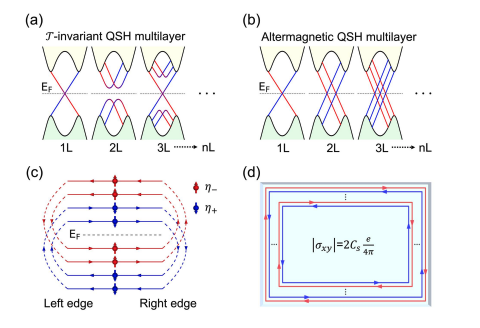
The quantum spin Hall effect promises dissipationless electronic transport, but conventional theory limits it to a single pair of conducting edge states. Zhiyu Chen, along with colleagues at the University of Science and Technology of China and the Max Planck Institute of Microstructure Physics, now demonstrates a pathway to overcome this restriction using a newly discovered magnetic state called altermagnetism. Their work reveals that carefully constructed multilayers exhibiting altermagnetic ordering support a unique quantum spin Hall phase with multiple pairs of conducting edge states, a phenomenon characterised by a novel ‘mirror-spin Chern number’. This breakthrough significantly expands the potential of quantum spin Hall effects and provides a clear route to engineer materials, such as iron selenium oxide multilayers, with predictably large and measurable spin-Hall conductance, paving the way for next-generation spintronic devices.
Altermagnetism Induces and Controls Topological Insulators
This research explores a new way to create and control topological insulators, materials that behave as insulators internally but conduct electricity on their surfaces. The team focuses on altermagnetism, a recently discovered form of magnetism that breaks symmetry without creating a net magnetic field. This unique property allows for the creation of topological insulators with tailored electronic properties, potentially revolutionizing spintronics and quantum computing. Topological insulators possess robust conducting surface states, ideal for advanced electronic applications. A key mechanism driving this behavior is mirror-spin coupling, an interplay between the material’s symmetry and its magnetic configuration.
The researchers investigated iron selenide oxide as a promising material, also examining its behavior in layered structures. The team discovered evidence of quantized spin-Hall conductivity in the iron selenide oxide multilayers, a crucial signature of a topological state indicating robust, dissipationless spin transport. These materials exhibit mirror Chern bands, topological electronic bands characterized by a non-zero Chern number linked to mirror symmetry. This leads to the existence of robust edge states, protected from scattering, allowing electrons to flow freely along the material’s surfaces.
The number of layers directly influences the topological properties, providing a means to tune its behavior. This work identifies altermagnetic materials as a promising platform for realizing topological insulators, opening doors for spintronic devices that enable low-power, efficient spin transport. The robust nature of these materials also makes them potential candidates for building quantum bits, the fundamental building blocks of quantum computers. This research advances our understanding of the interplay between magnetism, topology, and symmetry in materials, and demonstrates a pathway for designing materials with specific functionalities.
Altermagnetism Enables Multiple Edge Conducting Pathways
Researchers have challenged limitations in the quantum spin Hall effect by harnessing altermagnetism, a novel magnetic state. Traditional theory suggests only one pair of conducting pathways can exist at the edge of a material exhibiting this effect, but this team engineered materials with multiple pairs of these conducting edge states, significantly expanding the potential for advanced electronic devices and quantum computing. This approach centres on exploiting the unique magnetic ordering present in altermagnetic materials, where magnetism arises not from the alignment of electron spins, but from a complex interplay between spin and orbital motion. A key innovation lies in the design and investigation of multilayered materials composed of alternating layers of iron selenide oxide.
Through precise computational modelling, the researchers identified these multilayers as promising candidates to host this exotic quantum state, predicting that the number of conducting edge states increases directly with the number of layers. This predictive power stems from employing first-principles calculations, a sophisticated computational technique that determines material properties based solely on fundamental physical laws. These calculations revealed a crucial link between the material’s electronic structure, its magnetic ordering, and the emergence of topologically protected edge states. The team further characterised this new quantum phase using the mirror-spin Chern number, a mathematical tool that quantifies the topological properties of the material. This number provides a robust indicator of the number of conducting edge states and confirms their topological protection, meaning they are resistant to disruptions from imperfections or impurities. By meticulously analysing the interplay between spin-orbit coupling and altermagnetic ordering, the researchers demonstrated a new mechanism for stabilising multiple pairs of these edge states, opening up possibilities for designing materials with tailored topological properties.
Multiple Helical Edge States in Altermagnets
Researchers have discovered a new quantum state of matter that expands the possibilities for manipulating electron spin, potentially leading to advances in spintronics and quantum computing. This work centres on a unique quantum state arising in a class of materials called altermagnets, which exhibit a distinctive magnetic ordering. Conventional understanding limits the number of conducting electron pathways at the edges of these materials, but this research demonstrates a way to create multiple such pathways, significantly enhancing their potential. The team has shown that by carefully designing layered altermagnetic materials, they can create a quantum state with multiple pairs of spin-polarized electron pathways at the material’s edges.
These pathways, known as helical edge states, allow electrons to flow without resistance and carry information via their spin. Crucially, the number of these pathways scales directly with the number of layers in the material, offering a route to engineer materials with precisely controlled electronic properties. This contrasts with existing materials where the number of pathways is typically fixed. The key to this discovery lies in a newly identified interplay between electron spin, material symmetry, and the mirror-spin Chern number. Calculations reveal that these materials exhibit a robust quantum state characterized by a high spin Chern number of 2, indicating the presence of two pairs of helical edge states.
This is confirmed by detailed analysis of the material’s electronic structure and the behavior of electrons at its edges, which clearly show the presence of these spin-polarized pathways. Furthermore, the researchers have identified specific material candidates, iron selenide oxide multilayers, that exhibit these properties. These materials demonstrate an exactly quantized spin Hall conductance, a measure of spin current, with a value four times greater than previously observed in similar systems. This enhanced conductance is a direct result of the multiple helical edge states and suggests a pathway towards more efficient and versatile spintronic devices. The robust nature of these edge states, protected by the material’s symmetry, ensures that the spin information is preserved even in the presence of imperfections, making these materials promising for practical applications.
Multiple Edge States via Altermagnetic Multilayers
This research demonstrates a new pathway for creating materials with unique electronic properties, specifically expanding the scope of the quantum spin Hall effect. Conventional understanding limits QSH systems to a single pair of conducting edge states, but this work reveals that altermagnetic multilayers can host multiple pairs of these states. The key to this advancement lies in utilizing altermagnetism, a specific magnetic ordering, to circumvent established theoretical constraints on topological materials. Calculations suggest that iron selenide oxide multilayers are promising candidates, exhibiting a number of conducting edge states that scales with the number of layers, and correspondingly large, quantifiable spin-Hall conductance. These findings not only uncover a novel mechanism for stabilizing multiple gapless helical edge states, but also provide a blueprint for engineering altermagnetic topological insulators with extended topologically protected features. The researchers acknowledge that further investigation is needed to fully explore the potential of different altermagnetic materials and optimize their properties.
🗞 Quantum Spin Hall Effect with Extended Topologically Protected Features in Altermangetic Multilayers
🧠 ArXiv: https://arxiv.org/abs/2508.03580


