Altermagnetic materials, which exhibit unusual magnetic order without a net magnetisation, represent a promising avenue for next-generation spintronic devices, and Rafael Gonzáles-Hernández and Bernardo Uribe, from the Departamento de Física y Geociencias and Departamento de Matemáticas y Estadística at Universidad del Norte, respectively, have developed a new theoretical model to understand these complex systems. Their work introduces a Hamiltonian, a mathematical description of the energy of the system, that captures the essential features of altermagnetic topological insulators, materials that conduct electricity on their surfaces but behave as insulators in their interiors. This model, protected by fundamental symmetries, predicts the existence of robust electronic states confined to the material’s boundaries, corners, hinges, and surfaces, and establishes a framework for designing materials with tailored spintronic properties, potentially leading to devices that consume less energy and offer greater data storage capacity. The research bridges the traditionally separate fields of altermagnetism and topological materials, offering a new approach to engineering materials with unique quantum properties.
This growing field explores materials where magnetic moments align in a specific, non-conventional way, potentially leading to new technological applications. Altermagnetism differs from traditional magnetism because it doesn’t require a net magnetic moment, offering a new pathway to control electronic behavior. Topological materials are characterized by non-trivial electronic band structures, resulting in protected surface states and other exotic phenomena.
Key examples include topological insulators, which conduct electricity on their surfaces despite being insulators internally, and Weyl/Dirac semimetals, materials with unusual electronic properties due to their unique band crossings. Researchers are also investigating higher-order topological insulators, which exhibit conducting states localized on hinges or corners. Investigations center on understanding the fundamental properties of altermagnetism, its symmetry characteristics, and how it differs from conventional magnetism. A major focus is on how altermagnetic order can induce topological phases in materials that wouldn’t normally exhibit them, offering a powerful method for designing new materials.
Researchers are also exploring how altermagnetism affects existing topological insulators and can lead to higher-order topological phases with protected states localized on hinges. Classifying these topological phases based on their symmetry properties is a key area of study. Specific materials systems, such as MnP(S,Se)3 and FeSe, are being investigated as potential candidates for realizing altermagnetism and topological phases. Research on Fese/SrTiO3 thin films focuses on interface-induced superconductivity and the effects of strain and charge doping. There is also broader interest in exploring altermagnetism in two-dimensional materials, offering a platform for controlling magnetic order.
Theoretical tools like equivariant K-theory and calculations of Berry curvature are employed to understand these materials. The ability to induce topological phases through altermagnetic order represents a significant breakthrough in materials design. Symmetry plays a crucial role in determining the topological properties of these materials, and interfaces between different materials can be engineered to create altermagnetic order and induce topological phases. This field is vibrant and rapidly evolving, with altermagnetism emerging as a powerful tool for controlling topological phases and potentially enabling new technologies.
Topological and Altermagnetic Hamiltonian Engineering
Researchers have developed a new approach to designing materials with both topological and altermagnetic properties. This method involves constructing a mathematical description of the material’s electronic structure, starting with a Hamiltonian for electrons with a specific spin orientation. This initial Hamiltonian is engineered to possess a non-zero Chern number, indicating the presence of robust conducting pathways on the material’s surface. The team then extended this framework by adding a second Hamiltonian, representing electrons with the opposite spin, while carefully preserving a combined symmetry involving rotations and time-reversal symmetry.
This symmetry ensures the material’s electronic properties remain stable. Crucially, the two Hamiltonians are designed with distinct energy levels, creating an “altermagnetic” structure where spin-up and spin-down electrons behave differently, leading to unique magnetic characteristics without overall magnetization. To extend this concept into three dimensions, the researchers combined simpler two-dimensional models, linking a trivial Hamiltonian with a topological insulator Hamiltonian while maintaining a band gap to ensure stability. They investigated different symmetry cases corresponding to different types of altermagnetic ordering, exploring the resulting electronic band structures and edge states.
This approach allows for the systematic engineering of materials with tailored topological and altermagnetic properties, potentially leading to novel quantum phases and spintronic devices. By carefully controlling the symmetry and topology of the electronic structure, researchers can design materials with protected edge states and unique spin arrangements, paving the way for advanced electronic technologies. The methodology provides a blueprint for creating materials where the interplay of symmetry, topology, and magnetism leads to emergent quantum phenomena and potentially groundbreaking applications.
Altermagnetism Enables Robust Boundary Current States
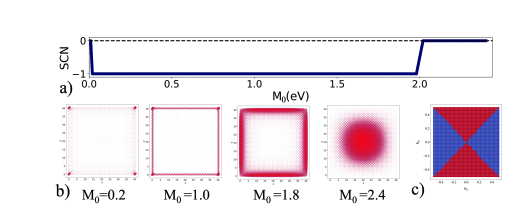
Researchers have discovered a new class of materials exhibiting unique electronic properties stemming from altermagnetism, a form of magnetism without a net magnetic moment. These materials possess insulating interiors but conduct electricity on their surfaces, and crucially, exhibit symmetry-protected conducting states on their boundaries, corners, hinges, or surfaces, without requiring conventional magnetism. This opens possibilities for designing spintronic devices that consume less energy and offer greater stability. The team’s models demonstrate that the spin Chern number, a mathematical quantity characterizing the topology of electronic states, serves as a robust indicator of these boundary states in both two and three-dimensional materials.
In three dimensions, the spin Chern number on specific planes reveals the nature of the conducting states, dictating whether they appear on corners, hinges, or surfaces. The research highlights that manipulating the material’s internal parameters can drive transitions between different topological phases, altering the location and characteristics of these conducting boundary states. Specifically, certain materials exhibit “strong” topological insulating behavior, with conducting states localized on faces, while others display “weak” behavior, with states confined to corners or hinges. In one instance, researchers observed conducting states on hinges accompanied by a reversal of the spin texture across different layers.
These discoveries build upon existing knowledge of topological materials and introduce new possibilities for controlling electronic behavior through symmetry and topology. The team’s work demonstrates that these altermagnetic materials offer a pathway to engineer novel spintronic devices that rely on the spin of electrons, potentially leading to more efficient and versatile electronic technologies. The ability to precisely control the location and characteristics of conducting boundary states represents a significant step towards realizing these advanced devices.
Altermagnetism and Topological Symmetry Protection
This research establishes a theoretical framework for understanding topological phases in altermagnets, a novel class of materials exhibiting spin splitting without net magnetization. The team demonstrates that these phases are protected by a combination of rotational symmetries and time-reversal symmetry, and are characterized by spin Chern numbers in both two and three dimensions. Importantly, these systems support symmetry-protected boundary states, including those found at corners, hinges, and surfaces, whose properties are dictated by the material’s magnetic symmetry and local magnetic moments. The findings bridge the fields of altermagnetism and topology, opening possibilities for designing spintronic devices that do not rely on conventional magnetization. Researchers propose that monolayer FeSe is a promising candidate for realizing these two-dimensional topological altermagnetic phases, exhibiting characteristics such as d-wave spin splitting.
🗞 Model Hamiltonian for Altermagnetic Topological Insulators
🧠 ArXiv: https://arxiv.org/abs/2507.23173