

Determining the lowest possible energy state of a complex thermodynamic system presents a significant challenge in physics and materials science, and researchers continually seek more efficient methods to solve this problem. Michele Minervini from EPFL and Madison Chin and Jacob Kupperman from Cornell University, along with their colleagues, now demonstrate a powerful approach using constrained free energy minimization. Their work benchmarks novel algorithms, combining classical and quantum techniques, on established thermodynamic models, including the Heisenberg model, and introduces a new framework called ‘stabilizer thermodynamic systems’ based on quantum error correction codes. This research not only offers a fresh perspective on designing low-energy states for controllable systems, with potential applications in molecular and materials design, but also reveals a promising route to efficiently encoding qubits for quantum computation at practical temperatures.
The pursuit of efficient and robust quantum thermodynamic systems necessitates tools capable of identifying states that optimise performance criteria, subject to physical constraints. This research addresses computational limitations by introducing a method for systematically designing quantum states tailored to specific thermodynamic tasks, enhancing the performance of quantum thermodynamic systems and paving the way for practical quantum heat engines and refrigerators.
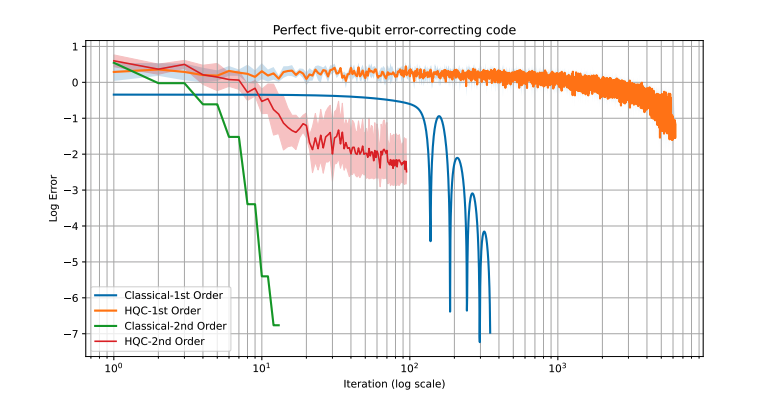
Researchers describe a quantum thermodynamic system using a Hamiltonian and conserved charges, aiming to determine the system’s minimum energy subject to these constraints. A recent study introduced first- and second-order classical and hybrid quantum-classical algorithms to solve a dual chemical potential maximization problem, demonstrating convergence to optimal solutions through gradient-ascent approaches. These algorithms were benchmarked on thermodynamic problems, specifically one- and two-dimensional quantum Heisenberg models incorporating nearest and next-to-nearest neighbor interactions, with conserved charges representing the total x, y, and z components of spin.
Quantum Error Correction and Optimization Algorithms
This research explores methods for simulating and optimising quantum systems, focusing on quantum error correction and optimisation algorithms. The team investigates protecting quantum information from noise using codes and finding the lowest energy configuration of quantum systems subject to constraints. The stabilizer formalism represents quantum states and codes, framing the optimisation problem as finding the thermal equilibrium state of a quantum system. Pauli operators, including X, Y, Z, and I, are fundamental for describing quantum errors and code properties, while constraints, such as fixed total magnetization, restrict possible states.
Hybrid quantum-classical (HQC) algorithms combine classical optimisation techniques with quantum computations to improve performance. The LMPW25 algorithm, a specific optimisation algorithm used in the simulations, likely builds upon classical methods with quantum-inspired features. Warm starting, initialising the algorithm with a good starting point, speeds up convergence.
Algorithms Find Ground States and Design Hamiltonians
This research presents new algorithms for solving constrained energy minimisation problems, central to determining the lowest energy state of a physical system with broad applications in physics, chemistry, and materials science. The team benchmarked both classical and hybrid quantum-classical algorithms on thermodynamic models, including the Heisenberg model and systems based on quantum error-correcting codes, demonstrating their ability to converge towards optimal solutions. Importantly, the work establishes a connection between quantum thermodynamics and semi-definite optimisation, potentially offering new insights into both fields.
Furthermore, the researchers demonstrate that these algorithms can be used not only to find ground states, but also to design Hamiltonians and thermal states with specific properties, opening avenues for the design of novel molecules and materials. They also introduce the concept of ‘stabiliser thermodynamic systems’ and show that their algorithms can effectively encode quantum information into these systems, even when starting from an incomplete initial state, offering a potential method for quantum error correction. The authors acknowledge that algorithm performance depends on the specific system studied and that further research is needed to explore scalability and applicability to more complex scenarios.
🗞 Constrained free energy minimization for the design of thermal states and stabilizer thermodynamic systems
🧠 ArXiv: https://arxiv.org/abs/2508.09103


