

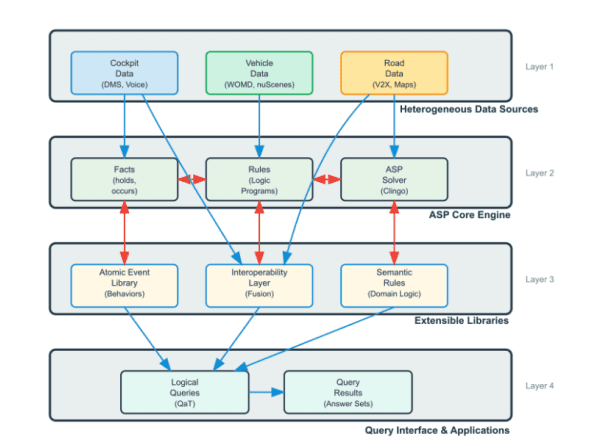
The convergence of artificial intelligence with vehicular technology necessitates a robust and unified approach to data management and system validation. Current testing methodologies, often reliant on extensive data collection and pre-defined scenarios, struggle to encompass the complexity of real-world driving conditions and maintain compatibility between the intelligent cockpit, autonomous vehicle systems, and emerging intelligent road infrastructure. Researchers are now proposing a shift towards logically-defined testing paradigms, leveraging formal reasoning to enhance both the expressiveness and rigour of validation processes. Shengyue Yao, RunQing Guo, Yangyang Qin, Xiangbin Meng, Jipeng Cao, Yilun Lin, Yisheng Lv, Li Li, and Fei-Yue Wang detail this approach in their article, “Query as Test: An Intelligent Driving Test and Data Storage Method for Integrated Cockpit-Vehicle-Road Scenarios”, outlining a novel data framework and testing methodology designed to address these challenges.
The automotive industry increasingly adopts innovative validation techniques for autonomous driving systems, moving away from traditional methods towards more flexible and rigorous approaches. Researchers introduce “Query as Test” (QaT), a novel testing paradigm that prioritises on-demand logical queries over rigid, predefined test cases, addressing limitations inherent in existing data-driven validation processes. This paradigm centres around “Extensible Scenario Notations” (ESN), a declarative data framework built upon Answer Set Programming (ASP), which unifies heterogeneous multimodal data from the vehicle, cockpit, and surrounding road environment, enabling deep semantic fusion and facilitating complex reasoning.
Current validation methods frequently rely on accumulating large datasets, a process known as data stacking, but struggle with the complexities of edge cases and unusual scenarios. QaT offers a more flexible approach by framing validation as a series of logical questions posed to a comprehensive representation of the driving environment. ESN, built upon Answer Set Programming (ASP), unifies data from various sources, enabling deep semantic fusion and complex reasoning. Answer Set Programming is a declarative programming paradigm, meaning programmers define what needs to be solved rather than how to solve it, allowing for efficient reasoning about complex relationships.
This transforms functional validation and safety compliance checks into logical queries against the ESN database, significantly enhancing the expressiveness and formal rigor of testing procedures. The system prioritises safety and reliability through a formalised methodology, contrasting with methods reliant on subjective human assessment or imprecise metrics. By expressing tests as logical statements, the system can formally verify whether the autonomous vehicle’s behaviour meets specified safety criteria.
Researchers advocate a shift towards Validation-Driven Development (VDD), guiding development through logical validation rather than solely relying on quantitative testing. This proactive approach aims to accelerate iteration and development cycles by identifying and addressing potential issues early in the design cycle, building safety and reliability into the system from the outset. The framework systematically assesses the autonomous vehicle’s response to a wide range of scenarios, including complex interactions with other road users and challenging environmental conditions, and precisely defines expected behaviours, facilitating automated evaluation of test results.
This provides a robust foundation for building safe and reliable autonomous driving systems, moving beyond empirical testing towards a more principled and verifiable approach. The ability to formally specify and verify safety requirements is crucial for gaining public trust and regulatory approval for autonomous vehicles.
👉 More information
🗞 Query as Test: An Intelligent Driving Test and Data Storage Method for Integrated Cockpit-Vehicle-Road Scenarios
🧠 DOI: https://doi.org/10.48550/arXiv.2506.22068


