An artificial intelligence framework successfully extracts quasiparticle interference kernels from complex scattering images. Employing a two-stage variational autoencoder, the system learns kernel representations and aligns them with observations, achieving higher accuracy and improved generalisation compared to direct extraction methods.
Understanding the behaviour of electrons within materials is central to advances in condensed matter physics and materials science. Visualising these behaviours directly remains a significant challenge, however, researchers routinely employ techniques like quasiparticle interference (QPI) imaging to indirectly probe electronic structure. Analysing QPI data to isolate the fundamental scattering ‘kernel’ – the underlying pattern governing electron behaviour – is a complex inverse problem. Now, Ji et al. from the University of Notre Dame present a novel artificial intelligence framework designed to extract these kernels with improved accuracy and robustness. Their work, entitled ‘Seeing the Invisible: Machine learning-Based QPI Kernel Extraction via Latent Alignment’, details a two-stage learning process utilising variational autoencoders and latent space alignment to overcome limitations in existing analytical methods and enhance the interpretation of QPI data.
AI Enhances Quasiparticle Interference Analysis via Learned Kernels
Researchers have developed an artificial intelligence framework that accurately extracts quasiparticle interference (QPI) kernels from complex observational data, advancing materials science capabilities. QPI is a technique used to investigate the electronic structure of materials; it relies on identifying these kernels – fundamental scattering patterns revealing information about electron behaviour – but direct inference proves challenging due to the ill-posed nature of the inverse problem. This work addresses this limitation by decoupling kernel representation learning from the process of inferring kernels from observations, establishing a robust and versatile solution for materials characterisation.
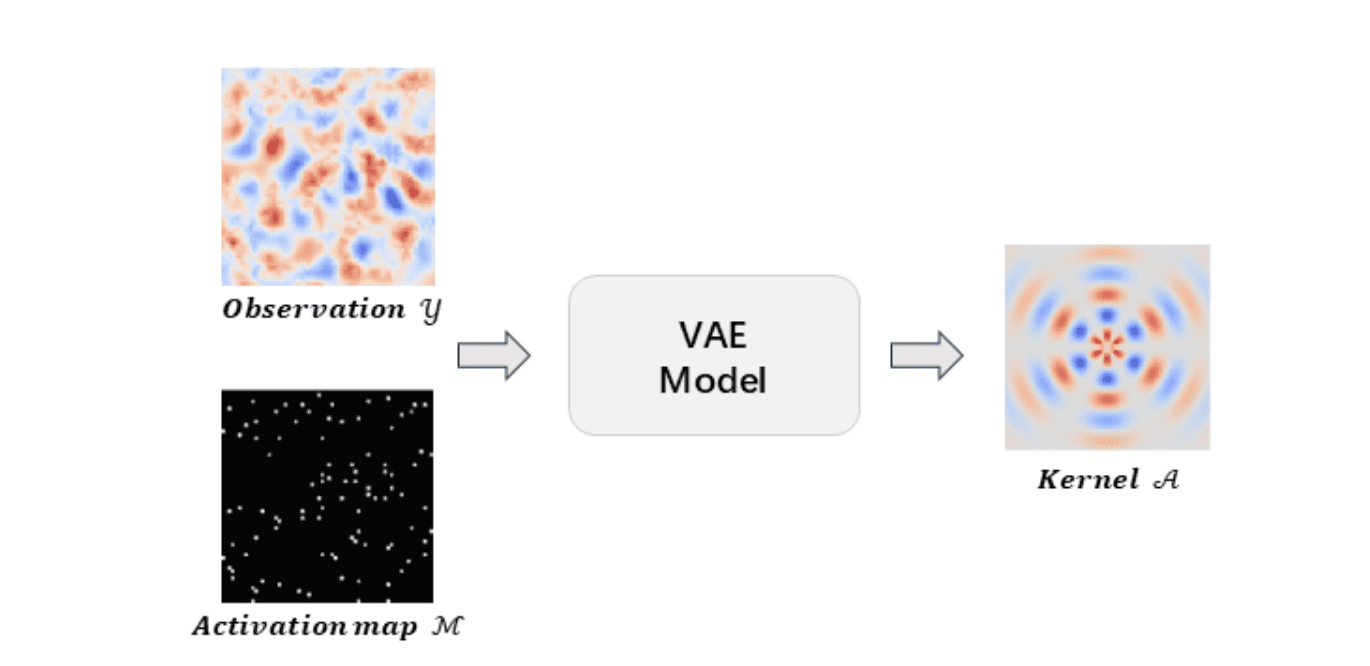
The method employs a two-step variational autoencoder (VAE) approach. A VAE is a type of artificial neural network used to learn efficient data representations. Initially, a VAE trains to establish a compact ‘latent space’ specifically for scattering kernels. This latent space is a lower-dimensional representation of the kernels, capturing their essential features. This first step focuses on understanding the intrinsic structure within the kernels themselves, creating an efficient representation and establishing a robust foundation for subsequent analysis. Subsequently, a second encoder aligns the latent representations of observed QPI data with this pre-learned kernel space, enabling accurate reconstruction even with complex scattering conditions.
Experimental validation, utilising both simulated and real-world data, confirms the effectiveness of this two-step approach and demonstrates a significant improvement in extraction accuracy compared to existing, direct one-step methods. The researchers constructed a dataset of 100 unique, physically realistic QPI kernels to rigorously evaluate their approach, confirming the model’s ability to generalise effectively to unseen kernels and indicating a robust and versatile solution.
By accurately reconstructing QPI kernels, the framework facilitates a deeper understanding of the underlying physics governing electron behaviour within materials, particularly superconductors – materials exhibiting zero electrical resistance below a critical temperature. Future work will focus on refining the model’s ability to determine the number of ‘folds’ present within the kernels – features related to the Fermi surface topology – a parameter crucial for detailed analysis, and further application to a wider range of materials is planned.
This AI-driven framework represents a substantial advance in QPI analysis, enabling scientists to probe the complex physics of superconducting materials and extract valuable insights from QPI measurements. The ability to learn directly from data, rather than relying on pre-defined assumptions, opens up possibilities for analysing more complex and noisy datasets, ultimately leading to a deeper understanding of these fascinating materials. The research establishes a powerful tool for materials scientists investigating electronic structures and accelerating materials discovery and characterisation.
👉 More information
🗞 Seeing the Invisible: Machine learning-Based QPI Kernel Extraction via Latent Alignment
🧠 DOI: https://doi.org/10.48550/arXiv.2506.05325