
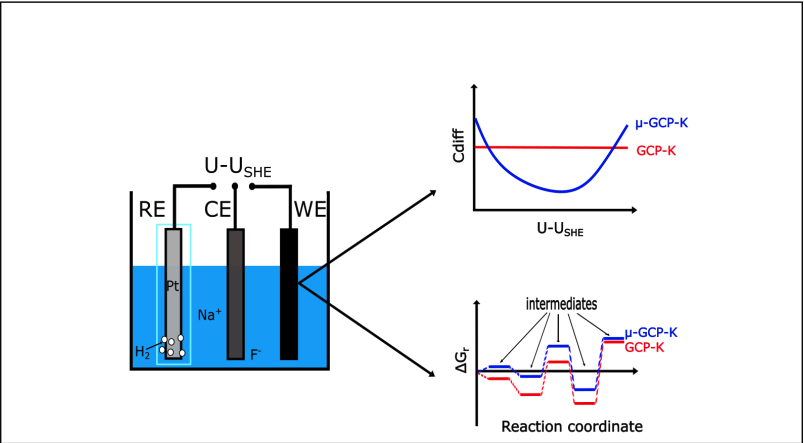
Electrocatalysis, a cornerstone of technologies ranging from fuel cells to carbon capture, demands a detailed understanding of how materials behave at the atomic level during electrochemical reactions. Márton Guba and Tibor Höltzl, from Budapest University of Technology and Economics and the Furukawa Electric Institute of Technology, present a new computational approach that significantly improves the accuracy of simulating these reactions. Current methods often assume a constant relationship between electrode potential and a material’s ability to store charge, known as differential capacitance, which limits their predictive power, but this research removes that restriction. By developing a more realistic model, the team demonstrates how accurately calculating potential-dependent differential capacitance is crucial for understanding complex reactions like carbon dioxide electroreduction and designing more efficient electrocatalysts.
As interest in nanomaterials grows, ab initio simulations play a crucial role in designing electrochemical catalysts. Electrochemical reactions depend on electrode potential, highlighting the importance of the grand canonical representation, especially when integrated with Density Functional Theory. The Grand Canonical Potential-Kinetics method, or GCP-K, is a valuable approach for determining electrocatalytic reaction mechanisms and kinetics rooted in quantum mechanics, simplifying the complex interplay of electron transfer and atomic rearrangements essential for designing efficient and selective catalysts for energy conversion and storage.
Quantum Capacitance and CO2 Reduction Mechanisms
This research focuses on understanding the electrochemical double layer and capacitance, particularly in materials like graphene and graphitic carbon nitride (g-C3N4). Researchers employ first-principles simulations to model the structure and capacitance of this double layer, exploring the concept of quantum capacitance , a quantum mechanical contribution to capacitance significant at the nanoscale. A major application driving this work is the electrochemical reduction of carbon dioxide (CO2) into useful fuels or chemicals. The research investigates several materials as electrocatalysts, including graphene as an electrode material, graphitic carbon nitride (g-C3N4) as a photocatalyst and electrocatalyst, copper (Cu) as a common electrocatalyst, and composites of Cu/g-C3N4 and MoS2/g-C3N4 for enhanced performance.
Key concepts explored include quantum capacitance, proton-coupled electron transfer (PCET), and synergistic effects when combining materials due to their complementary properties. Understanding electrode material properties, including electronic structure and surface properties, is also essential. Researchers investigate reaction mechanisms to identify rate-limiting steps and optimize catalyst design, aiming to control the products of CO2 reduction to favour desired fuels or chemicals. This research aims to develop a fundamental understanding of the electrochemical double layer at the nanoscale, design and optimize materials for efficient and selective CO2 reduction, and utilize advanced computational methods to model and predict the behaviour of electrochemical systems.
Graphene Capacitance Modelled with μ-GCP-K Method
Researchers have developed a refined computational method, termed μ-GCP-K, for accurately modelling electrochemical reactions at the nanoscale, significantly improving upon existing techniques. This new approach focuses on the electronic properties of materials, specifically the chemical potential, to determine how charge distribution and capacitance change during reactions. The team demonstrated the method’s accuracy by simulating graphene and meticulously calculating its charge density and differential capacitance. Results demonstrate that μ-GCP-K accurately predicts the behaviour of graphene under electrochemical conditions, revealing a non-linear relationship between charge density and electrode potential, and a non-constant differential capacitance, characteristics confirmed by experimental studies.
The simulations accurately reproduced the V-shaped Density of States characteristic of graphene near its Fermi level, a key factor influencing its capacitance. Comparisons with experimental data reveal that μ-GCP-K provides a more realistic and accurate simulation of graphene’s electrochemical properties, offering a powerful tool for designing and optimizing nanomaterials for energy storage and conversion applications. The method yielded a computed capacitance closely aligning with experimental values, unlike calculations based on traditional assumptions.
Accurate Electrochemical Modelling via μ-GCP-K Theory
This research introduces μ-GCP-K, a new computational method for modelling electrochemical reactions with improved accuracy and versatility. Building upon existing GCP-K theory, μ-GCP-K removes key assumptions about the relationship between electrode potential and differential capacitance, crucial in electrocatalysis. The team demonstrates the method’s effectiveness by accurately simulating graphene and analysing the carbon dioxide electroreduction process on a g-C3N4-Cu catalyst, highlighting the importance of precisely calculating the stability of reaction intermediates. The findings emphasize that accurately modelling potential-dependent differential capacitance is essential for understanding and predicting the behaviour of electrocatalysts, particularly those with unconventional electronic structures. The μ-GCP-K method proves suitable for both traditional metallic models and more complex materials, offering a universal approach to computational electrocatalysis and aiding the design of novel catalysts. Future work will likely focus on refining these calculations and applying the method to a wider range of materials and reactions.
👉 More information
🗞 Electrode Potential Dependent Differential Capacitance in Electrocatalysis: a Novel, Ab Initio Computational Approach
🧠 ArXiv: https://arxiv.org/abs/2509.02318