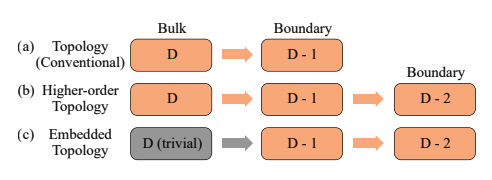
The established principles of topological physics dictate that robust, protected states at the edges or surfaces of materials require a fundamentally unusual internal structure, or ‘nontrivial bulk’. However, researchers led by Hau and colleagues at [Institution name(s) not provided in source] now demonstrate a surprising exception to this rule, observing topological states even when the material’s core structure appears ordinary. This work reveals a new form of ‘embedded topology’ within an acoustic crystal, where topological properties emerge not from the bulk itself, but are induced at lower-dimensional boundaries through a unique symmetry known as projective crystal symmetry. By achieving this unconventional bulk-boundary correspondence, the team effectively extends the possibilities for designing robust topological devices, potentially unlocking new avenues for manipulating sound and other physical phenomena with unprecedented control.
Bulk-boundary correspondence represents a foundational principle of topological physics, initially established within the quantum Hall effect. This principle dictates that a material with specific topological properties in its interior gives rise to protective states on its surfaces and edges, linking the material’s interior to its boundaries. The emergence of higher-order topology has subsequently generalised this principle, extending it to a hierarchical chain of correspondences, and enabling topological states to appear at even lower-dimensional boundaries. This progression allows for topological states to be present not just at surfaces, but also at corners, hinges, and even isolated points within a material, opening up new avenues for materials design and functionality. Understanding and controlling these higher-order topological states is therefore crucial for advancing the field of topological physics and realising novel device applications.
Topological Physics, Acoustics, Photonics and Circuit Realizations
This extensive list represents a comprehensive bibliography related to topological physics, particularly in the context of acoustics, photonics, metamaterials, and circuit realizations. The collection covers foundational concepts, material implementations, and potential applications, demonstrating the breadth of current research. It begins with core topological concepts, including topological insulators and the study of defects within them, and focuses significantly on higher-order topological insulators, materials exhibiting corner or hinge states instead of surface states. Research also explores topological phenomena in non-Hermitian systems, which often exhibit unique properties like exceptional points, and investigates how nonlinearity affects topological states and enables new functionalities.
The bibliography details various platforms for realizing topological states, with many references exploring acoustic metamaterials and phononic crystals. A large number focus on photonic implementations of topological concepts, including topological cavities, lasers, and waveguides, and a significant theme is the implementation of topological states in electrical circuits, offering a flexible and controllable platform. Research also explores mechanical analogs of topological phenomena, including Majorana-like modes. Specific topological features and phenomena are well represented, with a central focus on corner and hinge states, vortex modes, chiral modes, and Majorana modes.
The role of exceptional points in non-Hermitian topological systems is also investigated. Finally, the bibliography covers applications and advanced concepts, including lasing, cavity design, waveguiding, defect engineering, and the development of topological sensors and devices. Overall, this bibliography demonstrates the active and rapidly evolving nature of the field, highlighting its interdisciplinary nature.
Topology From Trivial Bulk Acoustic Crystals
This research demonstrates a new principle in topological physics, establishing a form of bulk-boundary correspondence that originates from a conventionally ‘ordinary’ material. Traditionally, topological states arise from materials with specific, non-trivial properties, leading to protected states at their boundaries; however, this work shows that topological boundary states can emerge even when the bulk material itself lacks these properties. The team achieved this by employing projective crystal symmetry within an acoustic crystal, inducing topology not in the bulk, but within the hierarchy leading to lower-dimensional boundaries. Notably, the researchers successfully created a three-dimensional system supporting zero-dimensional topological states, representing the longest chain of action for this unconventional bulk-boundary correspondence observed to date. This finding expands the possibilities for designing robust topological devices, offering additional freedom beyond reliance on materials with inherently non-trivial properties. The authors acknowledge that their current system is limited to specific symmetries and materials, and future work could explore extending these principles to more complex systems and investigating potential applications in areas like wave manipulation and information transport.
Topology From Trivial Bulk Acoustic Crystals
Researchers have demonstrated a new form of topological physics where robust, protective states arise not from materials with inherently special properties, but from the way ordinary materials are connected. Traditionally, topological states, known for their resilience to disturbances, require a material possessing specific symmetry characteristics. This work establishes that such states can emerge even when built from entirely ordinary materials, challenging conventional understanding in the field. The team achieved this by creating acoustic structures, three-dimensional lattices of resonators and connecting tubes, where the topological properties originate from the arrangement of the components, not the components themselves.
They successfully created a system where connecting four identical, but simple, acoustic insulators in a specific configuration induces a topological state localized at the junction where they meet. This state exists within a bandgap, a range of frequencies the system normally wouldn’t conduct, and is protected from scattering by imperfections in the material. The researchers verified this “embedded topology” through both simulations and physical experiments using 3D-printed acoustic lattices. They observed a distinct peak in the transmission spectra at a specific frequency, around 5620 Hz, corresponding to the topological state, and confirmed its localization at the junction point.
Importantly, the observed state is not a result of any inherent property of the individual insulators, but rather a consequence of their interconnectedness. This discovery opens new avenues for designing robust devices, as it removes the need for exotic materials with complex properties. Instead, engineers can focus on the architecture and connectivity of simpler materials to achieve desired functionalities. The ability to create topological states from ordinary building blocks represents a significant advancement, potentially leading to more versatile and cost-effective designs for a range of applications, including soundproofing, wave guiding, and potentially even quantum computing. The team’s work demonstrates that topology is not solely a property of the material itself, but can be engineered through clever design and interconnection.
🗞 Observation of Embedded Topology in a Trivial Bulk via Projective Crystal Symmetry
🧠 ArXiv: https://arxiv.org/abs/2508.03033