
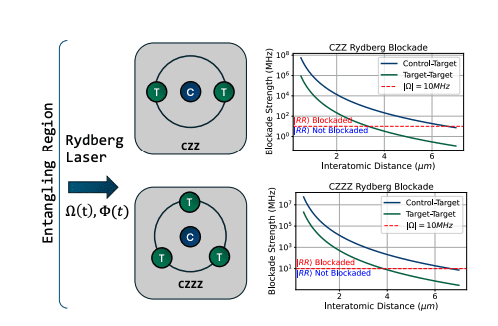
An article titled Multi-Target Rydberg Gates via Spatial Blockade Engineering, published on April 21, 2025, by researchers Samuel Stein and colleagues, introduces an innovative method in quantum computing. Their work details the creation of multi-target Rydberg gates with high fidelity, achieving up to 99.55%, through spatial blockade engineering. This advancement could significantly improve error correction processes in quantum systems.
The research proposes single-control-multi-target CZ gates for neutral-atom systems, enabling multi-qubit operations without additional controls or species. By leveraging tailored interatomic distances, an asymmetric blockade is created between control and target atoms. Using GPU-accelerated pulse synthesis, smooth control pulses achieve high fidelities of 99.55% (CZZ) and 99.24% (CZZZ), even with simulated errors. This approach reduces resource overhead for syndrome extraction in quantum error correction.
In quantum computing, precision is critical. Researchers have been exploring a diagnostic tool known as Pauli Transfer Maps (PTMs) to analyze and improve the performance of quantum gates, particularly focusing on the C(Z2) gate. This article examines how PTMs are used to identify errors in quantum operations and discusses their implications for advancing quantum computing technology.
Understanding Pauli Transfer Maps
Pauli Transfer Maps are essential tools for mapping how quantum operations transform input states into output states. They provide a visual representation of these transformations, highlighting both intended paths and any deviations or errors that occur during the process. By analyzing PTMs, researchers can identify discrepancies between theoretical predictions and actual experimental outcomes, enabling targeted improvements in quantum gate performance.
The research involves two key comparisons: a simulated PTM of a learned C(Z2) gate and an idealized PTM for an error-free C(Z2) gate.
In the first comparison, Figure 8 illustrates the PTM derived from a simulation of a learned C(Z2) gate without accounting for motion or decay. This figure reveals where the actual operation deviates from the ideal scenario, pointing out specific error channels. The second comparison, represented by Figure 9, presents the theoretical PTM for an ideal, error-free C(Z2) gate. This map is sparse, with only +1 or -1 entries, indicating a clean and deterministic transformation process.
The use of PTMs as a diagnostic tool underscores their importance in refining quantum gates. While the C(Z2) gate is not yet perfect, this research represents progress toward more reliable and scalable quantum computing solutions. The insights gained from these studies are vital for advancing the field, ensuring that quantum operations can be optimized for practical applications.
In conclusion, PTMs offer a detailed roadmap for identifying and mitigating errors in quantum systems, paving the way for future advancements in quantum computing technology. By leveraging these tools, researchers can continue to refine quantum operations, bringing the field closer to realizing its full potential.
👉 More information
🗞 Multi-Target Rydberg Gates via Spatial Blockade Engineering
🧠 DOI: https://doi.org/10.48550/arXiv.2504.15282