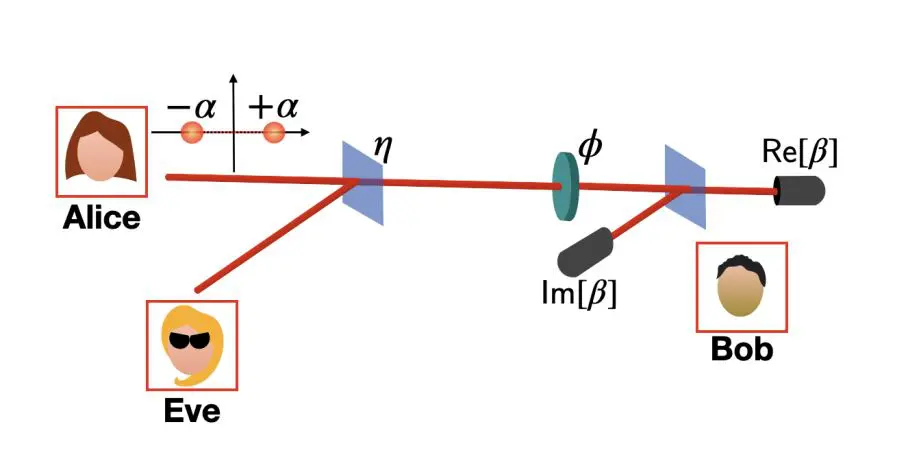
Estimating parameters remotely while ensuring privacy presents a significant challenge in quantum communication, particularly when data travels across insecure channels susceptible to eavesdropping and disruption. Farzad Kianvash, Marco Barbieri, and Matteo Rosati, from the Universitá degli Studi Roma Tre, now demonstrate a new approach to private remote quantum state estimation that overcomes limitations in previous methods. Their research introduces a protocol utilising continuous-variable states, allowing for a more accurate assessment of both estimation error and privacy levels, even when the communication channel is lossy. By incorporating realistic channel modelling, validated through measurement data, the team achieves substantially tighter bounds on performance, paving the way for practical applications of secure remote parameter estimation.
Continuous-Variable Quantum Key Distribution Advances
This research explores secure and efficient information transmission and sensing using quantum technologies, focusing on Quantum Key Distribution (QKD), quantum sensing, and enhancing security in quantum networks. Scientists are developing methods for establishing secure communication channels and improving measurement precision using quantum phenomena. The work investigates Continuous-Variable QKD, utilizing coherent states of light, and addresses practical challenges like signal loss and detector limitations. Furthermore, the research delves into quantum sensing and remote sensing, exploring networks of quantum sensors to improve measurement precision while addressing privacy concerns.
The integration of machine learning algorithms to enhance the performance of quantum communication and sensing systems is also a key focus, demonstrating how these algorithms can calibrate receivers and optimize communication strategies. Researchers explore combining classical and quantum techniques to achieve optimal communication performance. The research utilizes advanced mathematical tools to analyze and optimize quantum systems, allowing for a thorough understanding of the fundamental limits of information transmission and processing. The importance of analyzing security in practical scenarios with limited key sizes is highlighted, demonstrating the benefits of inspecting specific attacks to establish stringent bounds on privacy and estimation error.
Continuous Variable Private Quantum State Estimation
Researchers have pioneered a new approach to private remote quantum state estimation, a technique for determining a parameter at a distant location while protecting it from eavesdropping. This work departs from previous methods by employing continuous-variable states, offering a more practical approach to secure communication. Scientists engineered a protocol that minimizes information leakage to potential adversaries, focusing on minimizing estimation error and maximizing privacy. To achieve this, the team developed a detailed mathematical framework to calculate estimation error and privacy levels, considering realistic attack scenarios, specifically a passive photon-splitting attack.
This framework allows them to bound the attacker’s ability to discriminate between different quantum states. They harnessed tools from communication theory to derive analytical results, providing a complete picture of security and estimation performance. The research identified an optimal probe mean-photon number that balances privacy and estimation performance, mirroring the optimal modulation strategies found in other quantum communication protocols. By carefully analyzing the trade-offs between these two objectives, the researchers demonstrated the potential for designing secure and efficient PRQS systems. This detailed analysis provides valuable insights for future research and development in the field of secure quantum communication.
Private Remote Sensing with Continuous Variables
Scientists have achieved a breakthrough in private remote quantum sensing, a technique for estimating parameters at a distant location while safeguarding against eavesdropping and disruption of the estimation process itself. This work pioneers the use of continuous-variable states in a single-user protocol, offering a more practical approach to secure communication. The research demonstrates a method for quantifying both the estimation error and the privacy of the protocol, providing a comprehensive understanding of performance in both theoretical limits and practical, finite-size scenarios. The team calculated the true estimation error and privacy levels by integrating tools from quantum communication, specifically minimum-error state discrimination, to assess an attacker’s ability to gain information from the transmitted quantum states.
This analysis is valid for any number of channel uses, providing a complete picture of security and estimation performance. The protocol utilizes a discrete constellation of probe states, enabling a realistic implementation and allowing for the application of quantum communication techniques to counter potential attacks. Experiments reveal that assuming a specific noise model for the quantum channel yields an accurate quantification of an eavesdropper’s actions, effectively restricting the attack class while remaining practical for cryptographic implementations. This assumption, validated by measurement data gathered for channel parameter estimation, allows for a tighter quantification of both estimation error and privacy than previously possible. The results demonstrate a valuable asset for informing future deployments in real-world quantum networks, offering a pathway to secure and reliable remote sensing applications in areas like biometry and remote medicine.
Estimation Privacy and Optimal Probe Design
This work introduces and fully characterizes the first single-user continuous-variable private remote quantum state estimation protocol, operating under the assumption of passive photon-splitting attacks. Researchers derived analytical results for both the asymptotic and finite-size regimes, introducing the concept of estimation privacy and exploring its relationship to estimation error. The results demonstrate that, for a finite number of rounds, an optimal probe mean-photon number exists, maximizing privacy while maintaining good estimation performance, a characteristic similar to optimal modulation strategies in other quantum protocols. The team successfully bounded the attacker’s discrimination capabilities using a discrete modulation scheme, allowing for a detailed analysis of the protocol’s performance.
Importantly, the study reveals that realistic channel model assumptions, validated through measurement data, enable a much tighter quantification of estimation error and privacy than previously achievable. While the asymptotic expressions are valid for moderate photon numbers, further analysis is needed to fully understand the protocol’s behaviour at very low energies. Future work could focus on refining the expansion for small alpha values to provide a more complete characterization of the system’s performance across a wider range of parameters.
🗞 Private Remote Phase Estimation over a Lossy Quantum Channel
🧠 ArXiv: https://arxiv.org/abs/2511.09123