

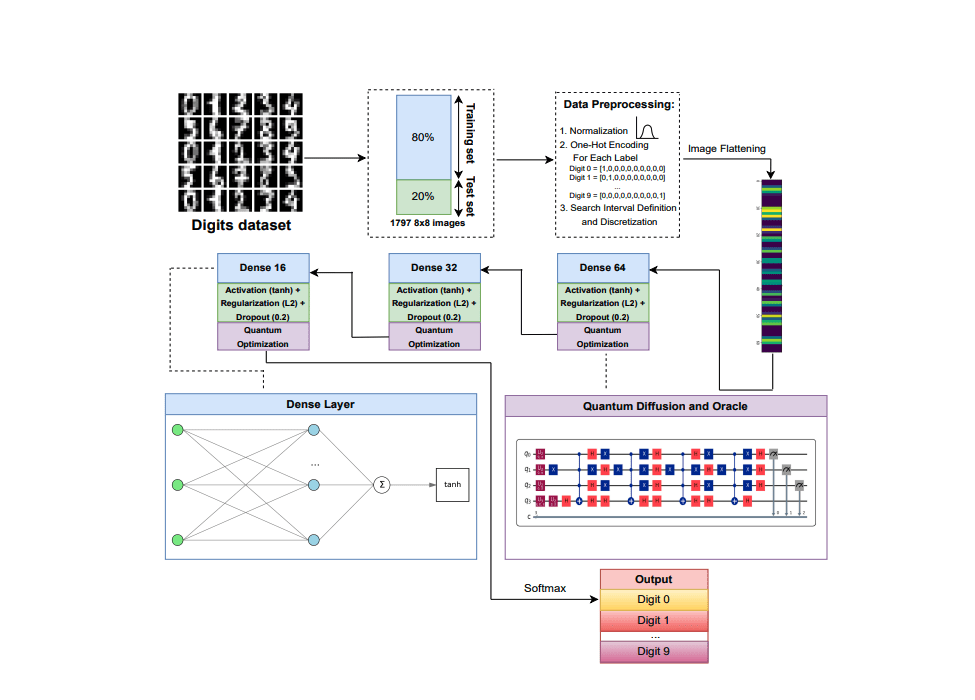
On April 20, 2025, researchers Stefan-Alexandru Jura and Mihai Udrescu published Quantum-Enhanced Weight Optimization for Neural Networks Using Grover’s Algorithm, detailing a novel approach that leverages Grover’s algorithm to optimize neural network weights. Their method achieved a 35.25% improvement in test accuracy and a 58.75% reduction in test loss on small datasets, demonstrating scalability and practicality with fewer qubits for near-future quantum applications.
The research introduces a novel strategy for optimizing classical neural networks using Grover’s search algorithm, replacing traditional backpropagation with gradient descent. This approach addresses issues like exploding/vanishing gradients by leveraging quantum speedup in high-dimensional spaces. The method significantly reduces test loss (58.75%) and improves accuracy (35.25%) on small datasets while maintaining scalability for deep networks. For an NN with 3 hidden layers trained on the Digits dataset, mean accuracy reached 97.7%. Additionally, the technique requires fewer qubits, making it practical for near-future quantum computing with limited logical qubits.
At the core of quantum computing lies Grover’s algorithm, which significantly improves search efficiency for unstructured databases. Unlike classical algorithms that require sequential checks, Grover’s algorithm leverages quantum parallelism to find target items in fewer steps. This capability is particularly valuable for optimization problems with vast solution spaces.
Variational quantum algorithms, such as the Variational Quantum Eigensolver (VQE) and the Quantum Approximate Optimization Algorithm (QAOA), combine quantum and classical computing to find approximate solutions to complex problems. VQE is notably applied in quantum chemistry for determining molecular ground states, while QAOA addresses optimization challenges in logistics and finance.
Quantum neural networks merge quantum computing with machine learning, enhancing computational power for tasks like pattern recognition and decision-making. This integration aims to solve intricate problems in fields such as drug discovery and financial modeling, potentially offering more efficient solutions than classical methods.
The transition from theoretical concepts to practical applications is evident in projects like implementing Grover’s algorithm on IBM quantum computers. These real-world tests demonstrate the feasibility of quantum algorithms while highlighting current hardware limitations, such as qubit count and error rates.
Quantum computing innovations, including Grover’s algorithm, variational methods, and quantum neural networks, are paving the way for powerful computational tools. While challenges remain, these advancements signify significant progress toward solving complex problems more efficiently. As research continues, we anticipate transformative impacts across various sectors, driven by the potential of quantum technologies to unlock new possibilities in computation and beyond.
👉 More information
🗞 Quantum-Enhanced Weight Optimization for Neural Networks Using Grover’s Algorithm
🧠 DOI: https://doi.org/10.48550/arXiv.2504.14568


