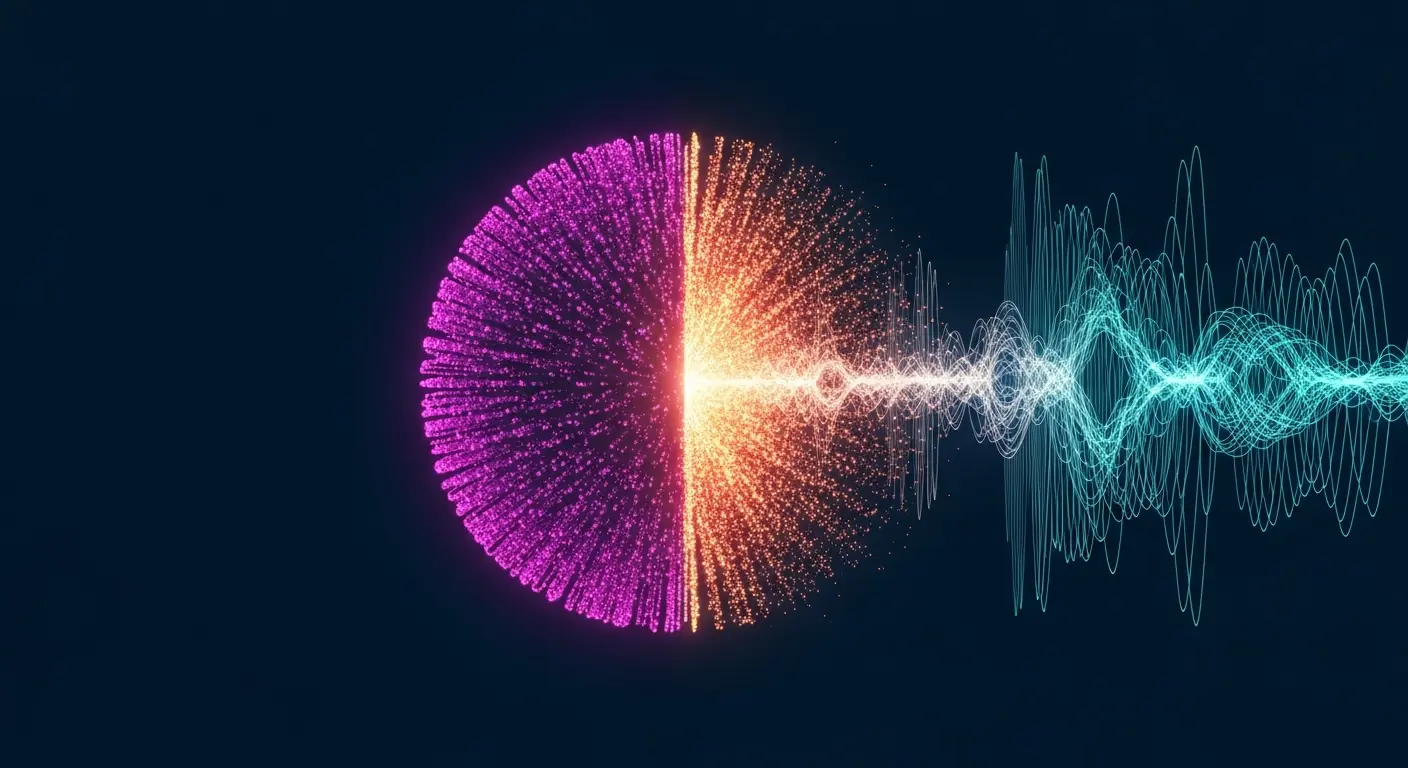
MIT physicists have created three-dimensional “moiré crystals” that simulate the behavior of electrons in four dimensions, potentially unlocking new avenues for electronic applications and the study of higher-dimensional physics. These novel crystals, constructed from twisted layers of two-dimensional materials like graphene, generate a “moiré superlattice” mathematically equivalent to a fourth dimension of space; within them, electrons act as if they can teleport in and out of this synthetic fourth dimension via a process called quantum tunneling. Unlike typical quantum tunneling, physicists have now measured that these electrons behave as if they have traveled to and from another world, effectively experiencing a fourth dimension. In a paper published recently in Nature, the team realizes a scalable technique for producing high-quality moiré materials, overcoming a materials limitation for advanced electronic applications and offering a realistic approach to realizing theoretical predictions of higher-dimensional superconductivity.
Moiré Crystals Simulate Four-Dimensional Quantum Materials
A newly discovered class of materials allows electrons to behave as if moving in four dimensions, opening a pathway to explore previously theoretical quantum phenomena. Physicists at MIT have engineered “moiré crystals” exhibiting properties that mimic those of four-dimensional quantum materials, a feat achieved through the creation of intricate, layered structures. The team, led by Joe Checkelsky, professor of physics at MIT, bypassed the traditionally painstaking process of assembling moiré materials one layer at a time. Previous methods involved peeling atomically thin materials like graphene with adhesive tape and meticulously aligning them with precise twist angles, a process that limited scalability.
Checkelsky’s lab instead developed chemical synthesis routes that leverage natural growth processes to create “moiré crystals” with built-in, high-quality superlattices. Kevin Nuckolls, a Pappalardo postdoc in physics at MIT and co-lead author on the work, says, “It feels incredible for our team to have made this materials discovery, particularly at MIT.” This approach allows for the creation of moiré materials by the tens of thousands. The team has effectively moved from assembling individual pages to generating entire encyclopedias with pre-defined, interfering patterns. The resulting materials exhibit unusual electronic properties. When subjected to magnetic fields, electrons within the moiré crystals don’t simply orbit in the conventional three dimensions; instead, they act as if they can teleport in and out of a synthetic fourth dimension, as if they had been transported through a fourth dimension.
This isn’t a change in the electrons themselves, but rather a consequence of the unique environment created by the moiré superlattice. Researchers have now measured that once an electron tunnels, it acts as if it had tunneled into a completely different world and come back again. The team’s findings, recently published in Nature, realize a scalable technique for producing high-quality moiré materials, overcoming a materials limitation for advanced electronic applications. This discovery builds upon a decade of research in moiré materials at MIT, spearheaded by physicists like Pablo Jarillo-Herrero and Raymond Ashoori. Their earlier work revealed intricate quantum phenomena within these materials, including the “Hofstadter’s butterfly” and unconventional superconductivity. Long Ju, the Lawrence C. Biedenharn Associate Professor of Physics, and his lab discovered in 2024 that moiré materials made from multilayer graphene and boron nitride cause electrons to split apart into fractional pieces, a quantum phenomenon previously thought to be exclusively confined to extremely high magnetic fields. The current study represents a crucial step towards realizing theoretical predictions of higher-dimensional superconductivity and topological properties in a laboratory setting, potentially leading to novel electronic devices and quantum technologies. While significant challenges remain before these materials can be integrated into practical applications, the MIT team has established a foundational proof-of-concept for scalable moiré material production.
Scalable Synthesis of High-Quality Moiré Superlattices
For over a decade, physicists have meticulously crafted moiré materials, layer by layer, to explore exotic quantum phenomena; however, the creation of these materials has remained a significant limitation, hindering their widespread application in advanced electronics. Researchers would then use microscopes and polymer films to stack these layers with specific twist angles, ultimately etching them into individual devices for testing. This laborious method, while successful in producing results, has hindered the potential for large-scale production and practical implementation. Now, a team at MIT has bypassed these limitations with a novel approach to moiré material synthesis, enabling the assembly of moiré materials by the tens of thousands. This represents a shift from assembling individual pieces to cultivating entire libraries of patterned materials. The resulting materials exhibit near-perfect crystalline structure, offering a crucial step towards scalable manufacturing.
This breakthrough isn’t merely about increasing production volume; it’s about unlocking the potential to simulate and study four-dimensional quantum materials. The team found that electrons within these moiré crystals act as if they can teleport in and out of a synthetic fourth dimension. Detailed studies of the electronic and magnetic properties of these crystals at high magnetic fields revealed that electrons align their motion to the areas where the two lattices interfere most strongly, effectively traversing this fourth dimension. While challenges remain in translating these fundamental findings into functional technology, this scalable synthesis method marks a significant advancement in the field of quantum materials research.
The electrons propagate in the synthetic dimension just as they do in our world’s three physical dimensions. It’s hard to detect this motion, but one of the striking realizations was that a magnetic field can reveal fingerprints of this synthetic dimension in experimentally measurable electronic properties known as quantum oscillations.
“Hofstadter’s Butterfly” & Unconventional Superconductivity in Graphene
Researchers at MIT have moved beyond the painstaking, layer-by-layer assembly of moiré materials, developing a chemical synthesis technique to grow “moiré crystals” containing built-in superlattices, a development expected to accelerate research into unconventional superconductivity and higher-dimensional quantum phenomena. This shift in methodology overcomes a materials limitation for advanced electronic applications. The significance of this advance lies in its connection to theoretical physics concepts dating back half a century; the team’s work suggests a pathway to realizing predictions of higher-dimensional superconductivity within a laboratory setting. When metals are subjected to magnetic fields, electrons orbit in patterns dictated by the material’s atomic structure, but in these newly synthesized moiré crystals, electrons act as if they can teleport in and out of a synthetic fourth dimension.
This breakthrough builds upon earlier work at MIT, including the 2014 discovery by Pablo Jarillo-Herrero and Raymond Ashoori that electrons in graphene-boron nitride moiré materials exhibit a complex quantum fractal known as “Hofstadter’s butterfly.” Furthering this research, Jarillo-Herrero’s lab in 2018 demonstrated unconventional superconductivity in twisted bilayer graphene, achieving some of the strongest superconducting properties ever recorded. Long Ju’s lab continued this momentum in 2024, revealing that multilayer graphene and boron nitride moiré materials can cause electrons to fractionate, a phenomenon previously requiring extremely high magnetic fields. The resulting materials can be assembled by the tens of thousands.
Moiré materials have become a central focus of quantum materials research today in large part because of the work of our colleagues just down the hallway.
Quantum Tunneling Enables “Synthetic” Fourth Dimension Electron Behavior
The pursuit of increasingly compact and efficient electronics has led physicists to explore unconventional avenues for manipulating electron behavior, and a recent discovery at MIT suggests a path toward simulating higher-dimensional quantum systems within readily fabricated materials. Researchers have demonstrated that electrons within specifically engineered “moiré crystals” act as if they can teleport in and out of a synthetic fourth dimension of space, a phenomenon enabled by quantum tunneling and offering a new approach to designing advanced electronic components. This isn’t about physically adding a dimension, but rather creating a material environment where electrons act as if they are traversing one. The team’s breakthrough centers on moiré crystals, materials constructed from layered two-dimensional materials with competing atomic lattices. These lattices generate a “moiré superlattice,” a complex interference pattern mathematically equivalent to a four-dimensional “superspace” lattice.
While quantum tunneling, the ability of a particle to pass through a barrier it classically shouldn’t, is well-established, physicists have now measured that once an electron tunnels, it acts as if it had tunneled into a completely different world and come back again, as if it had been transported through a fourth ‘synthetic’ dimension. This isn’t simply tunneling through a barrier, but a manifestation of the electron’s behavior within the engineered structure of the moiré crystal. Previously, creating moiré materials involved painstakingly assembling individual atomic layers using techniques like peeling graphene with adhesive tape, a process limiting scalability. The team’s approach allows for the creation of moiré materials by the tens of thousands, overcoming a materials limitation for advanced electronic applications.
By carefully analyzing these 3D silhouettes from different angles and perspectives, our measurement reconstructs the 4D landscape that guides electrons in moiré crystals.
Source: https://news.mit.edu/2026/electrons-in-moire-crystals-explore-higher-dimensional-quantum-worlds-0403



See today’s quantum computing news on Quantum Zeitgeist for the latest breakthroughs in qubits, hardware, algorithms, and industry deals.