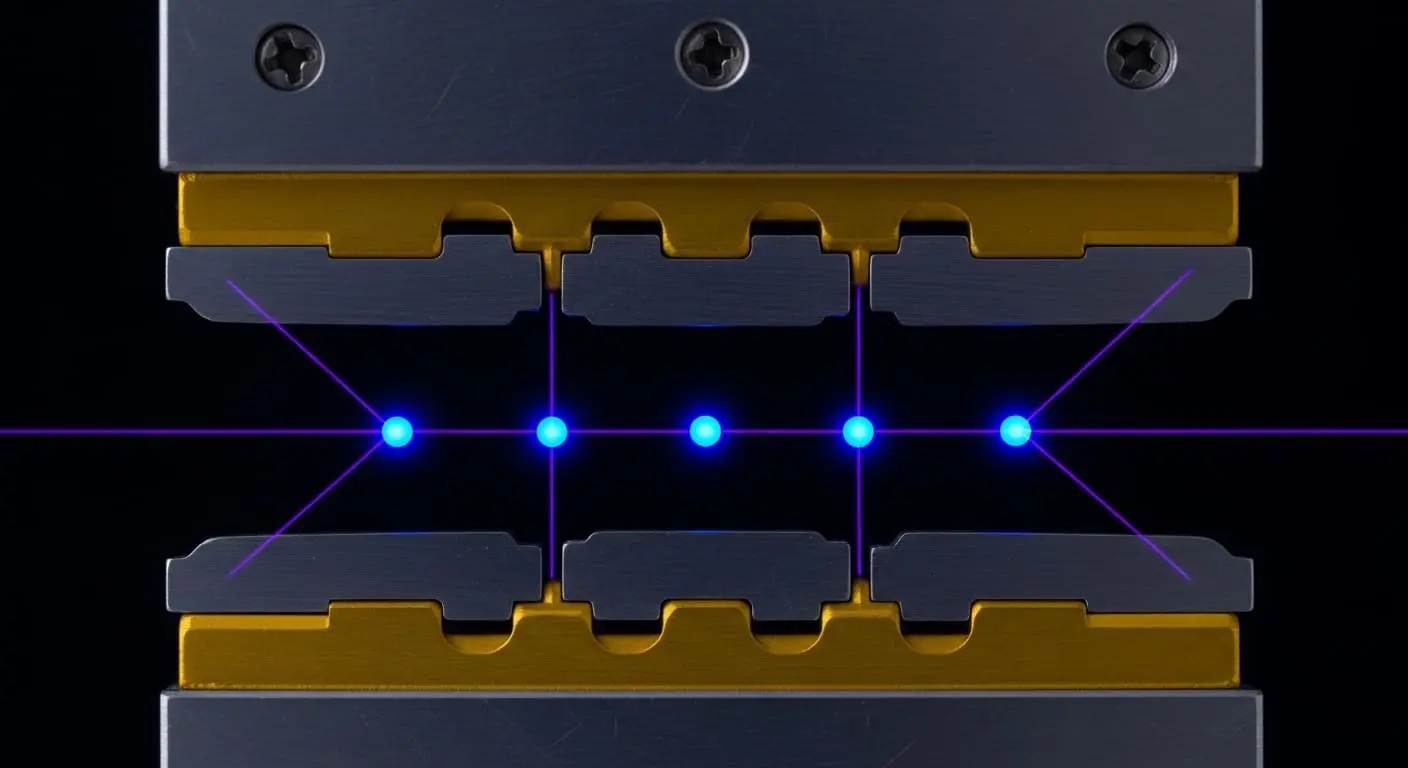
Jan Simon Haase and colleagues at Leibniz Universität Hannover, in a collaboration between Leibniz Universität Hannover and Deutsches Zentrum für Luft- und Raumfahrt e.V. (DLR), present an in-situ method for cancelling shifts arising from the optical fields used to trap atoms. The technique simultaneously interrogates multiple atomic ensembles at varying trap intensities, enabling the measurement and extrapolation of a light-shift-free frequency during each experimental cycle. This new approach circumvents the need for complex wavelength tuning or species-specific solutions. It offers a scalable pathway to enhance the stability and accuracy of compact trapped-atom clocks and associated quantum sensors.
In-situ cancellation of differential light shift via ensemble interrogation
A differential light shift (DLS) cancellation exceeding 99.9% was achieved in trapped rubidium atoms, a threshold previously unattainable without complex wavelength tuning or atom-specific techniques. This breakthrough overcomes limitations inherent in existing compact atomic clocks, where DLS fluctuations previously restricted stability and accuracy. Conventional methods demanded precise “magic wavelengths” of light, often unavailable or impractical for diverse atomic species.
Simultaneously interrogating multiple atomic ensembles at varying trap intensities established an in-situ technique that extrapolates to a DLS-free frequency, effectively removing the need for species-specific cancellation strategies. Validated with time-averaged optical potentials, the method demonstrates insensitivity to variations in total trap power, paving the way for more robust and precise quantum sensors. The technique’s validation using time-averaged optical potentials confirmed that variations in total trap power did not affect the extrapolated, DLS-free frequency.
Up to ten thousand atoms per trap were created, cooled to approximately one microkelvin, and spatially separated using a crossed-beam optical dipole trap formed by acoustic optical deflectors. A software-defined radio-controlled these deflectors, enabling precise manipulation of trap intensities and the creation of multiple, independent atomic clouds from a single laser source. Ramsey spectroscopy was then employed to measure the intensity-dependent frequency shifts within each ensemble, although scaling to achieve clock performance competitive with existing standards remains a significant challenge despite the current reliance on relatively short microwave interaction times of 200 milliseconds.
Quantifying differential light shifts using Ramsey spectroscopy of simultaneously trapped rubidium
This advance centres on simultaneously probing several distinct groups of atoms, each held in slightly different light intensities within time-averaged potentials. These potentials, created by gently rocking atoms back and forth, establish a stable trapping environment. By deliberately varying the light used to trap each atomic ensemble, a system was created where the impact of differential light shifts, inaccuracies caused by the trapping light, became quantifiable.
This allowed for the performance of Ramsey spectroscopy on each group and measurement of the frequency shift induced by the light at each intensity. Rubidium atoms held within time-averaged optical traps were investigated to address limitations caused by differential light shifts, inaccuracies arising from the light used to confine the atoms. Probing several atomic groups simultaneously, each experiencing varying light intensities, allowed for precise measurement of frequency shifts induced by the trapping light. Employing Ramsey spectroscopy determined a light-shift-free frequency without needing specific wavelengths or cancellation methods. Controlled power fluctuations validated the method, demonstrating consistent frequency results.
In-situ cancellation of light shifts improves atomic clock stability with linear extrapolation
Atomic clocks, essential for technologies ranging from satellite navigation to fundamental physics research, continually push the boundaries of precision. This new technique for cancelling differential light shifts offers a significant improvement, yet relies on extrapolating to a shift-free frequency. This extrapolation assumes a linear relationship between light intensity and frequency shift. However, the authors acknowledge that more complex trap geometries, such as two-dimensional arrays, may require multi-parameter extrapolations, introducing uncertainty and potentially limiting the scalability of the method.
This development represents a practical step forward for atomic clock technology, acknowledging that extrapolating beyond measured data always carries risk. While more complex trap designs may necessitate more sophisticated cancellation methods, this in-situ technique offers a readily implementable solution for current systems. Reducing differential light shifts improves clock stability and accuracy without requiring exotic materials or wavelengths.
A method for cancelling differential light shifts, a persistent source of error in highly precise atomic clocks, is now available. These shifts occur because the light used to trap atoms also subtly alters their energy levels, impacting timekeeping accuracy. By simultaneously examining multiple groups of trapped rubidium atoms, each exposed to differing light intensities, scientists extrapolated a frequency unaffected by these shifts. This in-situ technique avoids the need for carefully tuned “magic wavelengths” or atom-specific adjustments.
The researchers successfully cancelled differential light shifts in trapped rubidium atoms using a method of simultaneously interrogating multiple ensembles at varying light intensities. This matters because differential light shifts limit the precision of atomic clocks, vital for technologies like satellite navigation systems. By employing Ramsey spectroscopy and linear extrapolation, they achieved a light-shift-free frequency without needing specialised wavelengths or cancellation schemes. Future work could focus on adapting this technique for more complex two-dimensional atom arrays, potentially requiring multi-parameter extrapolations to maintain accuracy and scalability.
👉 More information
🗞 In-Situ Differential-Light-Shift Cancellation for Trapped-Atom Clocks
🧠 ArXiv: https://arxiv.org/abs/2603.26398



See today’s quantum computing news on Quantum Zeitgeist for the latest breakthroughs in qubits, hardware, algorithms, and industry deals.