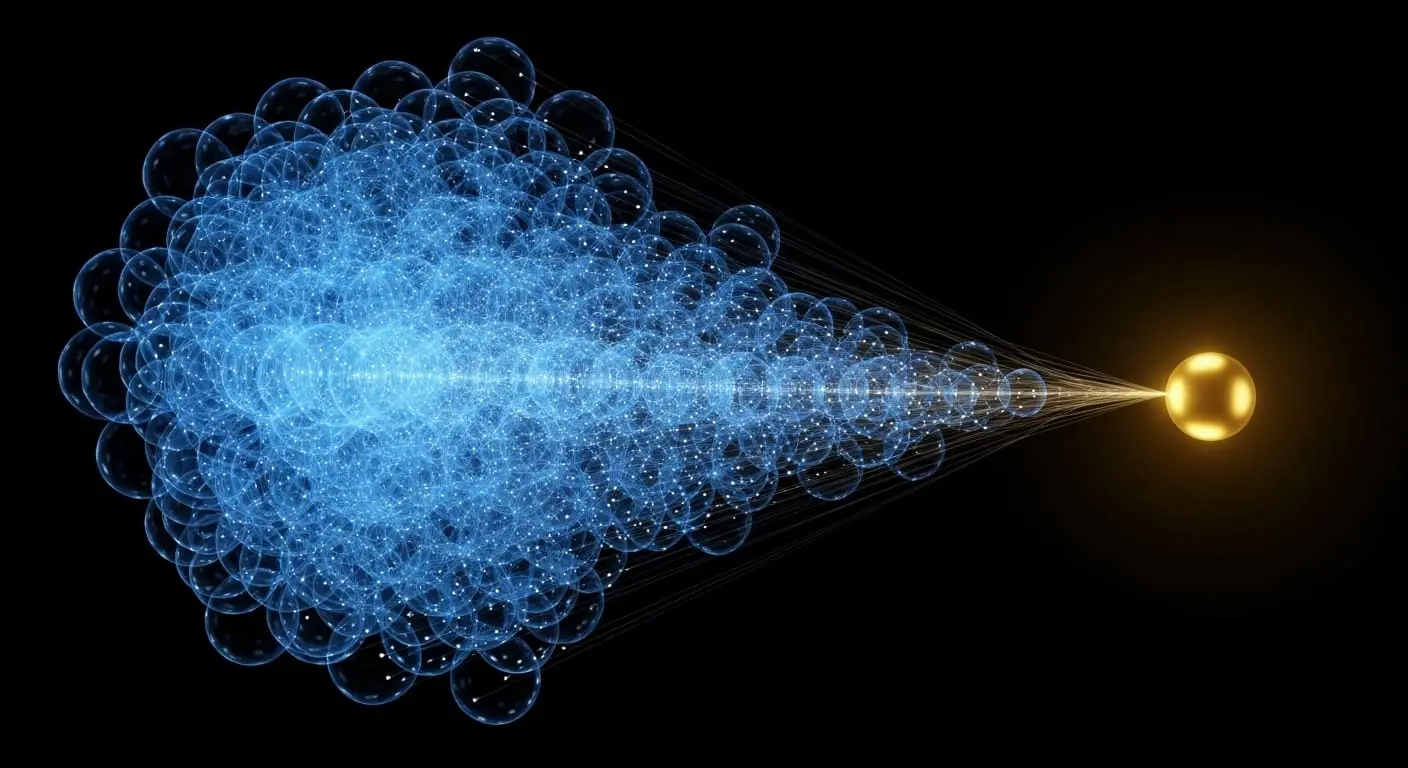
CERN researchers working with the NA62 experiment have significantly refined their measurement of an exceptionally rare particle decay, reducing the uncertainty by 40 percent and further validating the Standard Model of particle physics. The team studied the decay of a positively charged kaon into a positively charged pion and neutrino-antineutrino pair, a process occurring less than once in ten billion instances, requiring the creation of nearly a billion particles per second. This detailed analysis, incorporating data from 2023 and 2024 alongside previous observations, yielded an updated branching ratio of 9.6+1.9−1.8× 10⁻¹¹. “This is the most sensitive dataset we have analysed yet,” said lead data analyst Joel Swallow. “The fact that we can see clearly and measure with precision something so rare and elusive is a great success from a technological point of view.” The findings provide a stringent test of established theory and place tighter constraints on the potential existence of new physics.
NA62 Experiment Measures K+→π+νν Branching Ratio with 40% Reduced Uncertainty
Studying decays like the K+→π+νν, where a positively charged kaon transforms into a pion and a neutrino-antineutrino pair, allows physicists to search for discrepancies hinting at physics beyond our current understanding. This particular decay is valuable because its theoretical prediction is highly precise, yet occurs in less than one in ten billion events, demanding sophisticated experimental techniques for observation. The NA62 experiment, which generates nearly a billion particles per second by firing protons from the Super Proton Synchrotron at a beryllium target, with approximately 6% being kaons suitable for detailed study, built on their 2024 announcement of observing the decay with five standard deviations of statistical significance. Researchers incorporated data from 2023 and 2024, alongside improvements in data analysis utilizing machine learning algorithms. This refined analysis yielded a branching ratio of 9.6+1.9−1.8× 10⁻¹¹, a substantial improvement in precision.
The current result aligns with theoretical predictions, reinforcing the Standard Model’s predictive power and placing tighter constraints on potential new physics. NA62 spokesperson Giuseppe Ruggiero explained that “This stress test of the Standard Model is remarkable given the extreme rareness and theoretical cleanliness of the process that we investigated,” highlighting the significance of the findings.
Super Proton Synchrotron Enables High-Intensity Kaon Production for Rare Decay Study
Researchers meticulously analyze the decay products using the NA62 detectors, seeking deviations from the Standard Model’s predictions. Recent refinements to data analysis, incorporating machine learning algorithms and data from 2023 and 2024, have significantly improved the precision of the measured branching ratio for this decay. The collaboration achieved an updated value of 9.6+1.9−1.8× 10⁻¹¹, representing a 40 percent reduction in uncertainty compared to previous measurements. The experiment’s success in confirming theoretical predictions provides a stringent test of the Standard Model, reinforcing its predictive power despite ongoing searches for new physics. According to NA62 spokesperson Giuseppe Ruggiero, “We have demonstrated once again that our current leading theory of nature has incredible predictive power,” underscoring the importance of these rare decay studies in pushing the boundaries of particle physics.
This stress test of the Standard Model is remarkable given the extreme rareness and theoretical cleanliness of the process that we investigated.
Source: https://home.cern/news/news/physics/na62-collaboration-refines-measurement-rare-particle-decay