The quantum computing industry has entered what many observers now describe as its commercial inflection point. Record-breaking equity funding rounds and rapidly growing government commitments have reshaped the industry. With new companies listing on public markets, billion-dollar private fundraising rounds closing at unprecedented speed, and the first genuine enterprise deployments taking shape, the landscape of quantum computing companies has never been more dynamic or more consequential for investors, technologists and policymakers. This is a continuously evolving space where company valuations, technical milestones and competitive positions shift rapidly, and what follows is a snapshot of the landscape as it stands today.
This guide covers pure-play quantum firms, the large technology companies running major quantum R&D programmes, and the wider ecosystem of software, cybersecurity and sensing businesses that complete the quantum technology stack. For those looking to explore over 940 companies across 47 countries, the Quantum Navigator offers the most comprehensive directory of quantum technology firms anywhere in the world.
Context
Why the Landscape Matters Now
The quantum computing sector is no longer dominated by a handful of research labs. A full ecosystem has emerged, and 2026 is significant because of three converging trends.
Public markets have opened dramatically. Infleqtion completed its SPAC in February 2026, trading as INFQ on NYSE. Xanadu’s SPAC with Crane Harbor is expected to close in H1 2026. Quantinuum filed a confidential S-1 in January 2026 and is expected to achieve the largest quantum IPO valuation to date. The era of quantum as a purely private endeavour is ending.
The technology has matured to where modalities can be meaningfully compared. Superconducting, trapped-ion, neutral-atom, photonic and topological approaches have all demonstrated substantial progress in fidelity, qubit counts and error correction.
Government funding has reached system-altering scale, with Japan, Spain, the United States and China all committing multi-billion-dollar programmes. National quantum strategies now exist across dozens of countries, reshaping the competitive landscape. For more on investment patterns, see our guide to quantum computing stocks.
Pure-Play Companies
⚛️Pure-Play Quantum Computing Companies
Pure-play quantum companies are those whose primary business is quantum technology. These firms live or die by their ability to build commercially viable quantum systems, and they represent the most direct exposure to the sector for investors and partners.
Publicly listed since 2022, Rigetti builds superconducting quantum processors at its Fab-1 facility, one of the few dedicated quantum chip fabrication plants in the world. The company offers full-stack quantum cloud services, combining its own hardware with a software platform for hybrid classical-quantum workflows. Rigetti has faced the financial pressures common to early-stage public quantum firms but continues to iterate on its hardware roadmap.
D-Wave pioneered quantum annealing and occupies a unique dual-modality position. The Advantage2 system and its announced acquisition of Quantum Circuits signal ambitions to expand into gate-based quantum computing. D-Wave has generated more commercial revenue than most peers by focusing on practical optimisation in logistics, supply chains and portfolio management. The combination of annealing and gate-based systems is one of the most distinctive competitive strategies in the industry.
IQM Quantum Computers
Finland · Superconducting · On-Premises
Private
Europe’s leading full-stack superconducting provider. IQM builds processors for on-premises deployment at research institutions and supercomputing centres. The company operates across several European countries with significant government and institutional backing, making it the strongest non-US hardware competitor in the superconducting space. Also notable in Europe: Oxford Quantum Circuits (OQC) with its proprietary Coaxmon architecture, and Alice & Bob in France working on cat qubits for hardware-level error correction.
Trapped-Ion Pure Plays
IonQ
USA · Trapped Ion · Largest Pure-Play Balance Sheet
The most prominent publicly traded trapped-ion company. IonQ’s 2025 Tempo architecture delivered 64 algorithmic qubits at 99.9% fidelity, with a 256-qubit system targeted for 2026. The acquisition of Oxford Ionics brought critical scaling IP, and the transition from ytterbium to barium atoms underpins the path to larger machines. IonQ maintains one of the strongest balance sheets of any pure-play quantum firm. By 2030, the company has outlined plans for 80,000 logical qubits across 2 million physical qubits. Systems are accessible through AWS, Azure and Google Cloud.
Quantinuum
USA/UK · Trapped Ion · Highest-Fidelity System
S-1 Filed
Widely regarded as operating the highest-fidelity quantum computer in the world. Formed in 2021 from Honeywell Quantum Solutions and Cambridge Quantum. The Helios system achieved single-qubit gate fidelity of 99.9975% across 98 physical qubits (94 logical). Backed by NVIDIA’s venture arm, JPMorgan Chase, Mitsui and Amgen in a major 2025 fundraise. The confidential S-1 filed in January 2026 sets the stage for what could be the largest quantum IPO to date. A Helios installation is planned for Singapore in 2026. We covered Honeywell’s strategy in our analysis of Quantinuum’s path to IPO. Also in trapped-ion: Alpine Quantum Technologies (AQT) in Innsbruck.
Universal Quantum
UK · Trapped Ion · Modular Microwave Architecture
Private
Founded by Professor Winfried Hensinger and Dr Sebastian Shermer at the University of Sussex, Universal Quantum is pursuing a radically different approach to scaling trapped-ion systems. Instead of using lasers to control individual ions, the company uses microwave technology and a modular chip architecture where individual quantum computing modules can be connected together via electric field links. This means qubits can be shuttled between modules, allowing the system to scale without requiring every qubit to sit on a single chip. The approach has attracted backing from the German Aerospace Center (DLR) and the UK government. Universal Quantum’s bet is that modularity solves the hardest scaling problem in trapped-ion computing, and if it works, the architecture could scale to millions of qubits without the engineering bottlenecks that constrain monolithic designs.
The first publicly traded neutral-atom quantum company, listing on the NYSE in February 2026 after completing its SPAC merger with Churchill Capital Corp X. Infleqtion is a dual-threat business combining quantum computing hardware based on cold atoms with a substantial quantum sensing portfolio aimed at aerospace and defence. This dual positioning across computing and sensing gives it diversified revenue potential that few other pure plays can match.
QuEra Computing
USA · Neutral Atom · Harvard/MIT Spinout
Private
Harvard and MIT spinout with a 256-qubit Aquila system available through AWS Braket. Backed by Google Ventures and SoftBank in a significant 2025 convertible round. Continues to push toward larger systems with ambitious error correction goals.
PASQAL
France · Neutral Atom · Founded by Alain Aspect
IPO Expected
Founded by Nobel laureate Alain Aspect, PASQAL builds neutral-atom processors with a strong European customer base. The Fresnel processor uses rubidium atoms in 2D and 3D configurations. Has signalled intention to pursue a public listing. Also in neutral-atom: Atom Computing (USA), which demonstrated a 1,225-site atomic array in 2023.
Set to become the first publicly traded pure-play photonic quantum company. SPAC merger with Crane Harbor, with shares expected on both Nasdaq and TSX under ticker XNDU. Aurora, unveiled February 2025, is described as the first networked, modular, scalable universal photonic quantum computer: four interconnected server racks, 35 photonic chips, 13km of fibre optics. Targeting 100,000 physical qubits and 1,000 logical qubits by 2029. PennyLane, its open-source quantum programming framework, is used by nearly half of all quantum programmers globally. Customers include Volkswagen, Mitsubishi Chemical Group and Rolls-Royce.
One of the most heavily capitalised quantum startups. A landmark 2025 government-backed round combined BlackRock investment with substantial Australian government support. Building silicon-photonics quantum computers with GlobalFoundries. Collaboration with Lockheed Martin for aerospace and defence applications. Reportedly preparing for a public listing. Also in photonics: Quandela (France) and QuiX Quantum (Netherlands).
ORCA Computing
UK · Photonic · Room-Temperature Systems
Private
London-based photonic quantum computing company that has carved out a distinctive position by building compact, room-temperature systems that can be deployed in standard data centre and even field environments. ORCA’s PT Series uses telecom-standard single photons stored in quantum memories, giving it a practical deployment advantage over approaches that require cryogenic cooling. The company has secured significant UK Ministry of Defence contracts and partnerships, making it one of the most defence-engaged quantum firms in Europe. ORCA’s approach to photonic quantum computing prioritises near-term deployability and integration with existing classical infrastructure, positioning it as a pragmatic alternative to the larger-scale photonic visions pursued by Xanadu and PsiQuantum.
Large Technology Companies
🏢Large Tech Players in Quantum
The largest quantum R&D programmes are run by technology conglomerates whose quantum divisions represent a fraction of their overall business. These companies bring unmatched resources, engineering talent and customer relationships. They are not pure-play investments, but their efforts set the technical benchmarks the rest of the industry measures against.
The most consistent investor in superconducting quantum hardware, operating the largest fleet of cloud-accessible systems via IBM Quantum Platform. The 2026 Nighthawk processor connects up to three 120-qubit modules for 360 qubits running 7,500 gates, with significant gate depth increases planned for 2027 and 2028. Qiskit remains the primary quantum development framework. IBM’s quantum division benefits from enormous R&D budgets and a massive enterprise sales organisation, but investors buying IBM stock are primarily buying a classical computing and consulting company.
Achieved a landmark quantum supremacy result in 2019 with Sycamore and continued advancing with the Willow chip in late 2024. Investing heavily in quantum error correction research and committing billions in R&D. Google Ventures has also made strategic investments in pure-play firms including QuEra, giving the company both direct research capability and portfolio exposure to the wider ecosystem.
The only major company pursuing topological quantum computing. The Majorana chip (February 2025) uses topological qubits targeting reduced error rates and radical scalability toward millions of qubits on a single chip. Azure Quantum provides cloud access to systems from IonQ, Quantinuum and others, hedging the hardware-agnostic bet. If topological physics delivers, Microsoft could leapfrog the competition by eliminating most error correction overhead. This is the one major modality where pure-play exposure does not exist.
Amazon (AWS)
USA · Superconducting · Building Own Quantum Chips
Amazon is building its own quantum hardware through the AWS Center for Quantum Computing in Pasadena, developing a fault-tolerant superconducting quantum computer using a cat qubit approach similar to Alice & Bob. This is a genuine hardware play, not just cloud aggregation. Amazon’s Ocelot chip, unveiled in early 2025, demonstrated a purpose-built error correction architecture that the company claims reduces the overhead of quantum error correction by up to 90%. Separately, AWS operates the Braket managed quantum cloud service (covered below in software), which provides vendor-agnostic access to third-party quantum hardware. Amazon is therefore one of the few large tech companies pursuing both proprietary quantum chip development and a neutral marketplace for competitors’ systems.
Majority owner of Quantinuum, the most highly valued pure-play quantum company in the world. Honeywell is restructuring into three separate public companies by 2026, which will further clarify the strategic positioning of its quantum asset. For investors seeking quantum exposure through a large-cap industrial with robust cash flows and defence revenue, Honeywell offers a distinctive risk profile.
Not building quantum hardware directly but increasingly important as an enabler. Quantinuum will leverage NVIDIA’s Grace Hopper GPUs for real-time error correction decoding. NVIDIA’s venture arm (NVentures) has invested in multiple quantum companies. The role in quantum mirrors its role in AI: providing the classical infrastructure that quantum systems need to function effectively.
Taking a distinctive approach through silicon spin qubits, leveraging its existing semiconductor fabrication infrastructure. Intel’s Tunnel Falls chip uses its advanced CMOS manufacturing processes to build quantum processors on 300mm wafers, the same production lines used for classical chips. If the silicon approach scales, Intel’s unmatched fabrication capability could give it a decisive manufacturing advantage. Progress has been slower than some competitors, but the potential to produce qubits at semiconductor-industry volumes makes Intel a significant long-term contender.
Picks and Shovels
🔧Enabling Technology and Supply Chain
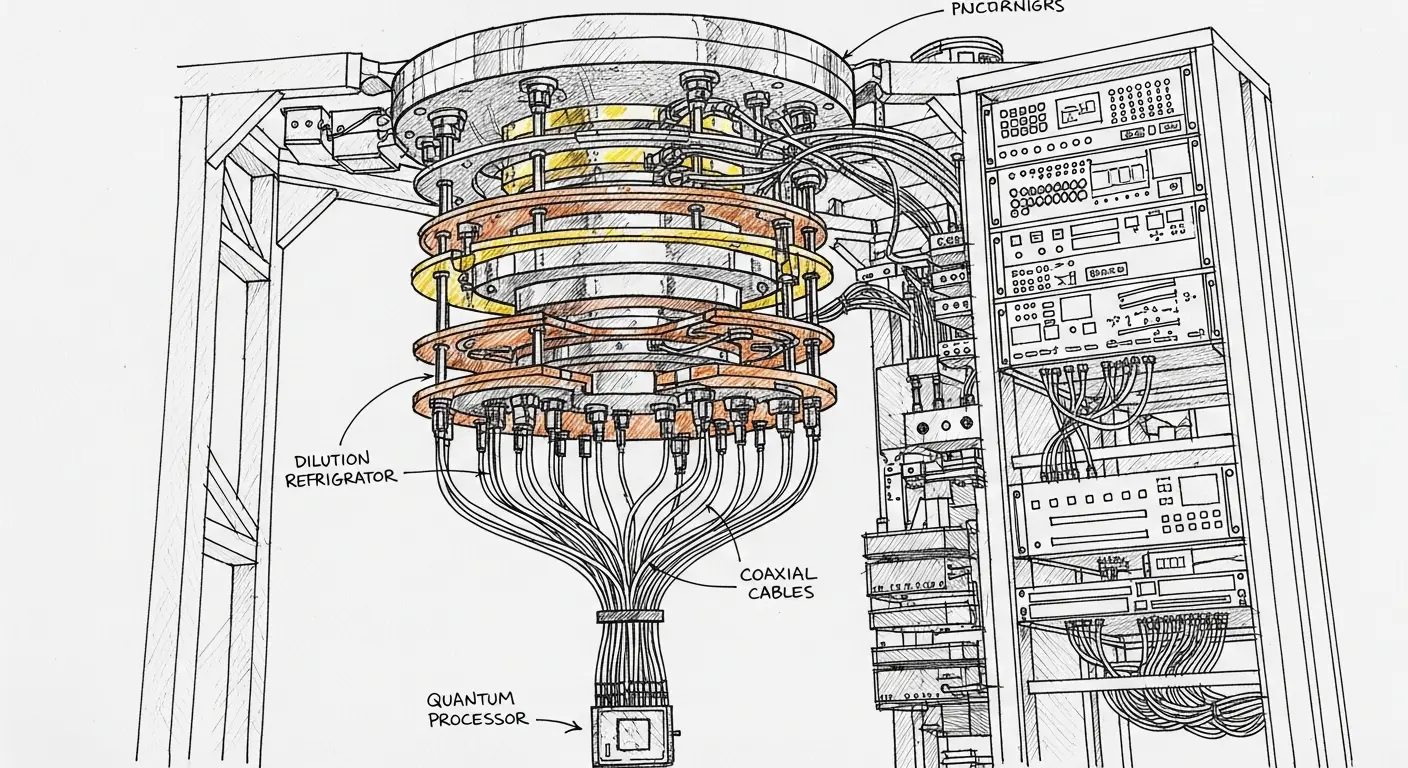
Every quantum computer depends on a supply chain of specialised enabling hardware that rarely gets the attention it deserves. Dilution refrigerators, control electronics, quantum processing units and cryogenic cabling are the picks and shovels of the quantum gold rush, and the companies that build them occupy critical chokepoint positions in the ecosystem.
Bluefors
Finland · Cryogenics · Dilution Refrigerators
Private
If you have used or seen a superconducting quantum computer anywhere in the world, there is an overwhelming chance it was cooled by a Bluefors dilution refrigerator. The Helsinki-based company is the global benchmark for the ultra-low temperature cryogenic measurement systems that every superconducting, spin qubit and many other quantum processors require to operate at millikelvin temperatures near absolute zero. With over 700 employees globally, Bluefors occupies one of the most strategically important positions in the entire quantum supply chain.
The company’s product range spans from its workhorse LD System (the most-sold dilution refrigerator in the world) to the KIDE Cryogenic Platform, designed for large-scale quantum computing with support for over 1,000 qubits, and the new Ultra-Compact LD for space-constrained labs and data centres. In 2024, Bluefors expanded its Syracuse, New York production facility by 45%, becoming the largest manufacturer of dilution refrigerators in North America and opening a shared Bluefors Lab at mHUB in Chicago as part of the Bloch Quantum Tech Hub. A 2025 strategic partnership with Delft Circuits integrates Cri/oFlex cryogenic cabling technology directly into Bluefors systems, solving the I/O scaling bottleneck as qubit counts climb into the thousands.
Bluefors systems are used by virtually every major quantum computing company, from IBM (which uses the KIDE platform for its Quantum System Two and developed Project Goldeneye with Bluefors technology) to Alice and Bob, which is building a 20-refrigerator cryostat farm in Paris for its cat qubit programme. The company also manufactures Cryomech cryocoolers for broader applications in medical and life sciences. As quantum computers scale, Bluefors sits at a critical chokepoint: you cannot build a superconducting quantum data centre without its refrigerators.
Delft-based company that has positioned itself as the world’s highest-volume supplier of commercial superconducting quantum processing units (QPUs). Rather than building its own quantum computer, QuantWare manufactures and sells the processor chips themselves, allowing other organisations to build quantum systems on top of its hardware. This “QPU-as-a-product” model is analogous to how ARM or TSMC operate in the classical semiconductor world, providing core components without competing with the companies that build end-user systems.
QuantWare is a key partner in the Quantum Utility Block (QUB), a collaboration with Q-CTRL and Qblox that launched in late 2025, combining QuantWare QPUs, Qblox control stacks and Q-CTRL infrastructure software into a pre-validated, modular full-stack quantum computer reference design. The first QUB system is being deployed at Elevate Quantum in Colorado in 2026. This open-architecture approach is designed to give enterprises and research institutions a practical, cost-effective path to on-premises quantum computing without being locked into a single vertically integrated vendor.
Ecosystem
💻Quantum Software and Platform Companies
The software layer is where much of the commercial value will ultimately be captured. These companies build the tools, compilers, algorithms and applications that translate raw qubit capabilities into useful computation.
Classiq
Israel · Quantum Software Engineering · Series C
Private
Closed a major Series C in 2025 and released Classiq 1.0, a production-ready quantum software platform with correct-by-construction enforcement and a hardware-aware compiler. Investors include Entrée Capital, Samsung Next, HSBC and NightDragon.
Quantum Machines
Israel · Control & Orchestration · Series C
Private
Closed a substantial Series C in early 2025 from PSG Equity, Intel Capital and Red Dot Capital Partners. Develops the quantum orchestration platform and control hardware that sits between classical and quantum layers. Also notable in software: Multiverse Computing (quantum-inspired financial solutions).
SandboxAQ
USA · AI + Quantum · Alphabet Spinout
Private
Spun out of Alphabet in 2022 under CEO Jack Hidary, SandboxAQ sits at the intersection of AI and quantum technology in a way no other company does. The company’s thesis is that large-scale quantitative models (what it calls “AQ”) will transform industries from drug discovery and materials science to financial modelling and cybersecurity, using a combination of quantum simulation techniques, AI and high-performance classical computing. SandboxAQ has raised substantial funding from investors including Breyer Capital, T. Rowe Price, Salesforce Ventures and Eric Schmidt. Its AQ Cybersecurity division is one of the leading providers of quantum-safe cryptographic migration tools, helping large enterprises and government agencies audit and upgrade their encryption ahead of the quantum threat. The company’s positioning as a horizontal platform across multiple verticals makes it one of the most broadly ambitious quantum-adjacent firms in the ecosystem.
Riverlane
UK · Quantum Error Correction · Deltaflow
Private
Cambridge-based company that has staked its entire business on solving the quantum error correction (QEC) bottleneck. Riverlane’s core product is its QEC decoding technology, which sits as a middleware layer between quantum hardware and applications, processing the torrent of error syndrome data that fault-tolerant quantum computers will generate. The company has partnerships with multiple hardware providers including Rigetti, IQM and the UK National Quantum Computing Centre, positioning its decoder as a hardware-agnostic standard. If fault-tolerant quantum computing is the destination, error correction decoding is the critical infrastructure that makes it work, and Riverlane is arguably the most focused company in the world on this specific problem. Founded by Steve Brierley, a former Cambridge University lecturer in quantum information.
Strangeworks
USA · Multi-Provider Cloud Platform
Private
Austin-based platform that provides a single access point to quantum hardware and software from multiple vendors. Strangeworks abstracts away the complexity of choosing between providers, allowing enterprise teams to experiment across IonQ, IBM, Rigetti and others without deep quantum expertise. The platform approach is particularly appealing to organisations in the early stages of evaluating quantum computing for their workflows.
Amazon’s managed quantum computing service within AWS, and the primary hardware-agnostic quantum cloud platform on the market. Braket provides unified API access to quantum systems from IonQ, Rigetti, QuEra and others, alongside fully managed simulators for testing and prototyping. For many enterprise teams, Braket is their first point of contact with quantum hardware, and its vendor-neutral positioning means customers can benchmark different modalities without committing to a single provider. The service includes hybrid classical-quantum job management, integration with other AWS infrastructure, and pay-per-use pricing that lowers the barrier to experimentation. Braket operates independently of Amazon’s own quantum chip programme, maintaining its role as a neutral marketplace.
🔒Quantum Cybersecurity Companies
The quantum threat to encryption has created a fast-growing cybersecurity segment. These companies deploy new post-quantum cryptographic standards to protect sensitive data. For a comprehensive treatment, see our complete guide to post-quantum cryptography.
Key players include PQShield (UK, hardware-level PQC for IoT), QuSecure (quantum-safe orchestration platform), Crypto Quantique (quantum-driven device identity) and evolutionQ (quantum risk assessment, partnered with SandboxAQ, profiled above).
Quantum Dice
UK · QRNG · Oxford Spinout
Private
Oxford University spinout specialising in quantum random number generation (QRNG). Quantum Dice builds hardware devices that exploit the fundamental unpredictability of quantum mechanics to generate provably random numbers, a critical ingredient for cryptographic key generation, secure communications and Monte Carlo simulations. What distinguishes Quantum Dice from other QRNG providers is its source-device-independent protocol, which continuously verifies the quantum nature of the randomness in real time rather than requiring users to trust the hardware. This self-certifying approach solves a significant trust problem in the QRNG market. The company’s DISC (Device-Independent Self-Certifying) technology can be integrated into existing security infrastructure, making it relevant today rather than dependent on future quantum computer availability. QRNG sits at the intersection of quantum cybersecurity and quantum hardware, representing one of the earliest quantum technologies with genuine near-term commercial applicability.
📡Quantum Sensing and Defence-Adjacent
Quantum sensing runs parallel to computing with strong defence-sector ties. Technologies including atomic clocks, quantum magnetometers and inertial navigation systems are already deployed. Infleqtion straddles both computing and sensing. Other notable firms include SBQuantum, Nomad Atomics and Q.ANT. See our feature on quantum computing as a defence-adjacent theme.
Q-CTRL
Australia · Infrastructure Software + Defence Sensing · $113M Series B
Private
Founded by physicist Michael Biercuk in Sydney, Q-CTRL has built what its CEO describes as “an index fund on the entire quantum industry” through a dual business spanning quantum infrastructure software and quantum sensing. The company wins regardless of which qubit modality, application sector or vertical ultimately dominates, because its technology sits beneath all of them.
On the computing side, Q-CTRL’s Fire Opal performance management software is natively embedded in IBM Quantum’s cloud fleet and has been deployed into platforms from Diraq, Oxford Quantum Circuits, Rigetti and others, making it arguably the most widely integrated third-party quantum software in the world. Its Boulder Opal toolkit provides autonomous QPU calibration and characterisation. In late 2025, Q-CTRL partnered with QuantWare and Qblox to launch the Quantum Utility Block (QUB), a pre-validated modular full-stack quantum computer reference design, with the first system going online at Elevate Quantum in Colorado in 2026. NVIDIA showcased Q-CTRL’s infrastructure software as part of its hybrid quantum-classical computing vision.
On the sensing side, Q-CTRL achieved what it describes as the first true commercial quantum advantage in GPS-denied navigation in 2025. Its Ironstone Opal system outperformed a high-end inertial navigation system by over 100x in airborne flight tests, earning recognition as one of TIME Magazine’s Best Innovations of 2025. In August 2025, DARPA selected Q-CTRL for two awards under its Robust Quantum Sensors (RoQS) programme, with contracts valued at US$24.4 million to develop next-generation quantum sensors for high-performance military vehicles, with Lockheed Martin as a subcontractor.
Q-CTRL closed its Series B at US$113 million in late 2024, led by GP Bullhound, making it the largest aggregate Series B for a quantum software company globally. The company reported over $50 million in sales and contract wins in 2025 alone, a commercial traction figure that almost no other pure quantum software company can match. With 130+ employees, its Black Opal education platform is deployed nationally in the UK and India, building the quantum workforce pipeline alongside its commercial business.
Honourable Mentions
🔭The Expanding Landscape
The companies profiled above represent the most prominent players, but they are far from the whole story. The quantum industry is expanding continuously, with new startups forming around emerging research, established firms pivoting into quantum, and entirely new application categories opening up. Any guide to this sector is inevitably incomplete the moment it is published.
In hardware, a growing wave of companies is pursuing alternative and hybrid approaches. planqc in Germany is building neutral-atom systems using optical lattices. Diraq in Australia is advancing silicon-based spin qubits using standard CMOS fabrication, a path that could eventually leverage existing chip manufacturing at scale. Quantum Motion in the UK is pursuing a similar silicon strategy. C12 Quantum Electronics in France is developing carbon nanotube qubits, and eleQtron in Germany is working on microwave-controlled trapped ions. Photonic Inc. in Canada is building silicon-photonic spin-based systems that combine networking with computation. Each represents a bet that the dominant modality has not yet been settled.
The intersection of quantum computing with life sciences and drug discovery is one of the fastest-growing application areas. Pharmaceutical companies are among the most active early adopters of quantum algorithms for molecular simulation, protein folding and materials discovery. Firms such as ProteinQure and Menten AI have built businesses specifically around quantum-enhanced computational biology, while major pharma companies including Roche, Merck and Boehringer Ingelheim have established quantum computing partnerships. The life sciences crossover illustrates how the quantum ecosystem extends well beyond hardware manufacturers into domain-specific application layers.
Other areas seeing rapid company formation include quantum networking and communications (Aliro Technologies, Qunnect, QphoX), quantum-safe migration services, quantum-inspired optimisation for logistics and finance, and the growing field of quantum error correction middleware (Riverlane, profiled above, and Q-CTRL). The Quantum Navigator adds new companies on a regular basis, reflecting a landscape where the pace of formation continues to accelerate.
Geography
🌍Global Quantum Hubs
The United States dominates, hosting IonQ, Rigetti, D-Wave, PsiQuantum, QuEra, Infleqtion and Atom Computing. The United Kingdom punches above its weight with Quantinuum, OQC, Universal Quantum, Riverlane, ORCA and PQShield. Canada has produced Xanadu, D-Wave and Photonic Inc. France and Germany lead in continental Europe with PASQAL, Alice & Bob, Quandela, IQM and planqc. Australia has grown through PsiQuantum’s partnership and Diraq’s silicon qubit work. Japan, Singapore and South Korea are expanding rapidly through government funding and partnerships with Western firms.
Not every quantum company makes it. The industry’s capital intensity, long development timelines and reliance on scientific breakthroughs that may or may not arrive on schedule mean that corporate casualties are an inevitable part of the landscape. Understanding the failures is as important as studying the successes.
Zapata Computing
USA · Quantum Software · Collapsed 2024
Defunct
Zapata Computing was one of the most prominent quantum software companies, founded in 2017 by Harvard professor Alán Aspuru-Guzik and a team of quantum chemists. The company built Orquestra, an enterprise quantum workflow platform, and went public via SPAC in 2023 trading as ZPTA. Zapata had partnerships with major enterprises and government agencies, and was widely regarded as a serious contender in quantum software. But the commercial reality of selling quantum software to enterprises that could not yet extract clear value from noisy intermediate-scale quantum hardware proved devastating. Revenue failed to materialise at the rate investors required, the share price collapsed, and by mid-2024 Zapata had ceased operations and entered bankruptcy. Its IP and assets were subsequently acquired.
Zapata AI
USA · Generative AI + Quantum · Phoenix from Zapata Computing
Reborn
Rising from the wreckage of Zapata Computing, Zapata AI acquired the original company’s core IP and pivoted decisively toward industrial generative AI, applying quantum-inspired mathematical techniques to enterprise AI problems. The reborn company has repositioned the Orquestra platform around generative AI workflows for industrial applications rather than pure quantum computing, betting that the mathematical insights from quantum algorithm research can create value today through classical and quantum-inspired methods, rather than waiting for fault-tolerant quantum hardware. It is a textbook example of the quantum industry’s capacity to regenerate. The underlying science and talent do not disappear when a company fails; they find new homes and new commercial framings. Whether Zapata AI can succeed where Zapata Computing could not will depend on whether the AI pivot generates the near-term revenue that quantum alone could not deliver.
Zapata is the highest-profile casualty but it is not alone. Several smaller quantum startups have quietly shut down or been absorbed as the market has consolidated, and the SPAC boom of 2022 to 2023 left some companies publicly traded before their technology or business models were ready for the scrutiny and reporting requirements that come with public markets. The lesson for investors and partners is clear: the quantum industry’s long development timelines mean that financial sustainability matters as much as technical brilliance.
Risk Factors
🔴What Could Go Wrong
Most coverage of quantum computing companies is relentlessly optimistic. This section is not. The quantum industry faces real risks that investors, enterprise buyers and policymakers should understand clearly. None of these risks mean the technology will fail, but any of them could reshape the competitive landscape in ways that current valuations and roadmaps do not account for.
The fault-tolerance timeline may slip. Every major company roadmap assumes that fault-tolerant quantum computing will arrive within a broadly defined 2027 to 2030 window. But quantum error correction remains extraordinarily difficult, and the gap between demonstrating error correction on a handful of logical qubits in a lab and running commercially useful fault-tolerant algorithms at scale is enormous. If the timeline slips by even a few years, companies with thin balance sheets and high burn rates will face existential pressure.
Classical AI may eat quantum’s near-term lunch. Many of the use cases used to justify quantum computing investment today, particularly in optimisation, machine learning and simulation, are also being aggressively pursued by classical AI. Large language models, diffusion models and classical high-performance computing are advancing at an extraordinary pace. If classical approaches solve enough of the problems that quantum was supposed to address, the addressable market for quantum computing could be smaller and later than current projections suggest.
A funding winter could arrive before commercialisation. The quantum sector has attracted enormous capital, but the gap between investment and revenue remains vast. Most pure-play quantum companies generate minimal commercial revenue relative to their valuations and burn rates. If investor sentiment shifts, as it did for quantum stocks in early 2023, companies that have not achieved profitability or secured substantial government contracts could find it difficult to raise the next round. The Zapata collapse is a warning of what happens when capital dries up before the technology delivers.
Geopolitical fragmentation could limit scaling. Quantum technology is increasingly treated as a matter of national security. Export controls, technology transfer restrictions and government mandates to use domestic suppliers could fragment the global market, preventing companies from accessing the best talent, components or customers across borders. A company that dominates the US market may find itself locked out of European or Asian procurement cycles, and vice versa.
The modality question remains genuinely open. Billions of dollars are being invested across superconducting, trapped-ion, neutral-atom, photonic, topological and silicon spin qubit approaches. It is entirely possible that one or two of these approaches will reach fault tolerance while others plateau, stranding the companies and investors who backed the wrong horse. The diversity of approaches is a sign of a healthy research ecosystem, but it is also a source of significant investment risk.
Talent scarcity constrains everyone. The number of people in the world with the skills to design quantum processors, build quantum error correction systems or develop quantum algorithms is vanishingly small. Every quantum company competes for the same limited pool of physicists, engineers and computer scientists. Rapid scaling is constrained not just by capital or technology but by the sheer scarcity of qualified humans. Universities are scaling their quantum programmes, but the pipeline takes years to produce results.
A Living Landscape
The quantum computing industry is in constant flux. New funding rounds close, IPOs launch, technical breakthroughs are announced and government policies shift, all of which can reshape competitive dynamics within weeks. The companies and positions described in this guide reflect a snapshot that requires regular updating. For the most current view of the ecosystem, the Quantum Navigator is continuously maintained and tracks developments as they happen.
FAQ
Frequently Asked Questions
What are the biggest quantum computing companies?
Among tech giants: IBM, Google, Microsoft and Amazon. Among pure plays: Quantinuum (largest valuation, IPO pending), IonQ (publicly traded, strongest balance sheet), Xanadu (SPAC pending) and PsiQuantum (one of the most capitalised startups).
Which quantum computing companies are publicly traded?
No definitive answer yet. Superconducting qubits benefit from decades of engineering. Trapped ions offer the highest fidelities. Neutral atoms provide natural scalability. Photonics enables room-temperature operation. Topological qubits promise inherent error protection but remain least proven. The winner will likely not be determined until fault-tolerant machines operate at scale.
How many quantum computing companies are there?
The Quantum Navigator currently tracks over 940 quantum technology companies across 47 countries and 124 industry categories. The number continues to grow.
When will quantum computers become commercially useful?
IBM, Quantinuum and IonQ have roadmaps targeting meaningful quantum advantage in specific applications between 2027 and 2030. Near-term value is already being generated in quantum-inspired optimisation, quantum-safe cryptography and quantum sensing.
Explore the Full Ecosystem
Browse over 940 quantum companies across 47 countries and 124 categories in the Quantum Navigator.
Disclaimer: This article is for informational and educational purposes only and does not constitute financial advice, investment advice, trading advice, or any other type of advice. The information provided should not be relied upon for making investment decisions. Always conduct your own research and consult with a qualified financial advisor before making any investment decisions. Past performance does not guarantee future results. Investing in stocks, particularly in emerging technology sectors like quantum computing, involves substantial risk including the potential loss of principal.