

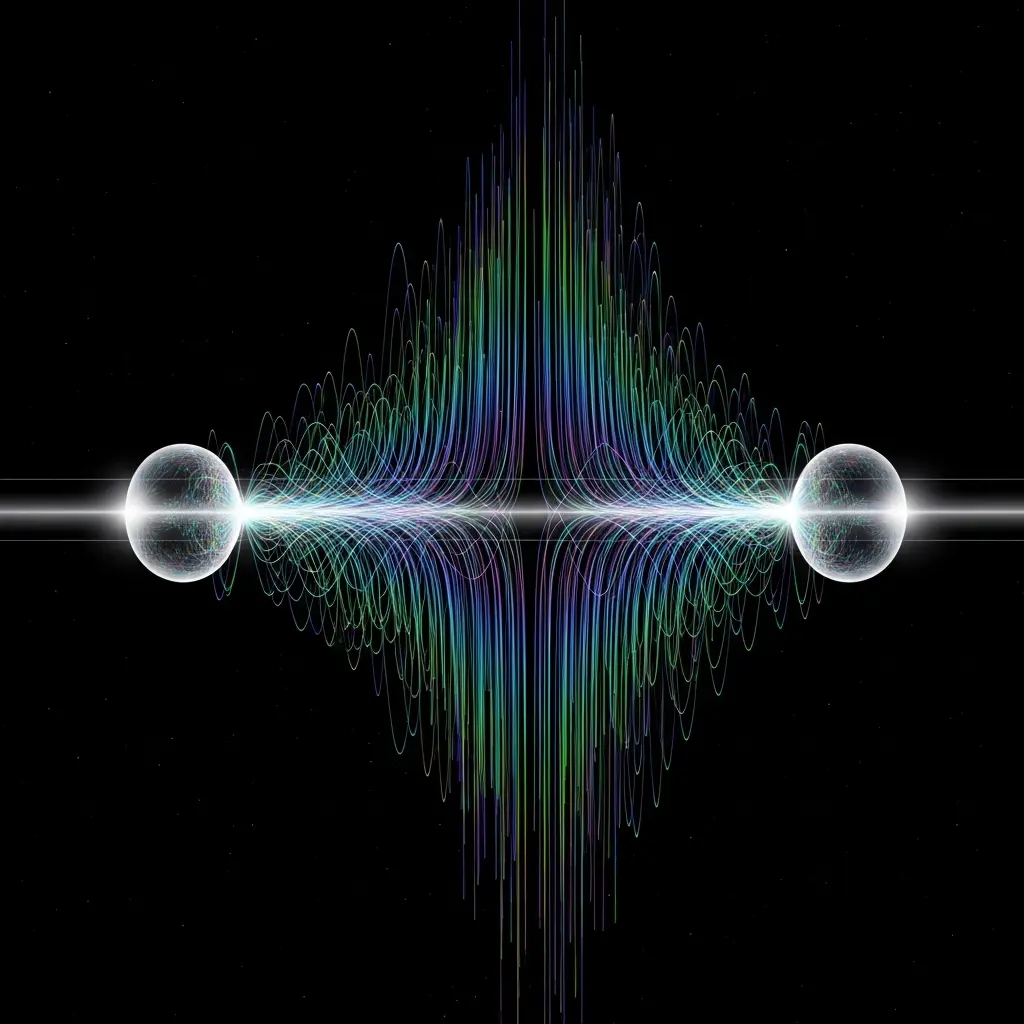
Scientists are increasingly interested in understanding the limits of predictability in quantum mechanics, and a new study by Chirag Srivastava from the Institute of Informatics, National Quantum Information Centre, Faculty of Mathematics, Physics and Informatics, University of Gdańsk, Poland, and Aparajita Bhattacharyya and Ujjwal Sen from the Harish-Chandra Research Institute, A CI of Homi Bhabha National Institute, India, explores the phenomenon of nonlocal prediction of quantum measurement outcomes. Their research, conducted in collaboration between the University of Gdańsk and the Harish-Chandra Research Institute, demonstrates that entangled quantum states can surpass classical limits on predicting measurement results, revealing a genuinely nonlocal effect where predictability increases after measurement. This finding is significant because it highlights the unique capabilities of entanglement and, surprisingly, shows that noise, specifically dephasing, can actually enhance this predictability for many states, challenging conventional wisdom about the detrimental effects of noise on quantum systems.
Imagine predicting the roll of a distant dice by knowing the properties of its paired twin. New work demonstrates that quantum systems can exhibit similar connections, allowing prediction of measurement results beyond what classical physics permits. This challenges our understanding of how information is shared and accessed in the quantum world.
Scientists are increasingly focused on understanding the subtle ways quantum entanglement manifests itself beyond its well-known applications in quantum technologies. This investigation moves beyond simply demonstrating entanglement to quantifying the degree to which measurement outcomes can be predicted across spatial separation without any conventional communication.
Establishing a baseline for this predictability is vital, as it allows researchers to identify scenarios where quantum systems surpass the limits imposed by classical physics. Product states, representing systems with no entanglement, invariably adhere to this bound.
However, investigations reveal that all pure entangled states, and even certain classically correlated states, can exceed this limit, demonstrating a distinctly quantum effect where predictability improves after a measurement is made. This finding challenges intuitive notions about information and measurement, suggesting that the act of measurement itself can unlock predictive power.
Perfect nonlocal predictability appears to be reserved for maximally entangled states when subjected to arbitrary projective measurements. Unlike partially entangled states, these uniquely connected systems consistently achieve complete predictability. Now, a surprising twist emerges when considering the impact of noise. By comparing pure entangled states with ‘dephased’ versions, those subjected to a form of quantum noise, scientists discovered that introducing dephasing can, counterintuitively, enhance nonlocal predictability for a wide range of states and measurements.
This noise-induced advantage vanishes only when dealing with maximally entangled states. At this point, the inherent strength of maximal entanglement prevails, retaining a fundamental edge in nonlocal predictability even in the presence of noise. These results open avenues for exploring how to optimise quantum states for predictive tasks and potentially designing new protocols for quantum information processing.
State discrimination optimises prediction of Alice’s quantum measurement outcomes
Initially, the research focused on quantifying nonlocal predictability between two parties, Alice and Bob, sharing a bipartite quantum system. Bob, possessing complete knowledge of the shared quantum state and Alice’s measurement settings, attempts to predict the outcome of Alice’s measurements. This prediction relies on state discrimination techniques, where Bob constructs an ensemble of states corresponding to Alice’s potential measurement outcomes.
Once this ensemble is established, Bob employs minimum error state discrimination to optimise his guessing strategy, thereby quantifying the degree of nonlocal predictability inherent in the system. This bound corresponds to the probability of the most likely outcome, and product states invariably satisfy this limit.
However, investigations revealed that both pure entangled states and certain classically correlated states can surpass this local bound, demonstrating a genuinely nonlocal phenomenon. The study moved beyond simply identifying this nonlocality to exploring conditions for perfect predictability, discovering that projective measurements performed on maximally entangled states consistently yield perfect nonlocal predictability.
This perfect prediction does not extend to partially entangled states, highlighting the special role of maximal entanglement. The work compared pure entangled states with their dephased counterparts, introducing dephasing as a method to compare coherent superpositions with classical mixtures. A dephasing channel was applied to Alice’s subsystem, simulating the effects of noise during transmission.
Surprisingly, results indicated that for many entangled states and measurement choices, this dephased setup could enhance nonlocal predictability, a counterintuitive advantage that vanishes only when dealing with maximally entangled states under any projective measurement. By comparing these scenarios, the research aimed to clarify the relationship between entanglement and classical correlations in enabling nonlocal prediction.
Enhanced predictability via dephasing in entangled and classically correlated systems
Nonlocal predictability, quantifying how well one observer can anticipate another’s measurement outcomes given shared quantum state knowledge, reveals intriguing behaviours. Work presented demonstrates that product states consistently adhere to the established local bound, the maximum probability of correct prediction before measurement. However, both pure entangled states and certain classically correlated states surpass this limit, indicating a nonlocal phenomenon where predictability increases following measurement.
Perfect nonlocal predictability, achievable only with maximally entangled states for arbitrary projective measurements, highlights their unique role in quantum correlations. Yet, comparing pure entangled states with their dephased counterparts, created by applying dephasing to one subsystem, reveals a counterintuitive advantage. Dephasing can enhance nonlocal predictability across a broad range of states and measurements, a noise-induced benefit that vanishes when considering maximally entangled states under any projective measurement.
At a two-outcome measurement, the Helstrom bound defines nonlocal predictability as N2 = 1 + ∆, where ∆ represents the trace of the absolute difference between the two resulting states at Bob’s disposal. Calculations show that for many states, dephasing increases ∆, improving Bob’s ability to predict Alice’s outcome. The local bound, the best possible prediction Bob can make knowing the shared state and Alice’s measurement, is defined as max i tr(πi ⊗IBρAB).
The research confirms that all pure entangled states and some classically correlated states can violate this local bound. For instance, a pure entangled state in Schmidt decomposition, |ψ⟩= d−1X i=0 √pi|iχi⟩, with probabilities 0 By contrast, when the shared state is a product state, ρAB = ρA ⊗ρB, Bob’s maximum guessing probability remains constrained by the local bound. Therefore, the work establishes that entangled and certain classically correlated states offer advantages in nonlocal predictability.
Controlled quantum noise boosts predictability of entangled particles
Scientists have long understood that quantum entanglement offers a route to effects impossible in the everyday world. However, demonstrating practical applications beyond fundamental tests has proven remarkably difficult. This latest work reveals a surprising way to enhance the predictability of correlated measurements, not by perfecting entanglement, but by carefully introducing a specific type of noise.
Instead of viewing environmental interference as a hindrance, these researchers show it can, counterintuitively, amplify nonlocal predictability in certain quantum states. The implications extend beyond simply tweaking established protocols. For years, maintaining pristine entanglement has been the holy grail of quantum technologies, with considerable effort devoted to shielding fragile states from external disturbances.
Yet, this research suggests that, for some applications, a degree of controlled ‘dephasing’ could actually be beneficial. This could mean designing systems less susceptible to the demands of perfect isolation, potentially lowering costs and complexity. Limitations remain. The enhancement observed is not universal; it’s most pronounced in non-maximally entangled states, and vanishes entirely when dealing with the most strong forms of entanglement.
Unlike previous studies focusing on maximising entanglement itself, this work highlights the potential of manipulating the quality of entanglement. A key question arises: can this noise-assisted predictability be harnessed to improve the performance of quantum devices, or is it merely a fascinating quirk of quantum mechanics. The most immediate path forward involves exploring whether this principle can be extended to more complex systems and measurement scenarios. By embracing a degree of imperfection, rather than striving for unattainable purity, a new generation of devices could emerge, offering a more pragmatic route to realising the promise of the quantum age.
🗞 Nonlocal prediction of quantum measurement outcomes
🧠 ArXiv: https://arxiv.org/abs/2602.16426
See today’s quantum computing news on Quantum Zeitgeist for the latest breakthroughs in qubits, hardware, algorithms, and industry deals.



