

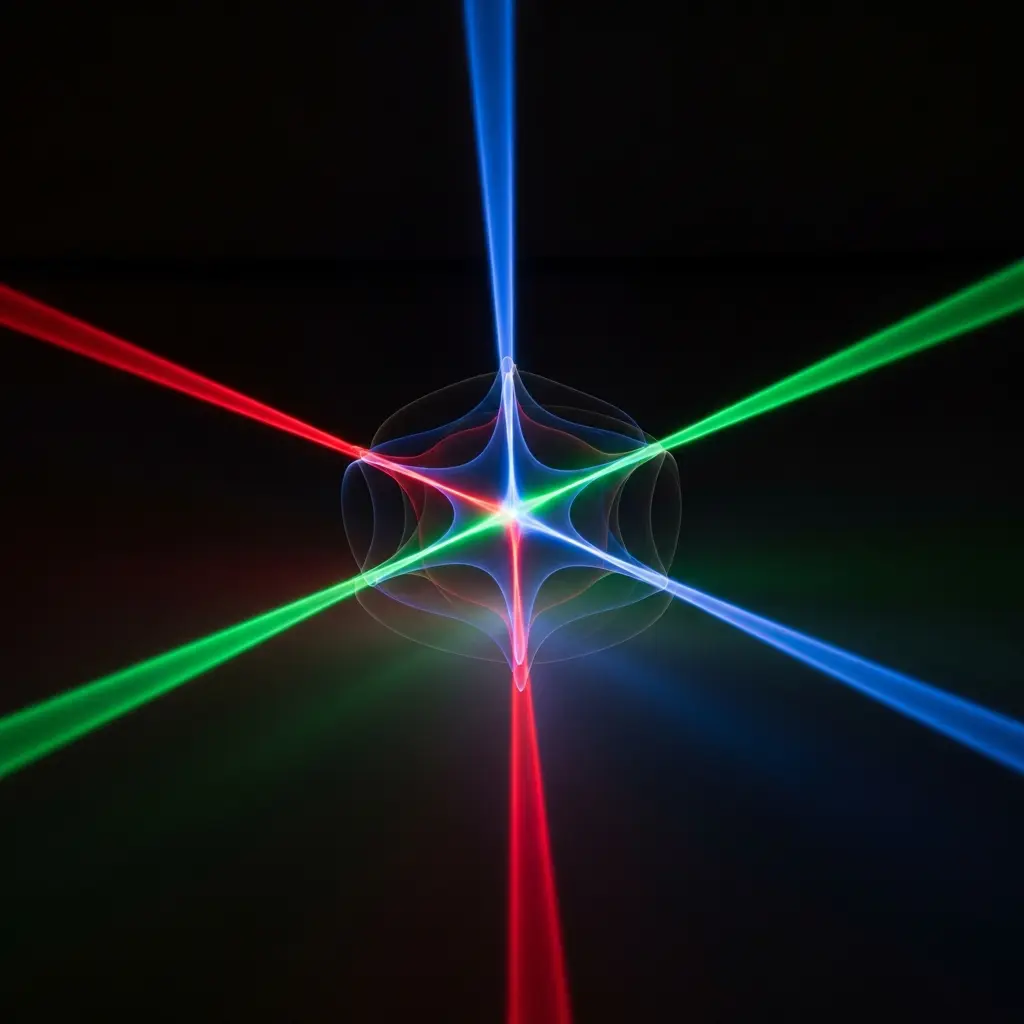
Researchers are increasingly focused on understanding and utilising multi-photon interference, a crucial step towards advanced quantum technologies. Nilakshi Senapati from the Department of Physics, Indian Institute of Technology Kanpur, Girish Kulkarni working with colleagues at the Department of Physics, Indian Institute of Technology Ropar, and Anand K. Jha from the Department of Physics, Indian Institute of Technology Kanpur, have developed a comprehensive theory describing temporal three-photon interference. Their collaborative work simplifies the characterisation of this complex phenomenon, demonstrating that despite involving eight length parameters in typical setups utilising cascaded or third-order parametric down-conversion, interference patterns are governed by only three independent values. This reduction in complexity, and the identification of novel three-photon effects analogous to the well-known Hong-Ou-Mandel effect, provides a vital theoretical foundation for current and future experiments and may unlock new possibilities for exploiting multi-particle correlations.
Scientists have unlocked a deeper understanding of how light interacts with itself, moving beyond the well-established behaviour of single and paired photons. This work clarifies the complex interplay when three photons meet, revealing a surprising level of control over their interference and potentially opening new avenues for advanced optical technologies and quantum computing applications.
Establishing the Theoretical Basis for Three-Photon Interactions
Establishing the Theoretical Framework for Three-Photon Interactions
Researchers have established a new theoretical framework for understanding how multiple photons interact, building upon established principles for single and two-photon interference and extending them to more complex systems. They formulated three-photon interference based on the concept of “each three-photon interfering only with itself,” mirroring Dirac’s famous dictum for single photons and its extension to two-photon systems.
Although a typical experimental setup involves eight length parameters, the team demonstrated that the interference pattern is fully defined by just three independent parameters: the three-photon path-length difference and two measures of path-asymmetry length. Unlike two-photon interference which requires only one parameter to quantify path asymmetry, three-photon interference necessitates two independent parameters.
This difference expands the range of possible nonclassical effects, including variations of the Hong-Ou-Mandel effect adapted for three photons. Existing and future experiments exploring three-particle entanglement now have a solid theoretical foundation, potentially leading to new quantum protocols and a pathway to better control and utilise the complex correlations inherent in multi-particle quantum systems.
Applications in Quantum Information Processing and Imaging
Potential for Quantum Information Processing and Imaging
Once considered a theoretical curiosity, multi-photon interference is becoming increasingly important for quantum information processing and quantum imaging. Extending current methods for generating entangled photon pairs, such as parametric down-conversion (PDC), to three or more photons presents significant challenges, and this research provides a crucial step towards harnessing the unique properties of these entangled states.
The team’s approach simplifies the analysis of complex interference patterns, reducing eight initial parameters to a manageable set of three. This reduction reveals a broader class of nonclassical effects, suggesting new possibilities for manipulating and detecting quantum states, potentially leading to more sensitive quantum sensors or more secure quantum communication protocols.
Conceptual Basis for Future Experimental Design and Quantum Protocols
Beyond the mathematical framework, the work provides a conceptual basis for interpreting experimental results and designing future experiments aimed at exploring the intricacies of three-particle entanglement. The research offers a theoretical foundation for exploring the rich correlations associated with three-particle entanglement and potentially enabling the development of novel protocols for harnessing those correlations.
Experimental Setup: Cascaded Parametric Down-Conversion Methods
Three-photon interference via cascaded and third-order parametric down-conversion setups
Figures 2(a) and 3(a) illustrate typical three-photon interference setups utilising three-photon states generated from cascaded parametric down-conversion (CPDC) and third-order parametric down-conversion (TOPDC) respectively. These arrangements employ single-photon detectors, Da, Db, and Dc, to register photons a, b, and c, with the subscripts denoting each specific photon.
The research assumes perfect spatial coherence and focuses on polarization-independent, temporal three-photon interference effects. Path diagrams detailing the various photon routes are presented in Figures 2(b) and 3(b), where ‘l’ signifies the optical path length travelled by a photon and ‘φ’ represents phases beyond the dynamical phase, such as those from reflections or geometric effects.
Consequently, la1 denotes the optical path length of photon-a in the first alternative pathway. Time taken for a photon to reach a detector is represented by τ = l/c, so τa1 indicates the travel time for photon-a reaching detector Da in alternative 1. Although sixteen potential interference pathways exist within the setups, a narrow detection time window during three-fold coincidence detection ensures only two alternatives remain relevant.
The work highlights that each of the eight length parameters within these setups is independently adjustable, allowing these prototypical arrangements to model any specific experimental realisation of three-photon interference. Despite the apparent complexity, interference can be fully characterised using only three independent parameters: the three-photon path-length difference, analogous to one- and two-photon cases, alongside two parameters quantifying path-asymmetry length.
This reduction in necessary parameters enables a broader range of nonclassical three-photon effects, including those resembling Hong-Ou-Mandel (HOM) interference. By formulating three-photon interference in terms of each photon interfering only with itself, the study provides a theoretical foundation for current and future experiments.
Three independent parameters fully characterise three-photon interference and asymmetry
Researchers demonstrated that three-photon interference can be fully described using only three independent parameters. This simplification represents a significant advance in understanding how multiple photons interact. Unlike two-photon interference, which requires a single parameter to quantify path asymmetry, analysing three-photon interference necessitates two independent parameters to achieve a complete characterisation of path asymmetry.
This distinction unlocks a wider range of nonclassical three-photon effects, including variations of the Hong-Ou-Mandel effect extended to three photons. The core of this work lies in establishing a framework where each three-photon state interferes only with itself, allowing for a clear separation of variables within the complex interference patterns.
Specifically, the research identifies a three-photon path-length difference, mirroring its one- and two-photon counterparts, alongside two path-asymmetry lengths that uniquely define the three-photon system. By isolating these parameters, scientists can predict and control the behaviour of entangled three-photon states with greater precision. A generalised two-alternative three-photon interference setup involves eight distinct length parameters, but the study proves these can be reduced to the three identified independent values.
This reduction in complexity is not merely mathematical convenience; it directly impacts the potential for future experiments. Researchers can now focus on manipulating these three key parameters to explore the rich correlations inherent in three-particle entanglement. The implications extend beyond fundamental quantum mechanics, promising to enable the development of novel protocols for utilising these complex correlations.
For instance, the ability to precisely control three-photon interference could lead to advancements in quantum computing and quantum communication technologies. The research provides a foundation for both current and future investigations into multi-particle quantum phenomena.
Characterising asymmetry in three-photon quantum interference
Scientists are beginning to untangle the complexities of three-photon interference, a field poised to expand the boundaries of quantum optics and potentially reshape technologies reliant on subtle light interactions. Demonstrating interference with more than two photons proved exceptionally difficult, largely because the number of variables to control increases dramatically with each added particle.
Previous work focused on establishing the basic phenomenon; now, researchers are refining the tools to characterise and predict these interactions with precision. This latest work doesn’t offer a spectacular new effect, but rather a streamlined method for understanding the underlying parameters governing three-photon behaviour. Simplifying the description of three-photon interference is no small feat.
Unlike its two-photon counterpart, which requires only one measure of path asymmetry, this research reveals that fully describing three-photon interference demands two independent parameters. This seemingly small increase unlocks a wider range of non-classical effects, including variations on the familiar two-photon Hong-Ou-Mandel effect, hinting at richer correlations between photons.
Now that a clearer theoretical framework exists, experimentalists can focus on probing these correlations more effectively. Challenges remain before these findings translate into practical applications. While the theoretical model elegantly reduces the complexity, building and maintaining the precise optical setups needed to generate and measure three-photon interference is technically demanding.
The fragility of quantum states means that maintaining coherence long enough to observe these effects requires exceptional isolation from environmental noise. These experiments remain largely confined to laboratory settings, but the potential rewards are considerable. Once these hurdles are overcome, the implications could extend to areas like quantum computing and secure communication.
By manipulating the correlations between multiple photons, it may be possible to create more powerful quantum algorithms or develop encryption methods that are impervious to eavesdropping. Further research will likely explore different methods for generating three-photon entanglement and investigate whether these principles can be extended to even larger numbers of photons, opening up entirely new avenues for quantum information processing.
🗞 Theory of temporal three-photon interference
🧠 ArXiv: https://arxiv.org/abs/2602.15573


See today’s quantum computing news on Quantum Zeitgeist for the latest breakthroughs in qubits, hardware, algorithms, and industry deals.



