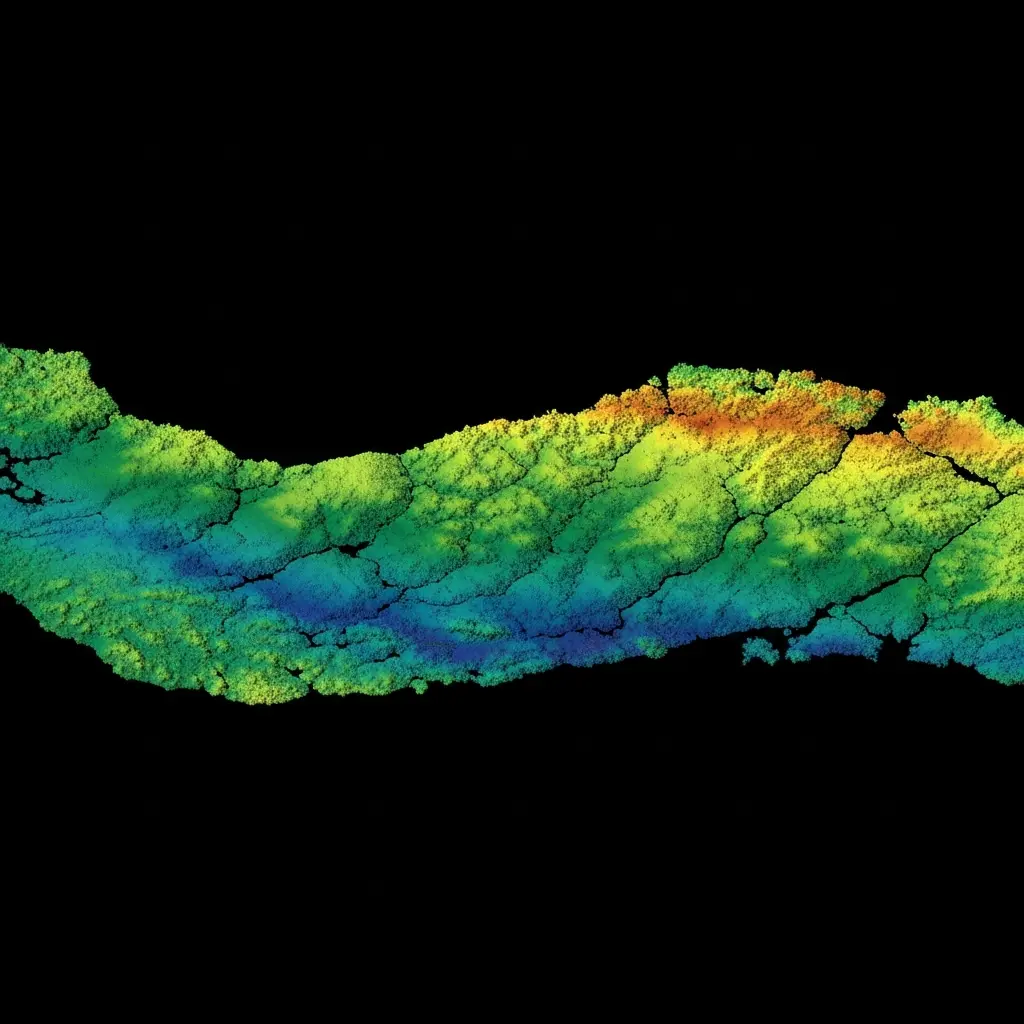
Scientists are tackling the challenge of creating accurate, wall-to-wall maps of global biomass using data from NASA’s GEDI mission, a task demanding effective interpolation of sparse LiDAR observations. Robin Young and Srinivasan Keshav, both from the Department of Computer Science and Technology at the University of Cambridge, alongside their colleagues, reveal that standard machine learning methods often fail to provide well-calibrated uncertainty estimates when predicting biomass across diverse terrains. Their research identifies a critical flaw in existing approaches , the confusion between different types of uncertainty and a neglect of local spatial context. To address this, the team introduces Attentive Neural Processes (ANPs), a novel probabilistic framework that dynamically adjusts uncertainty based on landscape complexity and leverages geospatial data, achieving competitive accuracy alongside near-ideal calibration across five biomes , from the Amazon to boreal forests. This work offers a scalable and theoretically sound alternative to traditional ensemble methods for large-scale Earth observation, paving the way for more reliable biomass estimates and improved environmental monitoring.
GEDI LiDAR and Biomass Uncertainty Calibration is crucial
This new study identifies that these failures stem from a fundamental flaw, confusing ensemble variance with true aleatoric uncertainty and overlooking the importance of local spatial context. Unlike traditional static ensembles, ANPs learn a flexible spatial covariance function, allowing uncertainty estimates to intelligently expand in complex landscapes and contract in more homogeneous areas. This adaptive Uncertainty quantification is a key innovation, providing a more realistic assessment of prediction reliability. Experiments show that ANPs not only provide accurate biomass estimations but also maintain a robust level of uncertainty even when extrapolating to new regions.
This was demonstrated through few-shot adaptation, where the model significantly recovered performance in cross-region transfer using only minimal local data. This capability is crucial for operational applications, reducing the need for extensive retraining when applying the model to previously unseen areas. This breakthrough reveals a pathway towards more reliable and informative biomass maps, essential for carbon accounting, climate change mitigation, and effective conservation planning. By explicitly modelling spatial relationships and incorporating foundation model embeddings, ANPs provide a context-aware uncertainty quantification that is absent in many existing methods. Researchers validated the ANP model across five diverse biomes, encompassing Tropical Amazonian forests, Boreal, and Alpine ecosystems, to assess its performance under varying environmental conditions. Experiments employed GEDI LiDAR data alongside multispectral and SAR remote sensing data, rigorously evaluating the ANP’s ability to estimate aboveground biomass with near-ideal probabilistic calibration. The team harnessed a few-shot adaptation strategy, demonstrating the model’s operational utility by recovering a substantial portion of the performance gap in cross-region transfer using minimal local data, a critical advancement for scalability. Specifically, the ANP model achieved competitive biomass estimation accuracy while simultaneously maintaining well-calibrated uncertainty estimates, unlike conventional tree-based ensembles. Experiments revealed that ANPs achieve a Log-space R2 of 0.747 ±0.043 on a held-out test set in Guaviare, Colombia, representing a significant advancement in predictive accuracy. Furthermore, the team measured a Log-space RMSE of 0.199 ±0.016, indicating a precise estimation of biomass levels. Results demonstrate that ANPs excel not only in predicting biomass but also in quantifying the uncertainty associated with those predictions. Measurements confirm a Z-score mean of 0.023 ±0.124 and a Z-score standard deviation of 0.997 ±0.099, values remarkably close to the ideal of 0.0 and 1.0 respectively, signifying well-calibrated uncertainty estimates.
This calibration is crucial for reliable decision-making in applications like carbon monitoring and conservation efforts. The study meticulously evaluated models using coverage statistics, finding that ANPs provide trustworthy prediction intervals, a key improvement over methods that conflate sampling variability with predictive uncertainty. The team further validated the ANP’s performance across five distinct biomes, Tropical Amazonian forests, Boreal, Alpine, and two separate tropical montane regions. Tests prove that ANPs maintain competitive accuracy while adapting uncertainty estimates to varying landscape complexities, expanding in complex areas and contracting in homogeneous regions. Specifically, in Guaviare, ANPs achieved a Linear-space RMSE of 50.56 ±5.36 Mg/ha and a Linear-space MAE of 27.33 ±3.44 Mg/ha, demonstrating practical relevance for real-world biomass assessments. Researchers recorded exceptional performance in cross-regional generalization, showcasing the model’s ability to transfer knowledge with minimal local data.
ANPs deliver accurate biomass and uncertainty
Crucially, the model exhibits strong performance even with limited local data, enabling effective adaptation to new regions with only a fraction of the usual training data. The authors acknowledge that while their method improves uncertainty quantification, validating prediction interval coverage on independent datasets remains an important area for future work. They also suggest extending the framework to handle categorical variables and exploring its application to other spatial environmental predictions, advocating for a broader shift towards rigorous uncertainty quantification in remote sensing. This work highlights a critical issue: commonly used methods often produce miscalibrated uncertainty estimates, potentially leading to unreliable results and flawed environmental decision-making. By demonstrating the feasibility of calibrated, context-aware uncertainty, the researchers offer both a practical method and a compelling argument for moving beyond simple ensemble variance and embracing more robust probabilistic spatial models. Reliable uncertainty quantification is vital for ensuring trustworthy information for biodiversity conservation, climate modelling, and sustainable livelihoods.
👉 More information
🗞 Calibrated Probabilistic Interpolation for GEDI Biomass
🧠 ArXiv: https://arxiv.org/abs/2601.16834