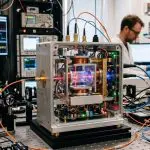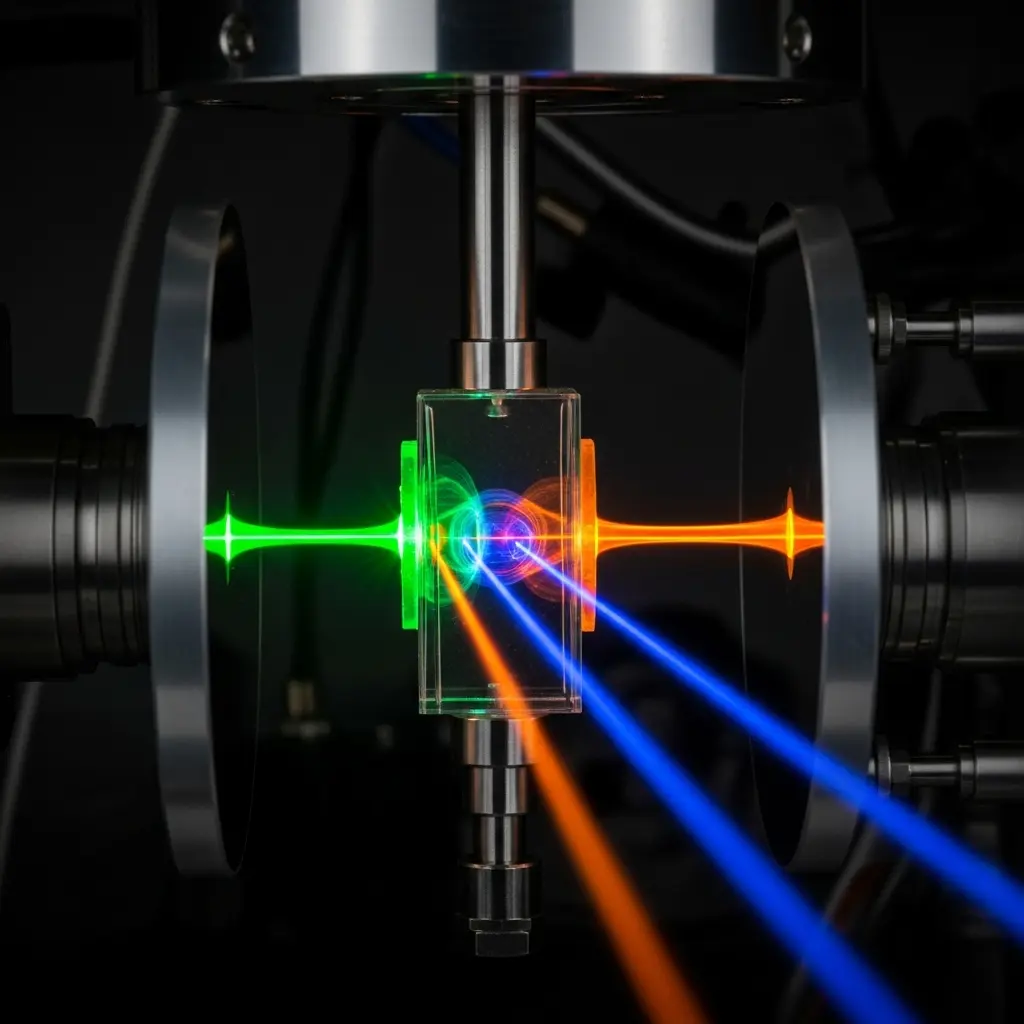
Scientists are unlocking new possibilities in integrated photonics by harnessing the power of microresonators and nonlinear optics. Ragheed Alhyder, Rishabh Sahu, and Johannes M Fink, all from the Institute of Science and Technology Austria (ISTA), alongside Mikhail Lemeshko and Georgios M Koutentakis, detail a novel analytic theory explaining how Kerr nonlinearity significantly amplifies three-wave mixing within electro-optic microresonators, even surpassing the limitations of conventional amplifiers. Their research, published today, demonstrates that ‘Kerr dressing’ effectively alters the interactions between light waves, reducing the threshold for amplification and opening doors to more efficient frequency conversion, lower-noise microwave photonics, and improved entanglement generation , a crucial step towards advanced quantum technologies.
The research establishes a fully analytic description of how Kerr nonlinearity can enhance χ(2) amplification, moving beyond the traditional view of Kerr effects as merely parasitic in electro-optic systems. By linearizing the standard χ(2), χ(3) microresonator Hamiltonian around the pumped mode, the team derived a dynamical matrix governing the fluctuations of the microwave mode and near-resonant optical sidebands. The study unveils that this Kerr-induced renormalization leads to an intensity-tunable landscape of gain thresholds, analytically tractable through the critical electro-optic cooperativity, Ccrit.
As the χ(3) interaction increases, approaching the Kerr amplification regime, the critical cooperativity, Ccrit, approaches zero, demonstrating that even modest cooperativity values (C 1) can achieve enhanced three-wave mixing when microwave coupling is applied to sidebands near the Kerr threshold. This finding is particularly significant as it suggests a pathway to overcome technical limitations currently hindering the pursuit of higher cooperativity values in microresonator devices. Furthermore, the work opens avenues for engineering three-wave mixing interactions that are stronger and more resonant than those achievable in purely χ(2) devices. Researchers defined an. Furthermore, the team investigated critical cooperativity, Ccrit, and critical microwave detuning, ζe,crit/κμ, as functions of optical detuning, ζμ/κμ, for varying Kerr shifts. By meticulously mapping these parameters, the study identified a minimum critical cooperativity and associated detuning, demonstrating how the Kerr nonlinearity can substantially reduce the required cooperativity for χ(2) amplification. This detailed analysis highlights that the combined χ(2), χ(3) dynamics isn’t merely a competition between nonlinearities, but a synergistic interaction that creates hybrid modes with frequencies and linewidths dependent on both pump power and Kerr strength.
Kerr dressing lowers amplification threshold in microresonators
Experiments focused on determining the critical cooperativity, Ccrit, and optimal detuning, ζe,crit, as functions of various parameters. The team discovered that Ccrit diverges at ζμ = g3|a0|2, indicating an impossibility of three-wave amplification at this point, while decreasing towards a finite asymptotic value on either side. Notably, the minimum of Ccrit remains below unity for all Kerr strengths, demonstrating that Kerr dressing enables χ(2) amplification in regimes where a bare χ(2) device would fail to reach the amplification threshold. Detailed analysis of critical values for optical and microwave detuning showed that amplification with Ccrit 1 occurs, with larger Kerr strengths correlating with smaller detunings, potentially simplifying experimental designs. The team observed that Kerr dressing reshapes the effective χ(2) amplifier in a non-monotonic manner; weak Kerr strength necessitates large detunings and strong cooperativity, while intermediate strength pulls one mode toward microwave resonance, significantly reducing Ccrit. To validate these findings, the scientists solved linearized quantum Langevin equations using experimentally motivated parameters. Results demonstrated that the sideband population ⟨a† +a+⟩ and microwave population ⟨b† +b+⟩ experience gain proportional to e2Re(λmax)t, matching analytical predictions. By diagonalizing the Kerr-induced optical block, the authors identify Kerr-dressed hybrid modes that modify the effective three-wave coupling and detuning, enabling amplification at lower cooperativities than in pure χ(2) cases. This work provides a design map for optimizing such hybrid nonlinear devices. The significance of these findings lies in their potential to improve frequency conversion, low-noise microwave photonics, and entanglement generation applications.
The authors acknowledge that the current study focuses on theoretical predictions, which need experimental validation. While the work opens several promising avenues for future research, it is important to note that the authors highlight some limitations. Specifically, they emphasize the need for experimental verification of their theoretical predictions and suggest that further investigation into the practical implementation in real-world devices would be beneficial.
👉 More information
🗞 Kerr-enhanced amplification of three-wave mixing and emergent masing regimes
🧠 ArXiv: https://arxiv.org/abs/2601.14726



See today’s quantum computing news on Quantum Zeitgeist for the latest breakthroughs in qubits, hardware, algorithms, and industry deals.