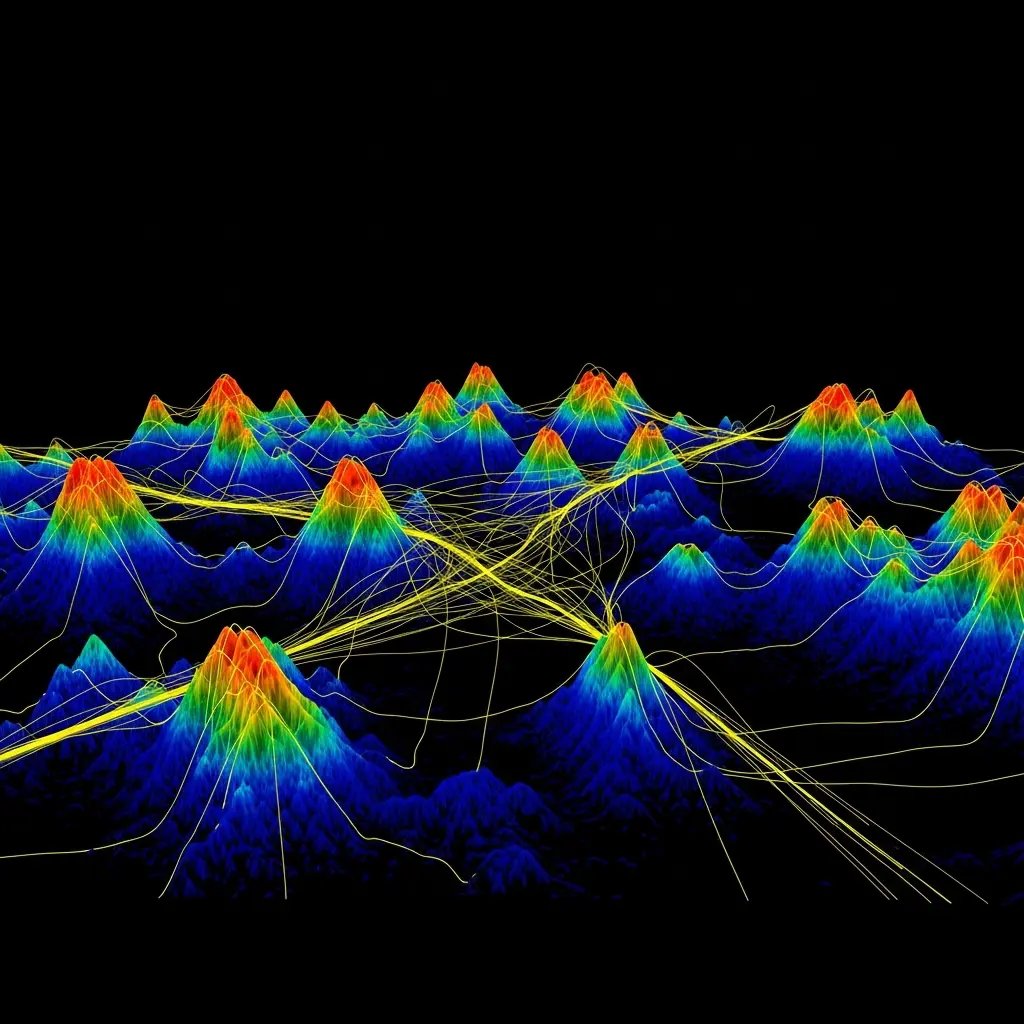
The behaviour of electrons in disordered materials presents a long-standing challenge in condensed matter physics, and understanding how they conduct electricity is crucial for developing advanced materials. Gabriel Hayoun, Ilya A. Gruzberg, and Marcel Filoche, from Institut Langevin and The Ohio State University, have advanced this understanding with a new theoretical framework that refines the established Mott-Berezinskiĭ theory of electrical conductivity. Their work moves beyond traditional assumptions of uniform electron localisation, instead modelling transport through a landscape that reflects the complex spatial arrangement and energy-dependent behaviour of electrons within the material. This innovative approach, which utilises a geometric criterion derived from the disorder landscape, provides a more accurate and unified description of electrical conduction in a wide range of complex materials, even those approaching the point where electrons become completely immobile, and significantly broadens the applicability of the Mott-Berezinskiĭ theory.
We introduce a conceptual reformulation of the Mott, Berezinskiĭ theory of low-frequency AC conductivity in disordered systems, based on localization landscape theory. Instead of assuming uniform localization and fixed hopping distances, transport describes itself through an effective potential, whose geometry encodes the spatial organization and energy-dependent localization of quantum states. Using the associated Agmon metric, we define a generalized Mott scale that replaces.
Disorder, Localization, and Conductivity Measurements
This research investigates disordered systems, materials where the atomic structure is random, and how this randomness affects electron behavior. A key phenomenon is Anderson localization, where electrons become trapped in specific regions, suppressing conductivity. The team focuses on Mott variable range hopping, a conduction mechanism where electrons hop between localized states, and the Urbach tail, an exponential decay of states near the band edge that signifies localization. By examining AC conductivity, the material’s response to alternating current, scientists gain insight into localized states and hopping mechanisms.
The research builds on Localization Landscape Theory, a framework that describes the complex energy landscape of localized states and predicts material properties using concepts from random matrix and percolation theory. Central to this work is the Agmon distance, a measure of connectivity between localized states; a smaller Agmon distance indicates stronger connectivity and potentially higher conductivity. The Agmon metric defines a localization landscape where regions of low Agmon distance represent pathways for electron transport. The team refined the understanding of AC conductivity in disordered systems, particularly in non-metallic regimes, arguing that the standard Mott-Berezinskii law breaks down in certain conditions.
They emphasize the importance of understanding correlations between electron wavefunctions, using mathematical tools like functional determinants to calculate these correlations. The Agmon metric influences the connectivity of localized states and, consequently, the AC conductivity, providing a geometric picture of transport pathways. They derived more accurate estimates for AC conductivity, incorporating wavefunction correlations and the Agmon metric, and connected the Anderson localization transition to a percolation transition in the Agmon distance landscape. The research proposes a model where transport properties depend on the specific realization of disorder, offering more accurate modeling of disordered materials and potentially improving the design of devices like thin-film transistors and solar cells.
This work contributes to our fundamental understanding of localization, transport, and the interplay between disorder and quantum mechanics, showcasing the application of advanced mathematical techniques to condensed matter physics and highlighting a connection to random matrix theory. Key takeaways include the importance of Agmon distance as a geometric property governing localized state connectivity, the crucial role of wavefunction correlations in predicting AC conductivity, and the limitations of the Mott-Berezinskii law. This research presents a sophisticated theoretical approach to understanding electron transport in disordered materials, emphasizing geometric properties and wavefunction correlations, offering a more nuanced picture than traditional models with implications for both fundamental physics and materials science.
Disorder and the Generalized Mott Scale
Scientists have developed a new theoretical framework for understanding electrical conductivity in disordered materials, building upon the established Mott-Berezinskiĭ theory. This work introduces a conceptual reformulation based on localization landscape theory, moving beyond the assumption of uniform localization and fixed hopping distances between states. The team describes transport through an effective potential, where the geometry of this potential encodes the spatial arrangement and energy-dependent localization of electronic states, offering a more nuanced picture of conduction. The core of this breakthrough lies in a generalized Mott scale, which determines the criteria for electron hopping based on the disorder landscape rather than a simple hopping length.
This scale defines a lower bound on the Agmon distance, a geometric measure of separation between localized states, necessary for conduction at a given frequency. The team demonstrates that conduction occurs through resonant-assisted tunneling between localized states separated by approximately this distance, establishing a conduction network defined by these geometric connections. Measurements confirm that the position matrix element between states is proportional to the square of the Euclidean distance between localized state basins. By calculating the average distribution of Euclidean distances between states separated by the Agmon distance, scientists derived a generalized Mott formula for conductivity, incorporating the landscape-generalized Mott scale. This allows investigation of systems beyond the scope of the standard Mott formula, and under specific assumptions, recovers the established Mott formula as a limiting case, reinforcing the validity of the new framework and highlighting its potential to advance understanding of AC transport in complex materials.
Disorder Landscape Defines Electron Conductivity
This research presents a new framework for understanding low-frequency alternating current conductivity in disordered materials, building upon the established Mott-Berezinskiĭ theory. Rather than assuming uniform localization of electrons, the team developed a model based on localization landscape theory, which accounts for the complex spatial organization and energy-dependent localization of electron states. This innovative approach defines a generalized Mott scale, utilizing a geometric criterion derived from the disorder landscape to determine how electrons move through the material, effectively replacing the traditional concept of a fixed hopping length. The results demonstrate that this landscape-based method extends the applicability of the Mott-Berezinskiĭ theory to a wider range of disordered systems, including those with significant spatial variations and energies near the mobility edge, offering a more unified description of electrical conduction in complex materials. By considering the geometry of the potential energy landscape, the model accurately captures electron behavior even when localization lengths are not uniform or well-defined, addressing limitations present in earlier formulations. Future research will focus on relaxing the assumption of constant density of states to explore even more complex scenarios, potentially enabling the tailoring of material properties at the nanoscale and opening new avenues for materials design.
🗞 Localization-landscape generalized Mott-Berezinskiĭ formula
🧠 ArXiv: https://arxiv.org/abs/2512.23240




See today’s quantum computing news on Quantum Zeitgeist for the latest breakthroughs in qubits, hardware, algorithms, and industry deals.