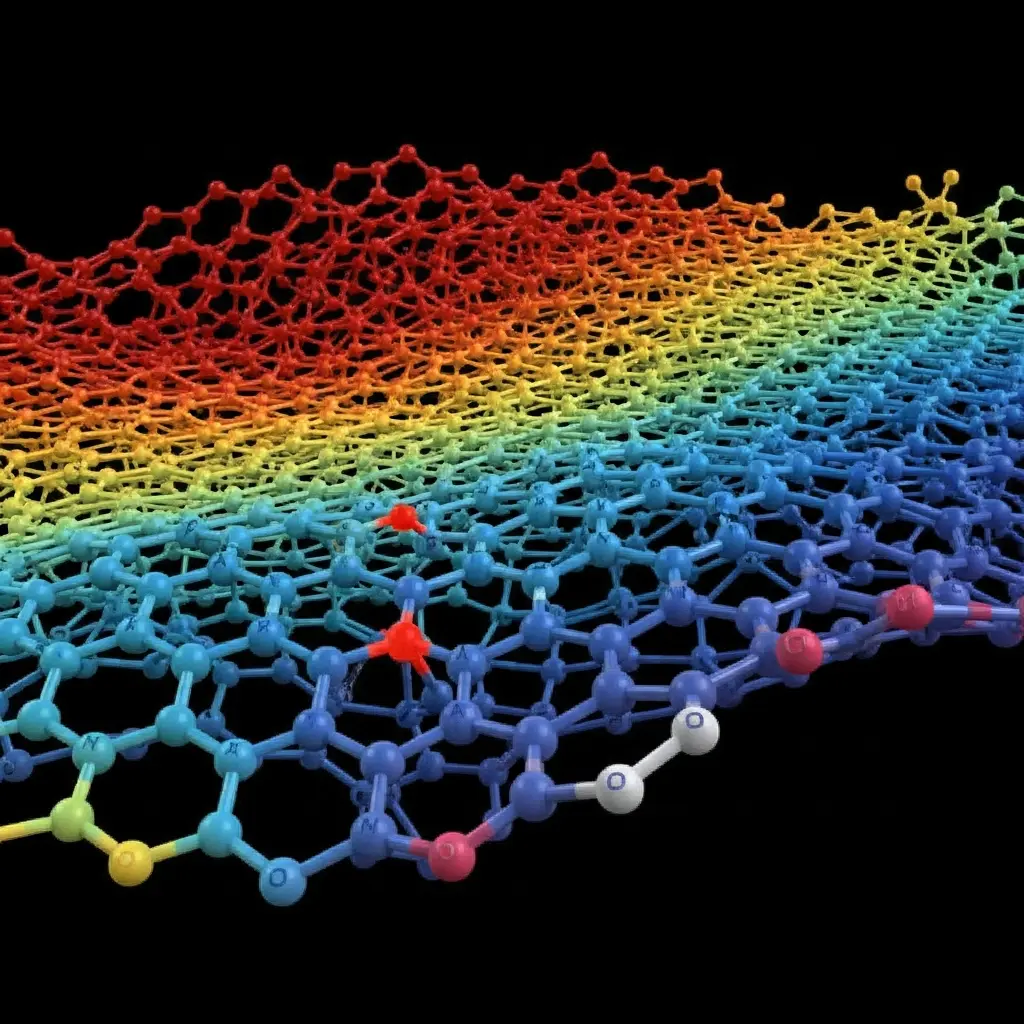
Graphene oxide, a material with remarkable potential in electronics and composites, presents a significant challenge for researchers seeking to understand how its complex chemical makeup affects its ability to conduct heat. Bohan Zhang, Biyuan Liu, and Penghua Ying, from their respective institutions, lead a team that now successfully connects the process of reducing graphene oxide to its thermal properties using advanced computational techniques. The researchers developed a novel machine learning potential, trained on precise quantum mechanical calculations, which allows them to simulate the behaviour of graphene oxide at a scale previously unattainable. This work reveals that reduced graphene oxide exhibits substantially lower thermal conductivity than its pristine form, and importantly, demonstrates a predictable relationship between its chemical structure and heat transfer, offering a powerful new framework for designing carbon materials with tailored thermal properties.
Reduction Chemistry Links to Heat Transport
Graphene oxide exhibits complex chemical properties that influence its structural, thermal, and mechanical behaviour, but quantitatively linking reduction chemistry to heat transport has proven difficult. This research investigates this relationship by combining controlled chemical reduction, Raman spectroscopy, and molecular dynamics simulations to characterise how graphene oxide’s structure and thermal properties evolve. The study demonstrates that systematically reducing oxygen-containing functional groups predictably increases thermal conductivity, providing a quantitative understanding of how reduction chemistry impacts heat transfer in these two-dimensional materials. Findings reveal that restoring sp2 carbon networks is the primary mechanism enhancing thermal conductivity during reduction, offering insights for tailoring the thermal properties of reduced graphene oxide for specific applications.
Neuroevolution Potentials for Molecular Dynamics Simulations
Researchers are employing machine learning interatomic potentials (MLIPs), particularly neuroevolution potentials (NEPs), to enable large-scale molecular dynamics (MD) simulations. These potentials are refined for accuracy against first-principles calculations and applied to study a range of materials, with a strong focus on carbon-based systems like graphene and graphene oxide. Investigations include thermal conductivity in pristine graphene, the effects of oxygen functionalization and reduction levels in graphene oxide, and thermal transport in various carbon allotropes. The team also explores 2D materials beyond carbon, such as MoS2 and h-BN, and has developed accurate models for water’s thermal and thermodynamic properties.
A key focus is understanding thermal conductivity in disordered materials, including amorphous silicon and graphene oxide, which present challenges for traditional modelling techniques. Researchers are decomposing thermal conductivity into contributions from different vibrational modes and analysing phonon mean free paths to reveal the mechanisms governing heat transfer. This work extends to applications such as thermal management, flexible electronics, and energy storage, with investigations into anisotropic thermal transport and temperature-dependent behaviour.
Neuroevolution Accurately Models Graphene Oxide Dynamics
Scientists have created a new computational method, a neuroevolution potential (NEP), to accurately and efficiently model the thermal reduction of graphene oxide. This advancement enables large-scale molecular dynamics simulations, overcoming limitations of previous computational approaches and providing a means to understand heat transport within this complex material. The NEP model, trained on density functional theory data, demonstrates strong agreement with high-fidelity calculations and achieves substantial gains in computational speed compared to existing methods. Simulations reveal that reduced graphene oxide exhibits suppressed thermal conductivities, ranging from a few to tens of watts per meter-kelvin, significantly lower than pristine graphene.
The team found that thermal conductivity moderately increases with increasing hydroxyl content, but reverses at the highest oxidation level. Analysis of gaseous byproducts during thermal reduction identified the production of water, carbon dioxide, and carbon monoxide, providing insight into the material’s structural evolution. These results provide a computationally tractable framework for exploring the relationship between chemical structure and heat transport in heterogeneous carbon materials.
Graphene Oxide Reduction Pathways and Heat Transfer
This research establishes a computational framework for understanding how chemical changes affect heat transfer in graphene oxide, a material with potential in thermal management. Scientists developed a highly efficient model, trained using fundamental calculations, that accurately simulates the thermal reduction of graphene oxide at a scale previously unattainable. Simulations reveal that the thermal conductivity of reduced graphene oxide is strongly influenced by the specific chemical composition of the starting material, not just the overall oxidation level. The team discovered two key pathways governing structural evolution during reduction, one promoting lattice recovery and enhanced heat transfer with increasing hydroxyl content, and another leading to defect formation and suppressed conductivity with increasing oxygen content.
Quantum effects were found to reduce thermal conductivity by suppressing high-frequency vibrations, resulting in values ranging from 1.28 to 13.71 watts per meter-kelvin. While lower than pristine graphene, these values suggest reduced graphene oxide holds promise for thermoelectric applications where minimizing heat conduction is beneficial.
🗞 Thermal conductivities of monolayer graphene oxide from machine learning molecular dynamics simulations
🧠 ArXiv: https://arxiv.org/abs/2512.21490
See today’s quantum computing news on Quantum Zeitgeist for the latest breakthroughs in qubits, hardware, algorithms, and industry deals.