
Black holes present a fundamental challenge to physics, as their evaporation via Hawking radiation appears to destroy information, violating a cornerstone of quantum mechanics, a problem known as the information paradox. Sobhan Kazempour, Sichun Sun, and Chengye Yu from the Beijing Institute of Technology investigate this paradox within the framework of asymptotically safe quantum gravity, a theoretical approach aiming to reconcile quantum mechanics with general relativity. Their work examines the thermodynamic behaviour of black holes, calculating properties like temperature and entropy, and introduces the concept of “entanglement islands” to account for the missing information. The team demonstrates that incorporating these islands leads to a finite amount of radiation entropy, resolving the paradox and confirming that information is ultimately preserved, a crucial step towards a complete understanding of black hole physics and the universe itself. This research also pinpoints the timescale for this information recovery, offering new insights into the dynamics of quantum gravity and the nature of spacetime.
Researchers from the Beijing Institute of Technology investigate this paradox within asymptotically safe quantum gravity, a theoretical approach aiming to reconcile quantum mechanics with general relativity.
Their work examines the thermodynamic behaviour of black holes, calculating properties like temperature and entropy, and introduces the concept of “entanglement islands” to account for the missing information. The team demonstrates that incorporating these islands leads to a finite amount of radiation entropy, resolving the paradox and confirming that information is ultimately preserved, a crucial step towards a complete understanding of black hole physics and the universe itself. This research also pinpoints the timescale for this information recovery, offering new insights into the dynamics of quantum gravity and the nature of spacetime.
Black Hole Phase Transition and Event Horizon Radius
Scientists have achieved a detailed thermodynamic analysis of black holes within the framework of asymptotically safe gravity, revealing crucial insights into their behavior and ultimate fate. The work establishes a precise relationship between a black hole’s mass and its event horizon radius, demonstrating that as mass and a parameter denoted as S0 increase, the event horizon also expands. Importantly, the team discovered that for values of S0 below a critical threshold, the radius scales linearly with mass, closely resembling the behavior of Schwarzschild black holes.
Experiments revealed a distinct phase transition as S0 approaches this critical value, with the event horizon expanding rapidly before transitioning to a different type of black hole solution. The research establishes a minimum mass, below which no event horizon forms, indicating the existence of stable remnants and resolving the information paradox associated with Hawking radiation. Measurements confirm that radiation entropy saturates at the Bekenstein-Hawking entropy, supporting the principle of unitary evolution.
The team derived the Page time and scrambling time by equating early- and late-time entropies, further solidifying this conclusion. The team measured the Hawking temperature, finding it dependent on both black hole mass and the S0 parameter. Results demonstrate a thermal gradient inconsistent with classical predictions, where lower mass black holes typically exhibit higher temperatures. The study pinpoints a discontinuity in temperature at a critical S0, signifying a first-order phase transition between black hole types, and indicating a thermodynamic instability as evaporation proceeds.
The derived relationship between mass and horizon radius allows for the calculation of heat capacity and provides a comprehensive thermodynamic description of these quantum gravity black holes. This breakthrough delivers a consistent framework for understanding black hole evaporation and offers a potential solution to the problem of curvature singularities.
Asymptotically Safe Black Holes Avoid Evaporation
This research investigates the thermodynamic properties of black holes within the framework of asymptotically safe quantum gravity, yielding significant insights into their behavior and the resolution of long-standing paradoxes. The team analyzed key characteristics like temperature, heat capacity, and entropy, revealing that the temperature of these black holes decreases as mass increases near the point of evaporation, suggesting a potential phase transition and the possibility of stable remnants. This finding represents a departure from established understanding and opens new avenues for exploring the ultimate fate of black holes.
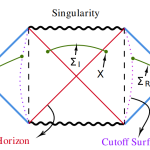
Crucially, the study addresses the information paradox associated with Hawking radiation. By incorporating the concept of quantum entanglement through “island” contributions, the researchers demonstrate that the entropy of Hawking radiation saturates at the Bekenstein-Hawking value, supporting the principle of unitary evolution, the preservation of quantum information. They further determined the Page time and scrambling time, which quantify the rate at which information is processed and released from the black hole, by comparing early and late-time entropy values.
👉 More information
🗞 Entanglement Islands and Thermodynamics of the Black Hole in Asymptotically Safe Quantum Gravity
🧠 ArXiv: https://arxiv.org/abs/2512.21995



See today’s quantum computing news on Quantum Zeitgeist for the latest breakthroughs in qubits, hardware, algorithms, and industry deals.