
The Bell Labs mathematician whose 1994 algorithm proved a quantum computer could break the world’s encryption, then invented the error correction that could make such a machine real.
For about fifteen years quantum computing was a beautiful idea that almost nobody outside a few physics departments took seriously. Then, in 1994, a quiet mathematician at Bell Labs named Peter Shor found something that changed the conversation overnight, an algorithm showing that a quantum computer could crack the codes protecting the world’s communications. Suddenly the field was not a curiosity but a question of national security.
This is the story of Peter Shor and the discovery that made everyone pay attention. It runs from the elegant mathematics of his factoring algorithm, through the encryption it threatens, to a second contribution that may matter even more in the long run. Few single results have ever moved a field as quickly as his did.
The mathematician who alarmed the internet
Peter Shor was born in 1959 and trained as a mathematician, earning his doctorate at the Massachusetts Institute of Technology before joining the famous Bell Laboratories, the research powerhouse that had already produced the transistor and information theory. He worked on the mathematics of algorithms and probability, the kind of deep and unshowy work that rarely makes headlines. That changed completely in 1994.
Drawing on earlier hints that quantum computers might be unusually good at certain problems, Shor turned his attention to factoring, the task of breaking a whole number into its prime components. What he produced was not a vague suggestion but a complete and rigorous algorithm, and its implications were immediately obvious to anyone who understood how modern cryptography works. The reaction was electric.
The setting mattered as much as the man. Bell Labs in that era still prized deep theoretical work with no immediate application, exactly the environment in which such a result could be pursued. It was the kind of place where a mathematician could spend months chasing an idea that turned out to unsettle an entire industry.
What Shor’s algorithm actually does
At its core the algorithm solves a problem that has frustrated mathematicians for centuries, finding the prime factors of a very large number quickly. Multiplying two big primes together is easy, but working backwards from the product to recover the primes is so slow on ordinary computers that it is considered effectively impossible for numbers of a few hundred digits. Shor found a way for a quantum computer to do it efficiently.
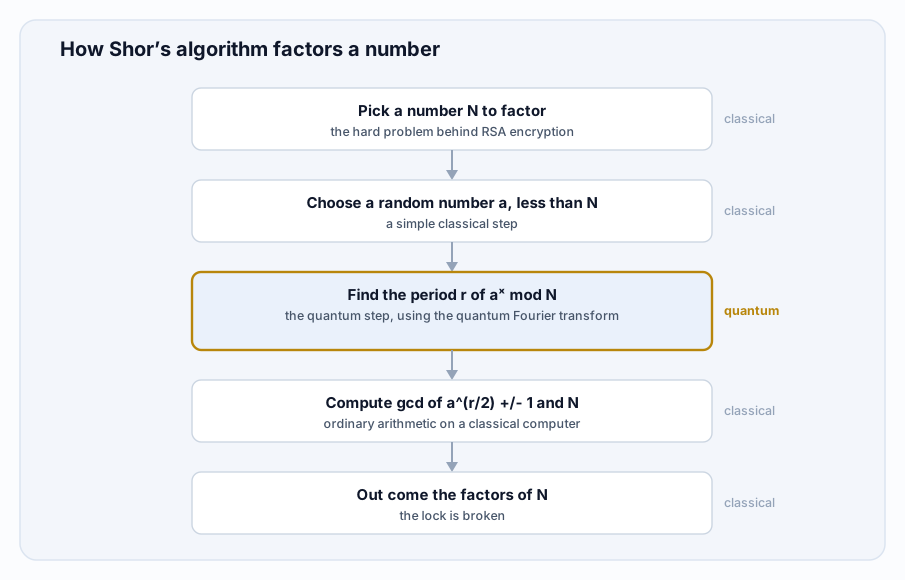
The trick is to convert factoring into a question about periodicity, the repeating pattern of a related mathematical sequence, which a quantum computer can uncover using an operation called the quantum Fourier transform. The diagram below traces the steps, with only the period-finding stage requiring a quantum machine and the rest running on an ordinary computer. It is a beautiful blend of classical and quantum reasoning.
Why factoring breaks encryption
The reason the result caused such alarm lies in how the internet keeps secrets. Much of modern encryption, including the widely used RSA system, rests on the assumption that factoring large numbers is hopelessly slow, so the security of online banking, messaging and commerce depends on a problem nobody can solve quickly. Shor’s algorithm dissolves that assumption at a stroke.
A large enough quantum computer running the algorithm could in principle read communications that are secure against any classical attack. No such machine exists yet, and building one remains a formidable challenge, but the mere possibility was enough to reshape the field. Shor’s work turned a theoretical gadget into a long-term threat that governments and companies could not ignore.
The discovery that made quantum computing matter
Before 1994 a quantum computer was a fascinating thought experiment with no obvious purpose, the kind of thing that attracted brilliant minds but little funding. Shor gave the field its first killer application, a concrete and consequential task that only a quantum machine could perform. Almost overnight the subject acquired urgency and money.
Research groups multiplied, governments launched programmes, and the long effort to build real quantum hardware began in earnest, all traceable in part to a single paper. It is the clearest example in the field of how one result can transform a discipline’s fortunes. The race that now involves companies and nations around the world was set off by his discovery.
The shift was cultural as much as financial. A generation of talented students who might have gone into other fields suddenly had a concrete reason to study quantum information and a sense of working on something that mattered. Reputations, careers and whole laboratories were built in the wake of that one paper.
Shor’s other gift, quantum error correction
The factoring algorithm made Shor famous, but among specialists his second great contribution may be even more important. In 1995 he showed that the fragile information inside a quantum computer could be protected against errors, inventing the first quantum error-correcting code and proving that reliable quantum computation was possible in principle. Without that insight the whole enterprise might have looked hopeless.
Quantum information is notoriously delicate, easily destroyed by the slightest disturbance, and many doubted it could ever be tamed. By showing how to spread information across many physical pieces so that errors could be detected and undone, Shor removed the deepest objection to the field. Modern quantum error correction grows directly out of that 1995 breakthrough.
The legacy of Peter Shor
The most visible legacy of his factoring work is the global scramble to replace vulnerable encryption with new schemes designed to resist quantum attack, an effort now known as post-quantum cryptography. Standards bodies and companies are already deploying these defences, years before a machine capable of running the algorithm at scale is expected to exist. The threat he identified is being taken seriously well in advance.
Honoured with many of the highest awards in mathematics and computer science, Shor has the rare distinction of having changed a field twice, once by giving it a reason to exist and once by showing it could be made to work. His name will be attached to quantum computing for as long as the subject is studied. Both of his great ideas remain at the centre of the field he did so much to create.
Frequently asked questions
Who is Peter Shor?
What is Shor’s algorithm?
Why is Peter Shor important to quantum computing?
Has Shor’s algorithm broken encryption yet?
What is the Shor code?




See today’s quantum computing news on Quantum Zeitgeist for the latest breakthroughs in qubits, hardware, algorithms, and industry deals.