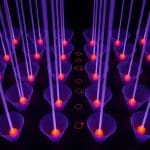
Researchers demonstrated an optical tweezer array capable of trapping 6,100 highly coherent atomic qubits. The array achieved imaging survival of 99.98952%—a record for this type of system—along with a coherence time of 12.6 seconds. These results suggest universal quantum computing and quantum error correction with thousands of qubits may be within reach.
Optical Tweezer Arrays Advance Quantum Computing
This new optical tweezer array demonstrates a significant leap in qubit count, trapping over 6,100 neutral atoms within nearly 12,000 potential sites. Room-temperature trapping for approximately 23 minutes further supports extended computation and enables record imaging performance. Achieving 99.98952% imaging survival and over 99.99% fidelity highlights the array’s stability and precision. These metrics are essential not only for quantum simulation and metrology, but also pave the way for building larger, more robust systems capable of quantum error correction.
6,100-Qubit Tweezer Array Realization with High Coherence
The array consists of 11,998 potential trapping sites, and utilizes far-off-resonant wavelengths within a room-temperature vacuum chamber to minimize atom loss. Demonstrated alongside this scale is a record hyperfine qubit coherence time of 12.6(1) seconds, crucial for maintaining quantum information during computations. The system achieves exceptional imaging performance with 99.98952(1)% survival and 99.99374(8)% fidelity, exceeding previous benchmarks for this technology. A 22.9(1)-minute trapping lifetime was also observed, providing ample time for complex operations.
6-Second Hyperfine Qubit Coherence Time Achieved
A key achievement of this research is the demonstration of a 12.6-second hyperfine qubit coherence time, setting a new record for optical tweezer arrays. This extended coherence is crucial because it allows for more complex quantum operations to be performed before the quantum information is lost. Maintaining coherence for this duration, while simultaneously controlling over 6,100 qubits, represents a significant step towards practical quantum technologies. The system also exhibited room-temperature trapping of atoms for approximately 23 minutes, leading to a 99.98952% imaging survival rate.
High imaging survival, combined with a fidelity exceeding 99.99%, is essential for accurately reading the state of each qubit without introducing errors. These metrics are particularly important as the number of qubits increases, supporting the potential for scalable quantum computing and error correction strategies.
Atoms anywhere in the storage zone can be transported with AODs to the interaction or readout zones in less than 500 μm.
Minute Room-Temperature Atomic Trapping Lifetimes
This extended trapping lifetime, significantly longer than previous room-temperature systems, enables high-fidelity imaging and supports complex quantum operations. The system demonstrated a record 99.98952% imaging survival rate, crucial for maintaining qubit information over time and allowing for scalable quantum experiments. This long coherence, combined with the extended trapping, is essential for implementing quantum error correction protocols, which require numerous physical qubits operating with minimal error. The ability to trap and control thousands of qubits at room temperature suggests universal quantum computing is a potentially achievable near-term goal.
98952% Single-Atom Imaging Survival Demonstrated
This level of preservation during observation is coupled with an imaging fidelity of 99.99374(8)%, exceeding previous results from smaller systems. The combination of high survival and fidelity is critical, enabling complex quantum operations with minimal loss of information from individual qubits. The system also maintains atoms in optical traps for approximately 22.9 minutes at room temperature—a significant improvement over typical tweezer array lifetimes. This extended trapping time, alongside the imaging results, establishes a foundation for performing lengthy and complex quantum computations. These metrics are especially important for developing quantum error correction, which requires maintaining qubit states over extended periods.
99% Imaging Fidelity in Large Tweezer Arrays
The demonstrated tweezer array achieves remarkably high fidelity in both imaging and atom retention. Specifically, the system exhibits an imaging survival rate of 99.98952%—meaning nearly every atom is correctly identified—paired with an imaging fidelity exceeding 99.99%. This level of precision is crucial as it minimizes errors during observation and manipulation of individual qubits within the large array. Maintaining this fidelity across over 6,100 qubits is significant for several applications. Long trapping lifetimes of approximately 23 minutes, combined with the high imaging metrics, provide ample time for complex quantum operations.
Zone-Based Quantum Computing Architecture Proposed
Researchers proposed a zone-based architecture for quantum computing utilizing an optical tweezer array containing 6,100 atomic qubits across nearly 12,000 sites. This system demonstrated coherence-preserving qubit transport and pick-up/drop-off operations, crucial for connecting computational zones. Interleaved randomized benchmarking characterized these operations, paving the way for scaling quantum computations across large areas. Imaging survival reached 99.98952%, with a fidelity exceeding 99.99%, critical metrics for realizing practical quantum error correction.
Coherence-Preserving Qubit Transport and Operations
Interleaved randomized benchmarking characterized these qubit movements across large spatial scales, proving reliable control and minimal decoherence during transport. The platform also showcases pick-up and drop-off operations necessary for building complex quantum circuits. Combined with a room-temperature trapping lifetime of approximately 23 minutes, the array supports extended manipulation of individual qubits. High imaging survival – measured at 99.98952(1)% – and fidelity exceeding 99.99% are vital for accurately reading qubit states throughout these processes.
Interleaved Randomized Benchmarking Characterization
Characterization of the qubit system involved interleaved randomized benchmarking, a technique used to assess gate fidelity. Demonstrating these operations at large scales is critical for implementing complex quantum algorithms and architectures. These results validate the potential for building scalable quantum systems based on neutral atoms.
Scalability Towards Thousands of Physical Qubits
Long trapping lifetimes, approximately 23 minutes at room temperature, coupled with high imaging survival of 99.98952(1)%, enable extended operations and precise observation of individual qubits. The ability to control and move these qubits across large spatial scales, verified through randomized benchmarking, is essential for advanced quantum architectures. This platform’s performance suggests the possibility of building universal quantum computers with thousands to tens of thousands of physical qubits in the near future. These advancements address a fundamental scalability challenge, specifically the need for numerous, high-fidelity qubits for effective quantum error correction.