The fundamental nature of gravity remains one of the most challenging problems in modern physics, and scientists are now applying the tools of quantum information theory to explore its deepest mysteries. Bruna Sahdo from the University of Vienna and the Austrian Academy of Sciences, along with Natália Salomé Móller from the Institute of Physics, Slovak Academy of Sciences, investigate how quantum phenomena like entanglement can shed light on the connection between gravity and quantum mechanics. Their work explores two promising avenues, examining whether gravity itself induces entanglement between massive objects and investigating the causal structure of spacetime for signs of non-classical behaviour. By employing these innovative quantum information methods, the researchers aim to provide indirect evidence for a quantum theory of gravity and deepen our understanding of the universe’s most pervasive force.
Their work explores whether gravity induces entanglement between massive objects and investigates the causal structure of spacetime for signs of non-classical behaviour, aiming to provide indirect evidence for a quantum theory of gravity and deepen our understanding of the universe’s most pervasive force.,.
Gravitationally Induced Entanglement and Quantum Inference
Scientists currently investigate the interface between quantum theory and gravity using tools from quantum information, seeking to determine whether gravity requires a quantum description, challenging alternatives like semiclassical gravity. This work builds upon fundamental concepts from quantum information theory, including the Mach-Zehnder interferometer and the Stern-Gerlach experiment, which establish the foundations for manipulating and measuring quantum states. Researchers employ qubits, quantum bits that leverage superposition and are governed by the no-cloning principle, to explore possibilities beyond classical information processing. The study pioneers an approach centered on gravitationally induced entanglement, a phenomenon designed to infer whether the gravitational field between massive bodies necessitates quantization.
Scientists theorize that if gravity is truly quantum, it should induce entanglement between particles, creating correlations that would not exist classically. To investigate this, researchers explore how gravity might modify quantum mechanics, potentially introducing noise associated with wave function collapse, and seek to detect these subtle changes through precise measurements of entangled states. Furthermore, the research investigates causal structures to provide indirect evidence of non-classical spacetime behavior. Scientists utilize quantum circuits, complex arrangements of qubits and quantum gates, to manipulate and analyze causal relationships, seeking deviations from classical expectations. This method allows them to probe the fundamental nature of spacetime and determine whether it exhibits quantum properties, potentially revealing a deeper connection between gravity and quantum mechanics. The overall aim is to characterize the quantum aspects of gravity and discern whether it should be treated as a quantum system or if it induces modifications to quantum theory itself.,.
Quantum Interference Probes Gravity’s Quantum Nature
Scientists are actively exploring the interface between quantum information and gravity, investigating whether gravity itself must be described by the principles of quantum mechanics. This work centers on adapting established tools from quantum information theory, such as interferometry and entanglement, to probe the fundamental nature of the gravitational field. Researchers are not attempting to formulate a complete theory of quantum gravity, but rather to infer whether a quantum description of gravity is even necessary. The team began by revisiting foundational experiments in quantum information, including the Mach-Zehnder interferometer.
Experiments with this device demonstrate wave-particle duality and interference effects, revealing that light behaves as both a wave and a particle. Specifically, when light traverses the interferometer with equal path lengths, detection occurs solely at one detector due to constructive interference. Altering the path length by half a wavelength reverses this effect, directing all light to the second detector, demonstrating a predictable and measurable shift in interference patterns. Further investigation focuses on entanglement, a uniquely quantum phenomenon where two or more particles become linked, sharing the same fate regardless of the distance separating them.
This work builds upon the established principle that entangled states cannot be perfectly copied due to the no-cloning theorem, a cornerstone of quantum security protocols. Researchers are now adapting these principles to explore gravitationally induced entanglement (GIE), proposing experiments to create entanglement between particles solely through their gravitational interaction. While concrete proposals for realizing GIE exist, interpreting the results to definitively prove quantum behavior remains a topic of intense debate. Beyond entanglement, scientists are also investigating indefinite causal order (ICO), a radical concept reconciling quantum theory and general relativity.
This work explores scenarios where the traditional past-to-future relationship between events breaks down, challenging our intuitive understanding of causality. Mathematical tools are being developed to describe these processes with ICO, potentially revealing situations where events do not have a fixed temporal order. This research represents a significant step towards understanding the deeper connections between quantum mechanics and the nature of spacetime.,.
Detecting Quantum Gravity Via Entanglement
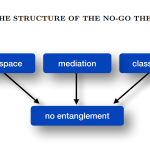
This research explores the interface between quantum information methods and the study of gravity, focusing on two key areas: gravitationally induced entanglement and causal structures. The work details how quantum information tools can be applied to investigate whether gravity requires a quantum description, challenging alternatives like semiclassical gravity. Specifically, the team proposes an experiment to detect gravitationally induced entanglement (GIE), which involves placing two massive systems in a superposition of positions using configurations similar to Mach-Zehnder interferometers. The proposed GIE experiment aims to determine if gravitational interaction can generate entanglement between particles, potentially revealing quantum properties of gravity if successful.
The researchers demonstrate that, if gravity mediates an interaction between the particles, it would manifest as a phase shift, altering the probabilities observed in the interferometers. By carefully controlling the experimental setup, including ensuring electrical neutrality and sufficient separation between the masses, the team believes it is possible to isolate the gravitational interaction and detect this entanglement. The authors acknowledge that the experiment relies on several assumptions, such as the interferometers having equal arm lengths and the gravitational interaction being dominant over other forces. Future work could focus on refining these assumptions and exploring the limits of the experimental setup. Nevertheless, this research represents a significant step towards using quantum information methods to probe the fundamental nature of gravity and potentially confirm its quantum properties.
👉 More information
🗞 Exploring the nature of gravity with quantum information methods
🧠 ArXiv: https://arxiv.org/abs/2512.20429

See today’s quantum computing news on Quantum Zeitgeist for the latest breakthroughs in qubits, hardware, algorithms, and industry deals.