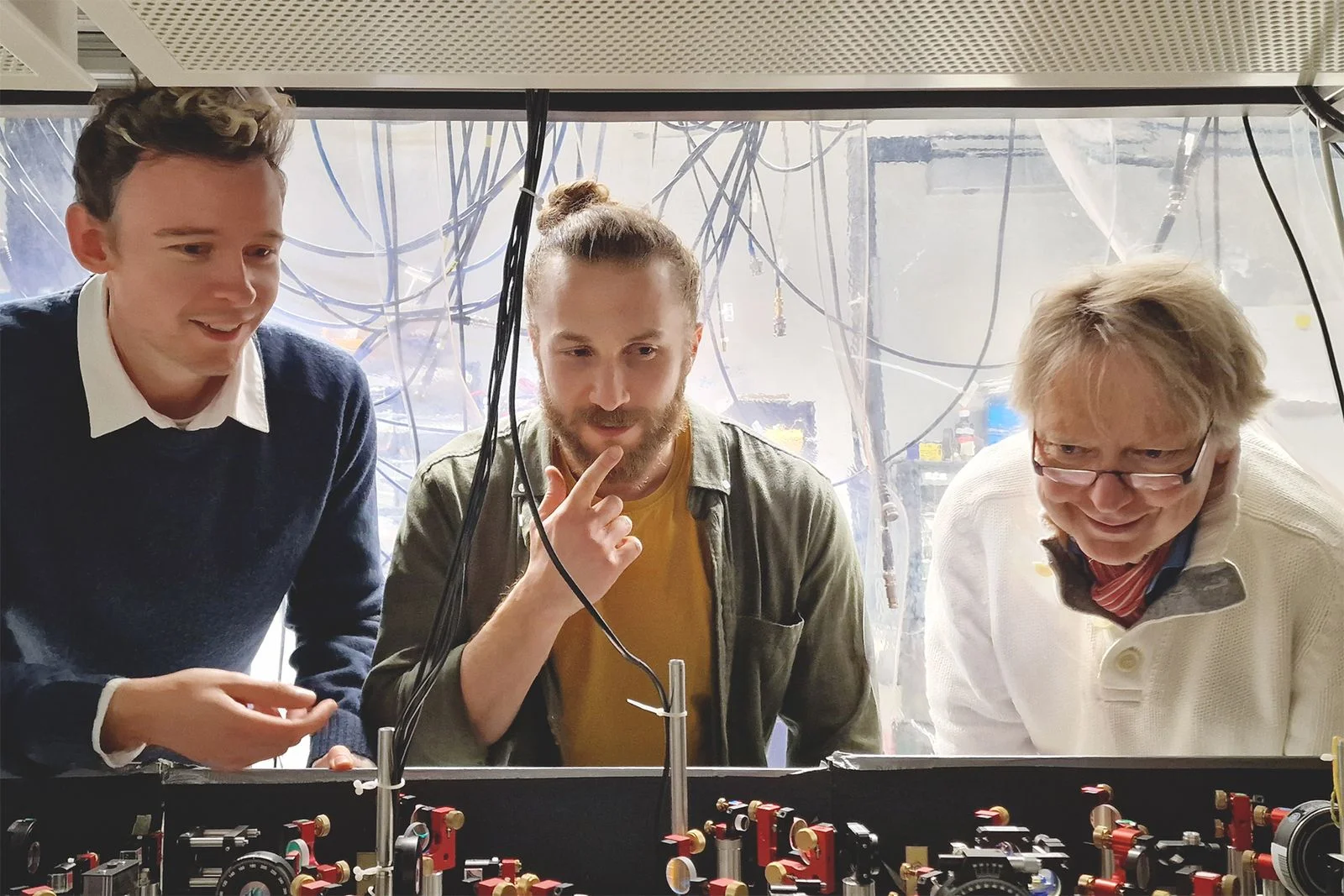
At TU Wien, Frederik Møller from the Atominstitut and colleagues have demonstrated a one-dimensional “quantum wire” comprised of an ultracold gas of thousands of rubidium atoms, exhibiting frictionless and lossless flow of mass and energy. This was achieved by confining the atoms to move along a single line using magnetic and optical fields, creating a system where diffusion is practically suppressed. The results, published in Science, reveal that despite countless collisions, the atomic current remains stable, defying typical dissipative transport and behaving like a perfect conductor, a phenomenon analogous to a Newton’s cradle where momentum is conserved and perpetually exchanged.
Quantum Gas Transport and Ballistic Movement
Researchers at TU Wien have created a one-dimensional “quantum wire” using thousands of rubidium atoms, observing a unique form of mass and energy transport. Unlike typical systems where collisions cause resistance and dissipation, this ultracold quantum gas exhibits nearly frictionless flow. The findings, published in Science, demonstrate that even with countless atomic interactions, quantities like mass and energy move with perfect efficiency, defying the behavior of ordinary matter. This controlled environment allows for investigation into the origins of resistance at the quantum level.
The observed transport resembles “ballistic transport,” where particles move freely, covering twice the distance in twice the time. This contrasts with “diffusive transport,” such as heat conduction, where energy sharing slows the process – requiring four times as long to cover twice the distance. By studying the “atomic current,” researchers confirmed that diffusion was “practically completely suppressed” in their system, indicating the gas behaves as a “perfect conductor.”
This unusual behavior is explained by comparing the atomic interactions to a Newton’s cradle. The atoms, confined to a single line, exchange momentum without scattering it, effectively passing energy from one atom to the next. This conservation of momentum prevents the gas from “thermalizing” – distributing energy as predicted by typical thermodynamics – and allows for sustained, undiminished flow of mass and energy, opening new avenues for understanding quantum-level resistance.
Suppression of Diffusion in Ultracold Atoms
Researchers at TU Wien have demonstrated suppressed diffusion in a one-dimensional “quantum wire” created from thousands of rubidium atoms. Unlike typical transport where collisions cause resistance, this ultracold atomic gas exhibits nearly frictionless flow of mass and energy. The findings, published in Science, reveal that even with countless collisions, the atomic current remains stable, a characteristic defying ordinary matter’s behavior and resembling ballistic transport where distance traveled is directly proportional to time.
This unusual behavior is explained by the atoms’ restricted movement along a single line, preventing momentum scattering. Collisions function as simple exchanges of momentum, similar to a Newton’s cradle, ensuring each atom’s momentum is conserved and passed on rather than lost. This restricted collision geometry results in a system where diffusion is “practically completely suppressed,” allowing energy and mass to flow freely without dissipation, behaving like a “perfect conductor.”
The suppression of diffusion prevents the atomic cloud from thermalizing, distributing energy according to typical thermodynamic laws. By measuring the “Drude weights,” researchers characterized this unique transport and found the gas maintained stable flow. Understanding transport under these perfectly controlled conditions could reveal how resistance emerges, or disappears, at the quantum level, offering insights into fundamental quantum phenomena.
The gas behaves like a perfect conductor; even though countless collisions occur between the atoms, quantities like mass and energy flow freely, without dissipating into the system.
Two Types of Transport Phenomena
Researchers at TU Wien have identified two distinct types of transport phenomena: ballistic and diffusive. Ballistic transport occurs when particles move freely, covering twice the distance in twice the time – similar to a bullet’s trajectory. Diffusive transport, exemplified by heat conduction, involves numerous random collisions, meaning it takes four times as long to cover twice the distance. Understanding the differences is key to analyzing how quantities move through materials.
The TU Wien experiment demonstrated a system defying typical diffusive behavior. Using a one-dimensional “quantum wire” of ultracold rubidium atoms, researchers observed nearly complete suppression of diffusion. This resulted in a gas behaving like a “perfect conductor,” where mass and energy flow freely despite countless atomic collisions, unlike standard materials where resistance causes dissipation.
This unusual behavior is analogous to a Newton’s cradle. The atoms, confined to a single line, exchange momentum without scattering it. Each atom’s momentum is conserved and passed on, preventing energy loss. This allows momentum and energy to travel indefinitely across the gas without damping, a key finding explaining why the atomic cloud doesn’t thermalize and opening avenues to understand resistance at the quantum level.
See today’s quantum computing news on Quantum Zeitgeist for the latest breakthroughs in qubits, hardware, algorithms, and industry deals.