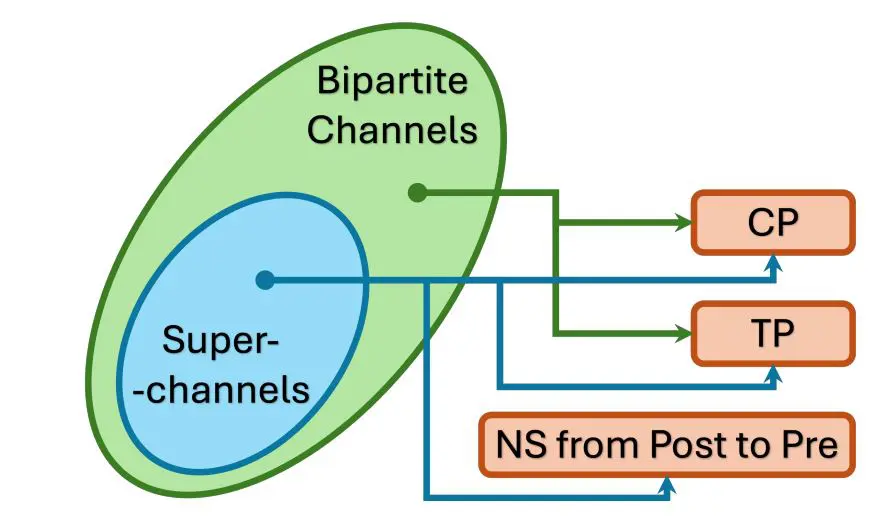
The fundamental building blocks of quantum theory, known as channels, describe how quantum information evolves, while superchannels represent the most general transformations acting upon these channels. However, existing frameworks for understanding superchannels suffer from inconsistencies and lack a solid mathematical foundation. Yunlong Xiao from the Institute of High Performance Computing (A*STAR), and colleagues, now address these long-standing problems by combining advanced tensor-network methods with a novel principle inspired by Occam’s razor. This work establishes a unified framework for superchannels, resolving inconsistencies between different approaches and developing essential mathematical tools, such as representations analogous to those used in channel theory. The team’s achievement not only simplifies the understanding of quantum transformations, but also provides a systematic way to characterise processes that introduce non-Markovian dynamics, potentially advancing the development of more realistic quantum technologies.
Optimal Superchannel Construction via Minimum Description Length
Superchannels, essential for describing the most general transformations in quantum theory, often lack systematic methods for model selection and optimisation, hindering their practical use. This research introduces a generalized Occam’s Razor, rooted in information theory, to overcome this challenge and provide a robust methodology for constructing optimal superchannels. The approach leverages the minimum description length principle, balancing model complexity with its ability to accurately represent observed data, and enabling the identification of the best superchannel from a given family. Specifically, the team demonstrates that the optimal superchannel minimizes the combined length of its own description and the description of the resulting quantum process, effectively penalizing overly complex models.
This framework constructs superchannels without requiring prior knowledge of the underlying quantum process, and provides a principled method for selecting the simplest model that adequately explains the data, significantly improving the efficiency and accuracy of superchannel construction and paving the way for more practical applications in quantum information processing and quantum control. Previous formulations of superchannels suffered from internal inconsistencies and structural incompleteness, lacking representations analogous to those that underpin channel theory. This research resolves these issues by combining tensor-network methods with the newly introduced generalized Occam’s Razor, establishing a unified foundation for superchannels. The framework clarifies connections between competing definitions, develops Kraus, Stinespring, and Liouville representations for superchannels, and provides a simplified derivation of the realization theorem, which identifies the minimal memory required to implement a given transformation.
Unified Superchannel Framework and Realization Theorem
This work establishes a unified framework for understanding superchannels, fundamental transformations in quantum information theory, by resolving inconsistencies present in previous approaches and completing their structural representation. Researchers addressed conflicting definitions of superchannels by combining tensor-network methods with the generalized Occam’s Razor, a principle guiding the selection of a simplified, canonical form. This combination yielded a consistent derivation of the realization theorem, which determines the minimal memory required to implement a given superchannel transformation. Applying this framework, scientists characterized superchannels capable of destroying quantum correlations and causal structures, opening avenues for investigating non-Markovian dynamics, where systems evolve without strict adherence to time-reversible processes. The authors acknowledge that their framework focuses on the mathematical structure of superchannels and does not directly address their physical implementation, suggesting future research directions include exploring the practical implications of these findings for quantum memory architectures and extending the analysis to more complex scenarios involving multiple interacting systems.
🗞 Superchannel without Tears: A Generalized Occam’s Razor for Quantum Processes
🧠 ArXiv: https://arxiv.org/abs/2512.02493




See today’s quantum computing news on Quantum Zeitgeist for the latest breakthroughs in qubits, hardware, algorithms, and industry deals.