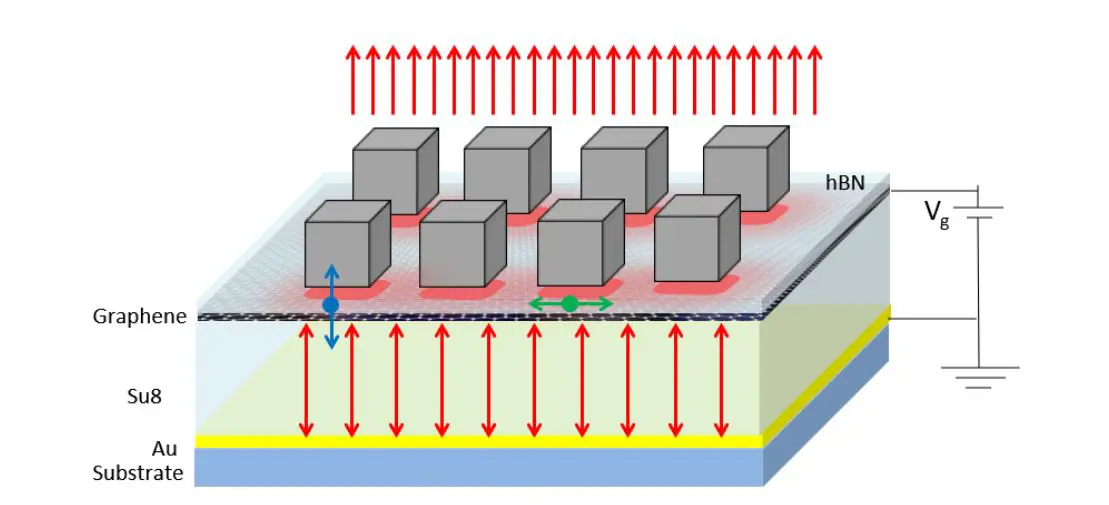
The pursuit of enhanced light emission underpins advances in diverse fields, from optical communication to quantum computing, and researchers are continually seeking methods to amplify these signals. Justin Gruber from the University of Central Florida and the University of Rochester, alongside Mahtab A. Khan from the University of Central Florida and Federal Urdu University of Arts, Sciences and Technology, and Dirk R. Englund from the Massachusetts Institute of Technology, now demonstrate a pathway to achieve exceptionally strong amplification using acoustic graphene plasmons. Their work reveals a novel structure, combining graphene and metallic nanocubes, that supports these plasmons and enables tunable, giant Purcell enhancement of light emission, boosting signals by up to six orders of magnitude in the mid-infrared spectrum. This breakthrough, which also includes contributions from Michael N. Leuenberger of the University of Central Florida, promises electrically controllable emitter devices with significant potential for applications in next-generation communication and information processing technologies.
This research centres on enhancing light-matter interactions by using nanostructures to concentrate light and increase the probability of optical processes like absorption, emission, and scattering. A key goal is to develop methods for dynamically controlling the optical properties of materials and to achieve quantum control over the states of photons and matter for applications in quantum information processing and sensing. Scientists are modifying the electronic properties of graphene through intercalation and doping to tune its plasmonic response and conductivity. Researchers are incorporating rare-earth ions into 2D materials to create luminescent materials and enhance light-matter interactions, using plasmonic nanostructures to enhance emission efficiency. Scientists are employing computational methods to predict the electronic and optical properties of materials and using experimental techniques to characterise their structural, electronic, and optical properties. Several trends are apparent, including the integration of 2D materials and rare-earth doping, the development of tunable plasmonics, and the exploration of 2D materials for quantum photonics. This research aims to create advanced photonic devices with unprecedented performance, functionality, and tunability for applications in sensing, communication, computation, and energy harvesting.
Giant Purcell Enhancement via Acoustic Graphene Plasmons
Scientists have achieved giant Purcell enhancements for single-photon and multi-photon emitters by leveraging acoustic graphene plasmons (AGPs) within a novel cavity structure. Experiments reveal Purcell enhancement factors reaching up to 10 6 in the mid-infrared spectrum and 10 4 at telecommunications wavelengths, with efficiencies of 95% and 89%, respectively, when utilizing high-mobility graphene. The team measured enhancement factors of 10 4 , 10 7 , 10 9 , and 10 9 for single-photon electric dipole, electric quadrupole, electric octupole, and two-photon spontaneous emission transitions, respectively. Importantly, the frequencies of the AGP modes are tunable via the graphene Fermi energy, allowing for real-time modulation of fluorescence enhancement through electrostatic gating. This delivers a pathway toward electrically tunable quantum emitter devices with potential applications in quantum communication and information processing. By carefully designing a cavity structure incorporating graphene and metallic nanoparticles, scientists achieved Purcell enhancement factors reaching up to eight orders of magnitude. These enhancements were observed across a broad spectrum, including mid-infrared and telecommunications wavelengths, with quantum efficiencies reaching 95% and 89%, respectively, when utilizing high-mobility graphene. The ability to tune the AGP frequency via an applied voltage provides a means to dynamically control the emission enhancement.
At a wavelength of 1. 55 micrometers, the researchers observed enhancement of 1. 76×10 4 for dipole transitions, 1. 19×10 7 for quadrupole transitions, and 3. 1×10 8 for two-photon emission, alongside a quantum efficiency of 79% for entangled-photon emission. This work establishes a promising platform for developing efficient single-photon and entangled-photon sources, crucial components for advancing quantum technologies.
🗞 Tunable giant Purcell enhancement of quantum light emitters by means of acoustic graphene plasmons
🧠 ArXiv: https://arxiv.org/abs/2512.02907