Researchers are continually pushing the boundaries of circuit quantum electrodynamics, a field that combines superconducting circuits with quantum properties, and a long-standing limitation has been the frequency of the cavities used to control these circuits. Now, Raymond A. Mencia, Taketo Imaizumi, Igor A. Golovchanskiy, and colleagues at the Institute of Physics, Ecole Polytechnique Federale de Lausanne, have demonstrated a significant advance by successfully raising the cavity frequency to 21GHz, while maintaining a standard 5GHz qubit. This achievement overcomes a fundamental constraint in the field and opens up exciting possibilities for improved qubit control and performance, as the team demonstrates high-fidelity qubit operation, exceeding coherence times and achieving accurate state assignment through innovative measurement techniques. The results encourage further exploration of high-frequency cavities and promise transformative advantages for future quantum technologies without compromising existing qubit functionality.
High-Frequency Qubit Readout, Experimental Details
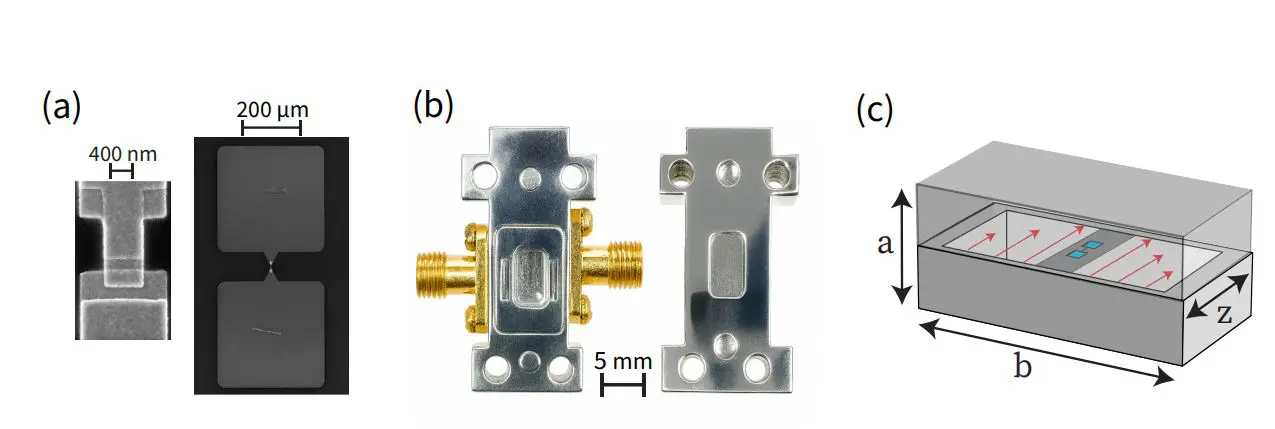
This research details the experimental setup for achieving high-frequency qubit readout, comprehensively describing the cavity design, noise analysis, and theoretical explanation of observed multiphoton resonances. The work demonstrates the feasibility of faster, higher-fidelity qubit readout by operating at higher frequencies, while addressing associated challenges. The experiment utilizes Zurich Instruments SHFQC equipment for generating and digitizing microwave pulses, employing an up-conversion/down-conversion scheme to reach readout frequencies around 13GHz and 8GHz. The transmon qubit resides inside a 3D aluminum cavity constructed from aluminum 7075-T6, with dimensions of 7. 0mm x 7. 5mm x 4. The drive and readout lines are asymmetrically coupled to favor signal decay through the readout port. The primary source of dephasing at high readout frequencies is identified as photon shot noise from thermal photons within the cavity. The dephasing rate decreases as readout frequency increases, effectively suppressing dephasing.
The model accurately accounts for temperature at each stage of the cryostat. Leakage observed in experimental data is attributed to multiphoton resonances, modeled using Floquet theory to map the time-dependent problem to a time-independent one. The research highlights the crucial role of noise mitigation through careful experimental design, demonstrating that thermal photons can be limited by increasing readout frequency. Understanding and mitigating multiphoton resonances is also essential for achieving high-fidelity readout.
Qubit-Cavity Coupling Characterization via Spectroscopy
Researchers implemented a circuit quantum electrodynamics (cQED) system featuring a superconducting qubit coupled to a high-frequency cavity operating at 21GHz, while maintaining the qubit’s transmon frequency around 5GHz. Conventional spectroscopic techniques characterized the dispersive interaction between the qubit and cavity, extracting a coupling strength of approximately 500MHz and a cavity linewidth ranging from 11 to 14MHz across four devices. This characterization involved fitting measurements to established equations and verifying results through analysis of measurement-induced dephasing. The team precisely determined qubit parameters, including energy levels, by measuring frequencies and fitting them to a transmon Hamiltonian model.
Single-shot measurements captured the qubit state in the IQ-plane as Gaussian clusters, allowing for careful analysis of resulting histograms. They accounted for leakage to higher excited states, which impacted readout fidelity, but enabled accurate determination of cluster centers and variances. The study meticulously quantified the signal-to-noise ratio (SNR) as a function of integration time and average photon number, revealing a linear dependence in both parameters. By equating experimental SNR values with theoretical predictions, the team extracted a quantum efficiency of approximately 4% for two devices and 8% for the remaining two, attributing the difference to variations in the measurement lines, including HEMT noise temperatures and cable losses.
Further experiments assessed the potential for quantum non-demolition (QND) readout, despite the observed leakage. Minimal leakage from the ground state suggests the possibility of improved readout fidelity with further optimization. The achieved efficiency of 8% represents a significant benchmark, comparable to the highest quantum efficiency measurements in cQED, and establishes compatibility with current microwave technology.
High-Frequency Cavity Coupling in Circuit QED
Scientists have achieved a breakthrough in circuit electrodynamics (cQED) by successfully implementing a system where a standard transmon qubit operates at approximately 5GHz, but is coupled to a cavity resonator with a fundamental mode frequency of 21GHz. This represents the first demonstration of such a high-frequency cavity within a cQED architecture. Experiments reveal that despite the substantial frequency difference between the qubit and cavity, the dispersive shift remains within the conventional range of several MHz. The team measured a qubit readout efficiency of 8%, demonstrating the ability to effectively extract information from the qubit state at this elevated frequency.
Furthermore, the qubit’s energy relaxation time, quantified by the T1 parameter, exceeds 107, indicating exceptionally long coherence. Measurements confirm that the qubit coherence time, T2, reproducibly surpasses 100 microseconds and can reach over 300 microseconds with the application of a single refocusing pulse, maintaining state-of-the-art performance. This work addresses a key challenge in cQED, namely minimizing the impact of residual thermal photons within the cavity. The high 21GHz frequency effectively reduces the cavity’s thermal population to levels below several 10−4, even without extensive filtering of measurement lines. The team also demonstrated the ability to initialize the qubit through repeated measurements with a post-selection error of only 2 × 10⁻³, achieving a state assignment error of 4 × 10⁻³. These results establish a foundation for future cQED experiments operating in the microwave K-band, potentially enabling more scalable and robust quantum processors.
High-Frequency Qubit System Demonstrates Improved Coherence
Researchers have successfully demonstrated a circuit electrodynamics system featuring a superconducting qubit coupled to a high-frequency cavity, operating at 21GHz, a significant departure from the traditionally used 7GHz range. This achievement involved maintaining standard qubit functionality while substantially increasing the cavity’s frequency. They observed dispersive shifts within expected ranges, achieved qubit readout efficiencies of 8%, and recorded energy relaxation and coherence times exceeding established benchmarks, with coherence times reaching above with a single refocusing pulse. Importantly, the team achieved state assignment through repeated measurement with post-selection. The work reveals a favorable scaling relationship between the qubit-cavity coupling constant and cavity frequency, suggesting that increasing cavity frequency can further enhance performance. The high frequency effectively reduces the cavity’s thermal population, minimizing the impact of thermal photons on qubit coherence.
See today’s quantum computing news on Quantum Zeitgeist for the latest breakthroughs in qubits, hardware, algorithms, and industry deals.