

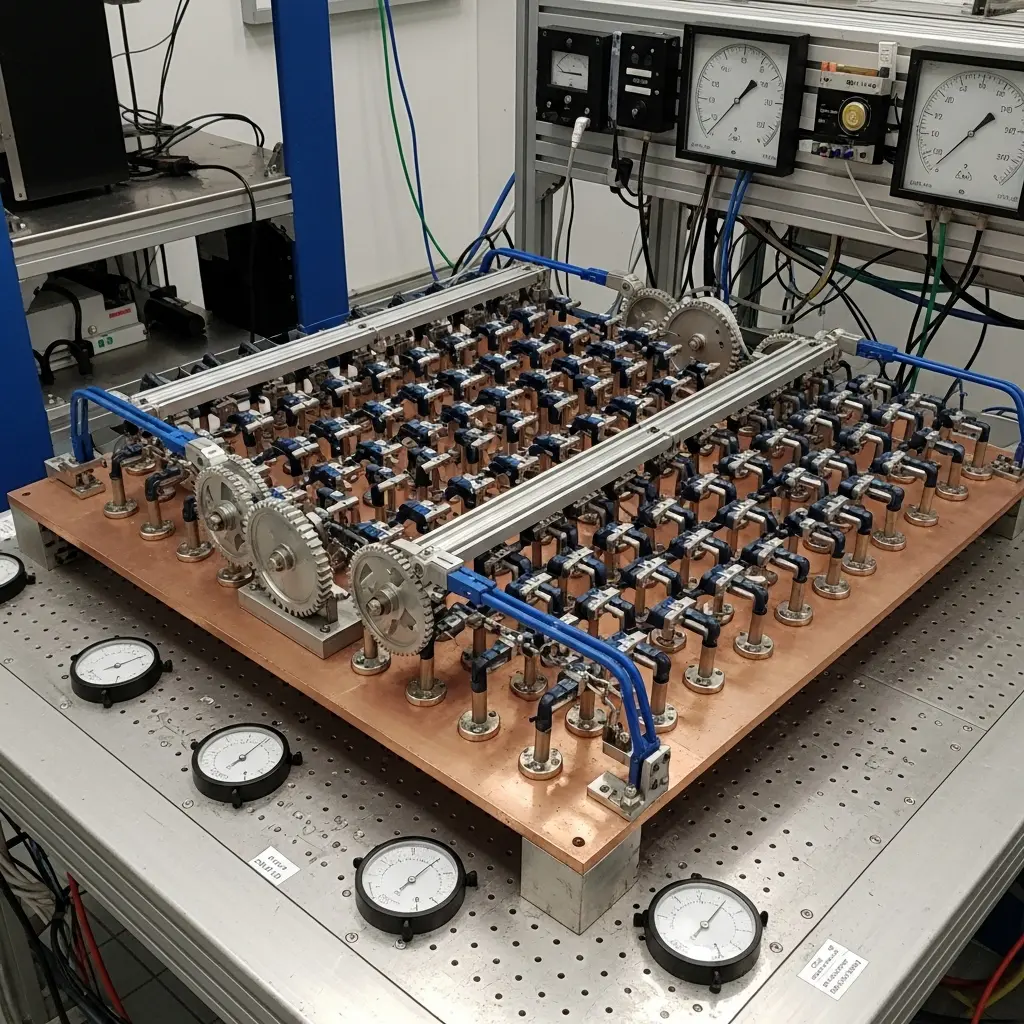
Estimating the ground state energy of complex materials presents a longstanding challenge in physics and chemistry, particularly for systems where interactions between particles are strong. Chinmay Shrikhande, Arnab Bachhar, Aaron Rodriguez Jimenez, and Nicholas J. Mayhall from Indiana University now demonstrate a new approach to this problem, utilising a variational double bracket flow algorithm enhanced with Sparse Pauli Dynamics. This method achieves remarkably accurate results, with errors less than one percent compared to established techniques like DMRG, but does so with a significant speed advantage. The team’s algorithm solves problems involving up to 128 qubits in a matter of minutes on a standard computer, offering a practical tool for investigating many-body physics where traditional methods require extensive computational resources and time.
Variational Double Bracket Flow with Sparse Dynamics
This approach efficiently simulates the time-dependent variational principle, crucial for evolving a trial wave function towards the ground state. The method constructs a Liouvillian superoperator, sparse in the Pauli basis, to drive the flow, significantly reducing computational cost compared to full Hamiltonian propagation. Results demonstrate the ability to accurately estimate ground state energies for systems inaccessible to conventional methods, offering a promising pathway for tackling strongly correlated materials and complex chemical systems.
Variational Double Bracket Flow Accelerates Quantum Simulations
Scientists have developed a new computational method, variational double bracket flow (vDBF), that significantly accelerates the estimation of ground state energies for strongly correlated quantum systems. This work addresses a key challenge in physics and chemistry, where accurately simulating the behavior of many interacting quantum particles is computationally demanding. Experiments demonstrate that vDBF achieves less than 1% error relative to established density matrix renormalization group (DMRG) benchmarks for both Heisenberg and Hubbard models in one and two dimensions.
Specifically, for a 10×10 Heisenberg lattice consisting of 100 qubits, vDBF obtains accurate results in approximately 10 minutes on a single CPU thread. This represents a dramatic improvement over DMRG, which requires over 50 hours on 64 threads to achieve comparable accuracy for the same system. The speedup is even more pronounced for an 8×8 Hubbard model containing 128 qubits, further highlighting the efficiency of the new method. The breakthrough relies on representing quantum operators using Pauli strings, which simplifies calculations due to their well-defined mathematical properties. By evolving these Pauli strings rather than the full quantum state, the team significantly reduced computational complexity. Results confirm that vDBF provides a practical tool for many-body physics, offering a viable alternative to traditional methods for simulating complex quantum systems and potentially accelerating research in materials science and chemistry. This advancement demonstrates that techniques initially developed for quantum computing benchmarking can be repurposed to enhance classical simulation capabilities.
Fast Ground State Estimation via vDBF
This research presents a new algorithm, variational double bracket flow (vDBF), for estimating ground state energies in strongly correlated quantum systems. Notably, the method demonstrates significant speed advantages, obtaining accurate results for a 10×10 Heisenberg lattice in approximately ten minutes on a single CPU thread, a task that would take DMRG over fifty hours using sixty-four threads. Similar performance gains are observed for the 8×8 Hubbard model.
These findings demonstrate the potential for repurposing techniques developed in the context of quantum advantage benchmarking as practical tools for classical many-body simulation. While the method excels at energy estimation, the authors acknowledge limitations in characterizing other ground state properties, observing exponential decay of spatial correlations instead of the expected power law. Future research will focus on accelerating convergence, particularly in later optimization stages, and incorporating symmetry preservation, such as particle number conservation. Investigations are also underway to couple vDBF with a Schrödinger picture correction and to modify the cost function to improve property estimation, building on encouraging preliminary results.
🗞 Rapid ground state energy estimation with a Sparse Pauli Dynamics-enabled Variational Double Bracket Flow
🧠 ArXiv: https://arxiv.org/abs/2511.21651

See today’s quantum computing news on Quantum Zeitgeist for the latest breakthroughs in qubits, hardware, algorithms, and industry deals.



