Understanding the behaviour of electrons confined within nanoscale structures is crucial for developing future quantum technologies, and recent research focuses on bilayer graphene quantum dots as promising platforms for solid-state qubits. Max J. Ruckriegel, Christoph Adam, Rebecca Bolt, and colleagues at the Laboratory for Solid State Physics, ETH Z ̈urich, have now achieved a significant advance in this field by directly observing the properties of just a few electrons trapped within these tiny structures. The team employs a highly sensitive technique called circuit quantum electrodynamics to probe these confined electrons, achieving unprecedented energy resolution compared to conventional methods. This breakthrough allows for the detailed characterisation of electron spin and valley states, revealing key information about the fundamental interactions governing their behaviour and paving the way for more robust and controllable quantum devices.
Bilayer Graphene Quantum Dot Spectroscopy Reveals Interactions
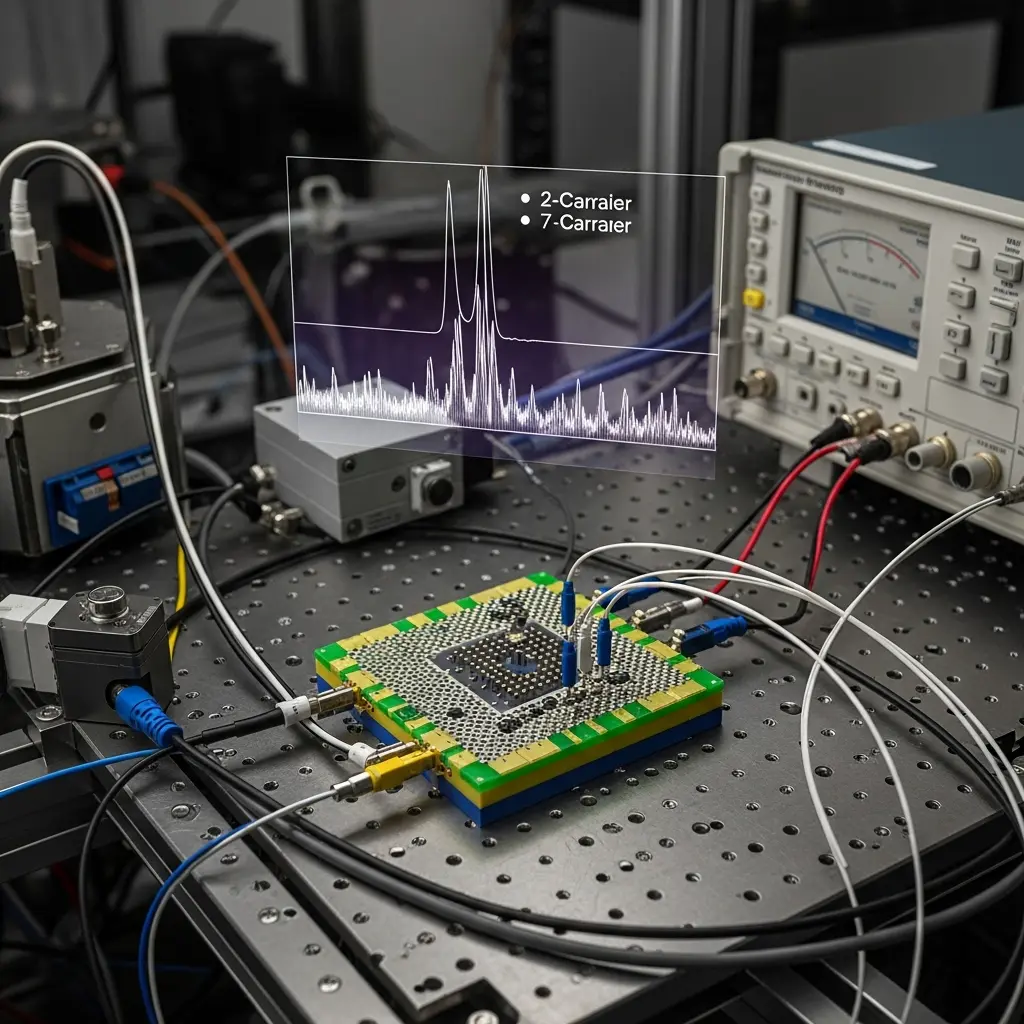
Microwave spectroscopy investigates the electronic properties of few-carrier states within bilayer graphene quantum dots, focusing on how carrier density and quantum confinement influence energy levels and electron interactions. Researchers fabricate quantum dots from bilayer graphene, a material with unique electronic behaviour, and identify resonant transitions by applying microwave radiation and measuring absorption spectra. This method precisely determines energy levels as a function of carrier density, demonstrating a clear dependence on the number of charge carriers, and provides insights into the fundamental physics of confined carriers and the development of novel electronic devices.
Bilayer graphene is a maturing material platform for gate-defined quantum dots, hosting long-lived spin and valley states, and understanding these confined electronic systems is crucial for implementing solid-state qubits. This work reports on the spectroscopy of few-carrier states, investigating energy levels and interactions, and providing insights into the behaviour of potential qubits within this material system. States of two and three carriers, where the exchange interaction is crucial, form a cornerstone for qubit readout and manipulation, contributing to the development of robust and controllable quantum devices.
Graphene Quantum Dots and Microwave Control
This research demonstrates a significant advance in understanding electrons confined within bilayer graphene double quantum dots, employing circuit quantum electrodynamics to achieve substantially improved energy resolution compared to conventional methods. Measurements reveal strong Pauli blockade arising from spin or valley-polarized ground states, and enable quantification of the Kane-Mele spin-orbit interaction, an intrinsic property of bilayer graphene. This technique allows precise measurement of energy levels and understanding of electron interactions.
The team’s dispersive measurements of dipole transitions provide exceptional detail, allowing precise characterization of low-lying energy gaps, and deepens our fundamental understanding of electron behaviour in these nanostructures. This work demonstrates the potential of circuit quantum electrodynamics as a powerful tool for investigating semiconductor nanostructures and probing spin-valley physics, and highlights the potential for discriminating between states crucial for implementing a Kramers singlet-triplet qubit within a bilayer graphene double quantum dot.
👉 More information
🗞 Microwave spectroscopy of few-carrier states in bilayer graphene quantum dots
🧠 ArXiv: https://arxiv.org/abs/2511.20185




See today’s quantum computing news on Quantum Zeitgeist for the latest breakthroughs in qubits, hardware, algorithms, and industry deals.