

The demand for increasingly precise simulations in high-energy physics continually challenges computational resources, prompting researchers to explore innovative hardware solutions. Michael H. Seymour and Siddharth Sule have addressed this challenge by developing a new event generator capable of running on Graphics Processing Units, or GPUs. This work presents a significant advancement by achieving comparable simulation speeds and energy efficiency on a single V100 GPU to those of a substantial 96-core CPU cluster, offering a potentially transformative alternative to traditional cluster computing for particle physics. By successfully implementing a matched initial and final state parton shower on a GPU, this research demonstrates a pathway towards more sustainable and accessible high-energy physics simulations.
Generators to GPUs. The team releases version 2 of the CUDA C++ parton shower event generator GAPS, which simulates both initial and final state emissions on a GPU and incorporates hard-process matching. Accompanying the generator is a near-identical C++ program for running simulations on single-core and multi-core CPUs. This provides a potential alternative to traditional cluster computing.
Monte Carlo Simulations of Particle Collisions
Monte Carlo simulations are essential for understanding particle collisions at high energies, such as those occurring at the Large Hadron Collider. These simulations rely on event generators, programs that model the entire collision process from the initial interaction to the final detected particles. These generators predict the outcomes of experiments and allow physicists to interpret experimental data. A key component of these simulations is the modelling of parton showers, which describe how quarks and gluons, the fundamental constituents of matter, evolve and branch into a cascade of secondary particles.
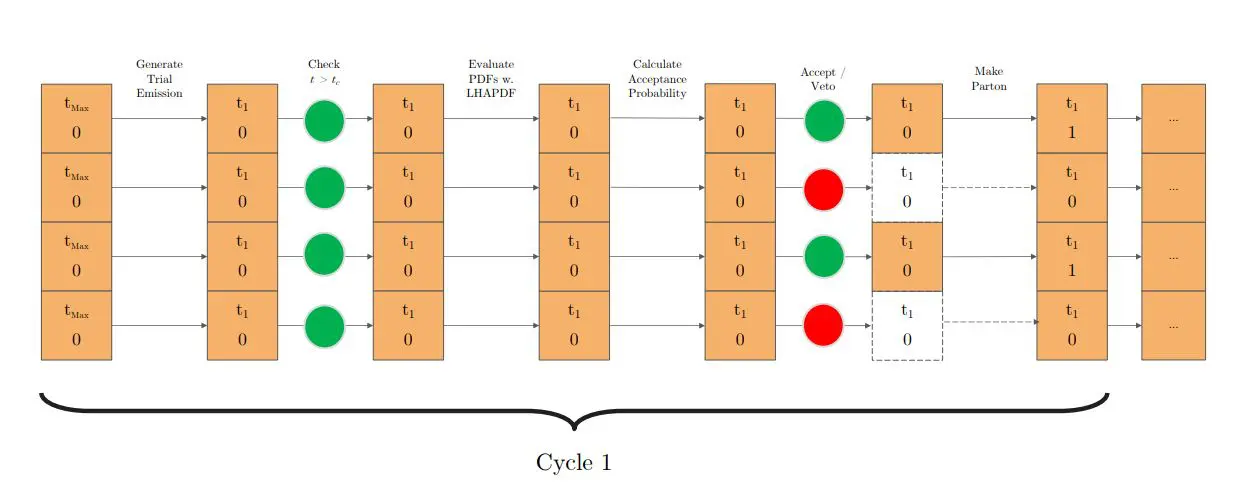
The accuracy of these simulations depends on sophisticated algorithms and theoretical frameworks. The Dokshitzer-Gribov-Lipatov-Altarelli-Parisi equations provide the foundation for understanding parton evolution, while models like the Color Dipole Model and Catani-Seymour Dipole Factorization offer different approaches to simulating the branching process. Recent advancements focus on maintaining coherence during branching and developing more efficient algorithms, such as the Partitioned Dipole Antenna Shower. The work centers on GAPS, a GPU-Amplified Parton Shower, now at version 2, which simulates initial and final state emissions, and is capable of hard-process matching. The team updated the parallelised veto algorithm to incorporate initial-state radiation, accurately modelling the effects of parton distribution functions to describe the probability of partons within incoming protons.
This allows for a more complete simulation of particle interactions. Researchers successfully ported a Monte Carlo event generator, GAPS, to a GPU platform, enabling faster simulations and potentially reducing energy consumption. Detailed profiling revealed that the most time-consuming aspect of the simulation is generating potential particle emissions, a process that benefits significantly from the parallel processing capabilities of GPUs.
Optimisation of event partitioning and the number of threads per block further improved performance, with the best results achieved using a thread count of 128. While acknowledging that the current implementation does not alter the underlying simulation algorithm, the team proposes future improvements through the use of two-dimensional kernels and atomic operations to further parallelise the selection of winning emissions. These results highlight the potential of GPU computing to address the increasing demands of complex simulations in particle physics and offer a promising alternative to traditional cluster computing infrastructure.
🗞 An NLO-Matched Initial and Final State Parton Shower on a GPU
🧠 ArXiv: https://arxiv.org/abs/2511.19633


See today’s quantum computing news on Quantum Zeitgeist for the latest breakthroughs in qubits, hardware, algorithms, and industry deals.



