Quantum computing continues to advance, but scaling up these systems remains a significant challenge, limited by the capacity of individual processors. Researchers, including Sen Zhang, Lingjun Xiong, Yipie Liu, and colleagues from George Mason University and Florida Atlantic University, are addressing this issue by exploring distributed quantum computing, which links multiple processors together. This approach requires sophisticated software tools to model and evaluate designs, but currently lacks a comprehensive circuit-level simulator capable of handling the complexities of distributed execution and noisy connections. To overcome this limitation, the team developed SimDisQ, a novel simulator that accurately models distributed quantum circuits and allows researchers to explore the potential benefits of linking different types of quantum processors. Through detailed simulations, SimDisQ demonstrates that heterogeneous distributed systems can achieve higher overall fidelity, paving the way for future advancements in scalable quantum computation.
Distributed Quantum Computing Simulation Challenges
The pursuit of increasingly complex quantum computations faces a fundamental challenge: scaling up single quantum processors. Current quantum processing units, or QPUs, struggle with limitations in qubit count, coherence, and fidelity. To address this, scientists propose distributed quantum computing (DQC), connecting multiple smaller QPUs to create a more powerful and flexible system, mirroring the approach used in classical distributed computing. However, a key obstacle has been the lack of comprehensive simulation tools capable of accurately modeling the complexities of DQC. Existing simulation tools fall short in representing the architectural intricacies, the process of adapting quantum circuits for different QPUs, and the noise that arises from communication between processors, all of which are crucial for realistic evaluation.
To overcome this limitation, researchers introduced SimDisQ, a novel circuit-level simulator specifically designed for DQC. SimDisQ focuses on the behavior of quantum circuits within a distributed architecture and incorporates features to model these critical aspects of DQC performance. The team evaluated SimDisQ using five different DQC architectures, ranging from a single monolithic QPU to more complex distributed systems with diverse QPUs. They employed a suite of quantum benchmarks, including quantum error correction codes, FullAdder circuits, and quantum approximate optimization algorithms, to assess performance.
Performance was measured using metrics such as fidelity, a measure of computational accuracy, average gate noise, and circuit depth. Simulations also considered realistic communication delays and noise levels expected in a data-center scale network. Results demonstrate that DQC architectures, particularly those utilizing multiple high-fidelity QPUs, can outperform single monolithic QPUs in terms of fidelity. Heterogeneous DQC architectures, combining different types of QPUs, offer a balanced tradeoff between performance and resource utilization. The study highlights the importance of employing high-fidelity QPUs in DQC systems, as even smaller, high-fidelity processors can outperform larger, noisier ones.
These benchmarking results validate SimDisQ as an effective and accurate tool for simulating DQC systems. SimDisQ represents the first comprehensive circuit-level DQC simulator integrating architectural modeling, heterogeneous transpilation, and inter-QPU noise modeling. This work provides valuable insights into the design and optimization of DQC systems and offers a practical framework for future research and development. By addressing a critical gap in the quantum computing community, SimDisQ enables researchers to evaluate and optimize DQC architectures, paving the way for more powerful and scalable quantum computers.
SimDisQ, A Distributed Quantum Circuit Simulator
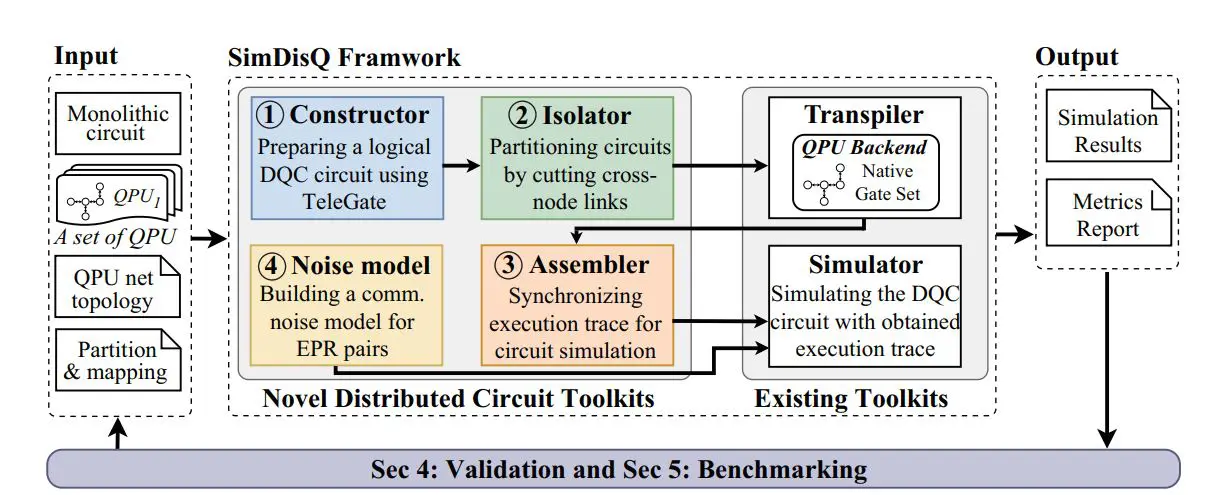
Scientists developed SimDisQ, a novel end-to-end circuit-level simulator designed to explore the potential of distributed quantum computing, addressing a critical gap in existing software tools. This work pioneers a framework that seamlessly integrates with current quantum software ecosystems, enabling quantitative assessment of distributed architectures and their associated challenges. The core of SimDisQ comprises four newly developed toolkits, a constructor, isolator, assembler, and noise model, working in concert to simulate complex distributed quantum circuits. Initially, the constructor toolkit takes a standard monolithic quantum circuit, a defined set of quantum processing units, their network topology, and a user-defined partitioning strategy as input.
This toolkit then transforms the circuit into a logical distributed quantum circuit by replacing multi-qubit gates spanning multiple QPUs with TeleGates, effectively creating remote entanglement operations. Subsequently, the isolator toolkit independently optimizes each subcircuit for the specific native gates, coupling maps, and noise characteristics of its assigned QPU, tailoring the computation to each individual device. The assembler toolkit then integrates these independently transpiled subcircuits, inserting and scheduling remote-gate operations to ensure deadlock-free execution across the distributed system. Finally, the integrated noise model unifies the inherent noise within each QPU with the communication noise arising from optical loss and distance-dependent effects, providing a realistic simulation environment.
Researchers validated the framework by simulating six representative circuits, including quantum error correction codes and variational quantum circuits, across five distinct DQC architectures, varying in QPU size and qubit types. Results from these simulations demonstrate that distributing circuits across multiple smaller QPUs can, under certain network topologies and backend configurations, achieve higher execution fidelity than a single, larger, but noisier QPU. This finding underscores the potential benefits of DQC and highlights the importance of dedicated simulation tools like SimDisQ for co-designing hardware architectures, network topologies, and compilation strategies for future quantum systems.
Distributed Quantum Simulation Outperforms Single Processors
Scientists have developed SimDisQ, the first circuit-level simulator designed specifically for distributed quantum computing, seamlessly integrating with existing quantum software ecosystems. This work addresses a critical need for tools that can assess the benefits of distributing quantum computations across multiple processing units, known as QPUs, and evaluate emerging designs for these distributed systems. The simulator incorporates novel toolkits for circuit construction, isolation, assembly, and noise modeling, enabling detailed exploration of architectural trade-offs and communication fidelity constraints. Experiments using SimDisQ demonstrate that distributing circuits across multiple smaller QPUs can, under certain network topologies and backend configurations, outperform a single, larger but noisier QPU in terms of fidelity.
Specifically, the team benchmarked six representative circuits, including quantum error correction codes and variational quantum circuits, across five different DQC architectures varying in size and qubit types. These results highlight the potential of distributed quantum computing to overcome limitations imposed by the scalability and noise present in monolithic QPUs. The SimDisQ framework operates through a series of interconnected toolkits. The constructor takes a traditional quantum circuit, a set of QPUs, their connection topology, and a user-defined circuit partition as input. It then generates a logical DQC circuit by replacing multi-qubit gates spanning multiple QPUs with TeleGate operations, which facilitate communication between the distributed units.
An isolator module then cuts the links associated with cross-QPU gates, preparing independent subcircuits for transpilation. The assembler generates an execution trace, and a noise model simulates communication errors, providing a comprehensive simulation environment. Researchers validated the simulator’s functionality and benchmarked circuits across distributed QPUs, demonstrating its ability to accurately model complex quantum computations. The team employed a depth-first search algorithm to identify optimal paths for establishing entanglement between QPUs, minimizing resource consumption and maximizing fidelity. The framework also incorporates virtual gates to manage cross-QPU links, ensuring deadlock-free assembly and efficient simulation. These advancements facilitate the co-design of hardware architectures, network topologies, and compilation strategies for emerging DQC systems.
Heterogeneous Architectures Boost Quantum Fidelity
As quantum processors encounter limitations in scaling, distributed quantum computing (DQC) emerges as a crucial approach to overcome the constraints of monolithic devices. Researchers have now developed SimDisQ, the first circuit-level DQC simulator integrating architectural modeling, heterogeneous transpilation, and inter-processor noise modeling. This simulator enables quantitative exploration of architectural.
🗞 An End-to-End Distributed Quantum Circuit Simulator
🧠 ArXiv: https://arxiv.org/abs/2511.19791



See today’s quantum computing news on Quantum Zeitgeist for the latest breakthroughs in qubits, hardware, algorithms, and industry deals.