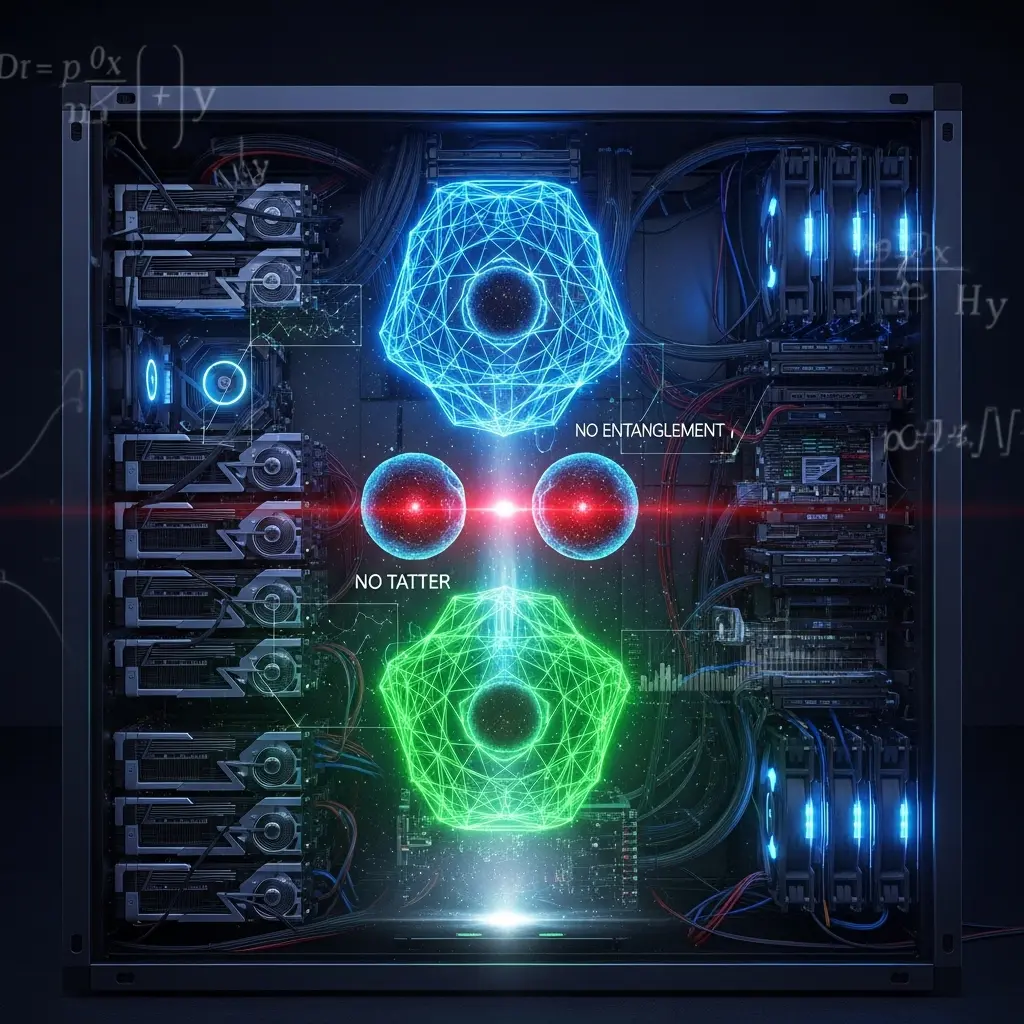
The fundamental nature of gravity and its relationship to quantum entanglement remains a topic of intense debate, particularly concerning experiments designed to detect gravitationally induced entanglement between massive particles. Mike D. Schneider from the University of Missouri, Nick Huggett from the University of Illinois Chicago, and Niels Linnemann from the University of Geneva demonstrate, through a rigorous Newton-Cartan analysis, that classical gravity cannot, on its own, produce entanglement. This research resolves ongoing confusion surrounding interpretations of proposed experiments, establishing that any observed entanglement in such scenarios must originate from a source beyond classical gravity itself, fundamentally altering the understanding of how gravity interacts with quantum systems and providing a crucial benchmark for future investigations. The team’s work clarifies the theoretical underpinnings of these experiments, ensuring that future research accurately isolates and identifies any genuinely gravitational contributions to entanglement.
Confirming or refuting hypotheses about gravity requires precise experiments and careful theoretical analysis. This current investigation builds upon previous work, focusing on the theoretical implications of a specific mathematical approach and the limitations of classical gravity in mediating entanglement. A detailed analysis using a refined Newtonian framework demonstrates that if gravity is classical, and entanglement is observed in an experiment, another force must be responsible for producing the effect.
Applying Newton-Cartan Analysis to Quantum Entanglement
Newton-Cartan Analysis and Entanglement Implications
Newton-Cartan Gravity and Quantum Entanglement
Scientists investigate whether classical gravity can induce entanglement between quantum systems, a question central to understanding the boundary between classical and quantum physics. The research addresses claims that classical gravity can produce entanglement through specific mathematical formulations, potentially violating established principles in quantum information theory. To address this, researchers employ a refined Newtonian framework of gravity, considered a more accurate representation of the Newtonian limit of general relativity than traditional approaches. This framework describes gravity not as spacetime curvature, but as a Galilean spacetime with a derivative operator that defines inertial trajectories.
Demonstrating Gravity’s Limitation in Mediating Entanglement
The team demonstrates that within this framework, gravity does not directly mediate entanglement because it lacks the necessary interaction between quantum systems. The method involves analyzing the dynamics of massive quantum systems, calculating the energy input required for particles to follow specific trajectories, and determining whether this process generates a phase difference indicative of entanglement. The calculations reveal that if gravity is described by this framework, the energy input required to maintain particle trajectories is equivalent to zero, preventing the emergence of entanglement. This result aligns with the understanding that this framework, as a non-local theory, cannot act as a mediator for entanglement. The team acknowledges outstanding questions regarding the full quantum derivation of the standard phase difference, but the current findings establish that classical gravity, formulated as this framework, cannot induce entanglement within the specified experimental regime. This suggests that if entanglement is observed in experiments designed to test these effects, another mechanism must be responsible.
Classical Gravity Cannot Mediate Entanglement Between Masses
Gravity Cannot Mediate Entanglement Between Masses
Recent work rigorously establishes that classical gravity, specifically formulated as a refined Newtonian framework, cannot induce entanglement between spatially separated massive particles acting as a mediator. Scientists performed a detailed analysis using this framework, demonstrating that if entanglement were observed in a gravitationally induced entanglement (GIE) experiment, the effect must originate from a source beyond classical gravity itself. This conclusion arises from the inherent non-local character of classical gravity when considered as a mediating force. The team’s findings definitively show that within this framework, a mediating force cannot account for observed entanglement.
This work clarifies a long-standing debate concerning the interpretation of proposed information theory experiments designed to probe the nature of gravity. The analysis confirms that any observed entanglement in a GIE experiment, assuming gravity is classical, necessitates the presence of an additional mechanism responsible for the effect. This formalism highlights the implications of assuming classical gravity can act as a mediator, given its non-local properties. This breakthrough delivers a crucial theoretical constraint for interpreting future GIE experiments and directs research towards identifying potential alternative mechanisms responsible for any observed entanglement. The team’s work provides a clear theoretical foundation for understanding the limits of classical gravity in mediating quantum phenomena.
Theoretical Constraints Using Wavefunction Operators
Gravitational Effects And Wavefunction Derivative Operators
Separating Classical Gravitational Theory from Quantum Entanglement
Classical Gravity Does Not Imply Quantum Entanglement
This research clarifies the theoretical foundations of proposed experiments designed to probe the nature of gravity by investigating gravitational effects between massive particles. The team demonstrates that, within a Newtonian framework, observing such an effect does not necessarily imply a classical gravitational mediator, but rather suggests the presence of differing derivative operators within separate branches of a quantum system’s wavefunction. This analysis reveals that any observed effect can be understood as work performed to maintain a particle’s trajectory when surveying differing gravitational environments, analogous to the deflection of a charged particle within an electromagnetic field. The work establishes a mathematical framework to quantify this energy input, demonstrating its equivalence to a classical action that, upon quantization, aligns with existing theoretical analyses of these experiments. Importantly, the team shows that the energy required for this effect is not indicative of a force beyond gravity itself, but arises from the differing geometric descriptions within the quantum system. The authors acknowledge that this analysis relies on the assumption of a Newtonian regime and well-approximated classical spacetimes.
🗞 A demonstration that classical gravity does not produce entanglement
🧠 ArXiv: https://arxiv.org/abs/2511.19242


See today’s quantum computing news on Quantum Zeitgeist for the latest breakthroughs in qubits, hardware, algorithms, and industry deals.