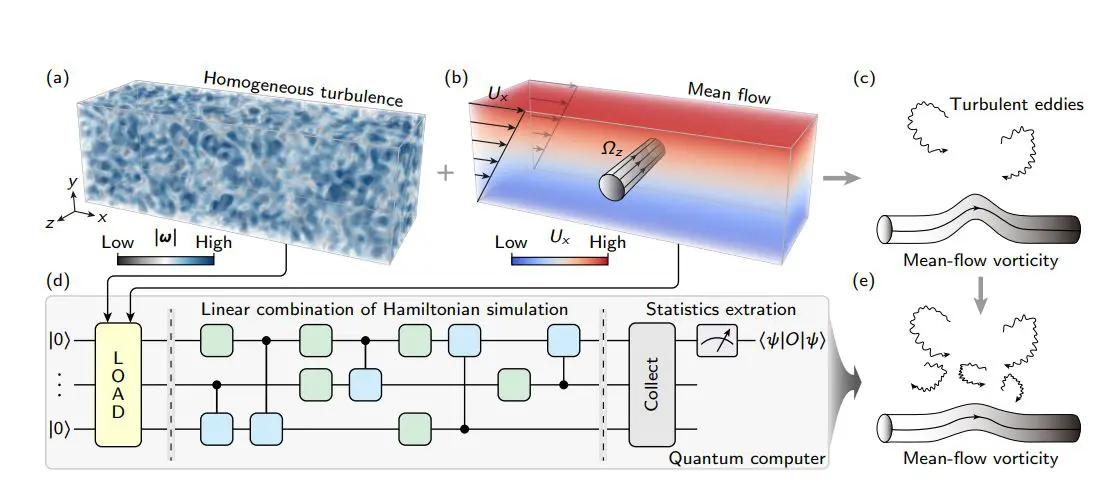
Turbulence, a chaotic fluid motion, presents a significant challenge to both classical and quantum simulation, particularly when rapidly distorted, as this intensifies the complexity of the flow. Zhaoyuan Meng from the Chinese Academy of Sciences, Leyu Chen from Beihang University, and Jin-Peng Liu from Tsinghua University, along with Guowei He, now demonstrate an end-to-end quantum algorithm for simulating this challenging phenomenon. Their approach utilises a linear combination of Hamiltonian simulation, efficiently preparing turbulent states, evolving them over time, and directly measuring key statistical properties. This work represents a crucial step towards overcoming the limitations of classical methods, offering a potential speedup for simulating turbulence on quantum computers and establishing a pathway for tackling even more complex fluid dynamics problems in the future.
The research connects the physics of nonlinear turbulence with linear quantum algorithms through rapid distortion theory, which describes turbulence under strong, uniform strain. This approach allows for efficient modeling of turbulent flows on a quantum computer, opening new avenues for understanding and predicting complex fluid dynamics.
Quantum Simulation Captures Rapidly Distorted Turbulence
Researchers have successfully simulated rapidly distorted turbulence using a quantum algorithm, demonstrating excellent agreement with established solutions. The team efficiently prepared an initial turbulent state with a defined energy spectrum and evolved it using a linear combination of Hamiltonian simulation, accurately modeling the dynamics of turbulence under rapid distortion. This method captures essential physics, including the generation of anisotropy and the growth of Reynolds shear stress, phenomena observed in simulations and experiments.
The simulation accurately predicts the tilting of coherent structures, a defining characteristic of turbulence evolution, and models the transfer of kinetic energy from the mean flow to turbulent fluctuations. This work lays the foundation for addressing more complex turbulent phenomena on future, fault-tolerant quantum computers.
Quantum Simulation of Turbulent Fluid Flows
Scientists are exploring the use of quantum computing to simulate and model fluid dynamics, particularly turbulent flows, a notoriously difficult problem for classical computers. Researchers are examining how to transform the equations governing fluid flow into a form solvable by quantum algorithms, such as through Schrödingerization and linear combination of Hamiltonian simulation. They are also investigating quantum Koopman theory, quantum lattice-gas models, and quantum analogs of the Fokker-Planck equation.
A significant challenge lies in handling non-unitary dynamics, which arise from dissipation and external forces, as standard quantum algorithms are designed for unitary evolution. Researchers are developing techniques to address this, including amplification and state preparation methods, and algorithms specifically designed for non-unitary evolution. This work could lead to breakthroughs in weather forecasting, climate modeling, aerospace engineering, combustion optimization, and materials science.
Turbulence Simulation via Quantum Algorithm
Researchers have developed a novel quantum algorithm for simulating rapidly distorted turbulence, potentially offering a speedup over classical methods for sufficiently large computational grids. The team created an end-to-end approach, efficiently preparing an initial turbulent state, evolving it using a linear combination of Hamiltonian simulation, and directly measuring key turbulence statistics. Numerical results demonstrate excellent agreement with established solutions, accurately capturing both the qualitative evolution of turbulent fields and the quantitative behavior of relevant statistical measures.
The algorithm leverages the mathematical framework of rapid distortion theory and casts the simulation into a form suitable for quantum computation. While the current implementation focuses on a specific case of rapidly distorted turbulence, the researchers establish a foundation for addressing more complex turbulent phenomena using future fault-tolerant quantum computers. Future research will focus on optimizing initial state preparation and developing more efficient techniques for measuring turbulence statistics on a quantum computer.
🗞 Toward end-to-end quantum simulation of rapidly distorted turbulence
🧠 ArXiv: https://arxiv.org/abs/2511.18802


See today’s quantum computing news on Quantum Zeitgeist for the latest breakthroughs in qubits, hardware, algorithms, and industry deals.