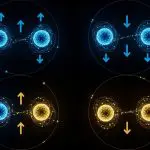
Understanding how fundamental particles interact remains a central challenge in physics, and researchers continually seek methods to model these interactions with increasing accuracy. Bahaa Al Sayegh from Lebanese University and Wissam Chemissany from the University of Pennsylvania, along with their colleagues, now present a new approach to simulating particle collisions within a complex theoretical framework. Their work demonstrates how a technique called the time-dependent variational principle, combined with matrix product states, can accurately model the scattering of particles in real-time, even in scenarios where traditional methods struggle. The team’s simulations reveal distinct scattering behaviours depending on the strength of the interaction, pinpointing a clear dynamical signature of the critical point where the system undergoes dramatic changes, and establishing a powerful new tool for exploring nonperturbative physics in lattice theory.
Simulating Real-time φ⁴ Theory with MPS
This research details a method for simulating how particles interact and scatter over time in φ⁴ theory, a fundamental model in quantum field theory, using uniform Matrix Product States (MPS). Simulating real-time scattering is computationally challenging for interacting theories due to their complex nature. The team employed MPS to represent the quantum state of the system, leveraging their efficiency in representing states with limited entanglement, common in lower-dimensional systems. They used uniform MPS, simplifying calculations and allowing simulations of infinite systems, and evolved the MPS in time using a time-dependent variational principle to simulate the scattering process. The method successfully simulates real-time scattering in φ⁴ theory, validating the approach against known analytical and numerical results, and offers a potentially scalable approach for studying more complex scattering processes and connecting to a growing body of research using tensor networks. This allows for calculations beyond standard approaches, providing a tool for studying the real-time dynamics of quantum systems and potentially paving the way for quantum algorithms for simulating quantum field theories.
Uniform Matrix Product States for Real-Time Dynamics
Scientists investigated the critical behaviour and real-time scattering dynamics of an interacting field theory using uniform matrix product states and a time-dependent variational principle. The study discretized the continuous theory and constructed the Hamiltonian, representing the system’s energy, ensuring accurate reproduction of the standard continuous limit. The many-body state was represented as a translation-invariant uniform matrix product state, enabling simulations in the thermodynamic limit. Researchers employed finite-entanglement scaling to locate the quantum critical point and characterize adjacent phases, leveraging the relationship between the half-chain entropy and the correlation length.
They parametrized the theory with a mass parameter and determined the critical value through analysis of the entropy scaling with bond dimension, yielding an estimate for the critical mass-squared and providing a quantitative map of the symmetric, near-critical, and spontaneously broken regimes. The team then used these ground states as initial conditions to simulate two-particle collisions in a ‘sandwich’ geometry, imprinting localized wave packets with opposite momenta onto a uniform background. By evolving the resulting state using the time-dependent variational principle, they extracted the elastic scattering probability and the Wigner time delay, tracking their behaviour as the theory transitioned through different phases. This combination of finite-entanglement scaling and real-time scattering simulations provides a non-perturbative view of criticality and quasiparticle dynamics in lattice field theory, achieving precise control over truncation errors.
Critical Mass and Real-Time Dynamics Mapped
Scientists achieved a detailed understanding of critical behaviour and real-time scattering dynamics within an interacting field theory using uniform matrix product states and the time-dependent variational principle. Through finite-scaling analysis, researchers bounded the critical mass-squared parameter, establishing a quantitative map of the symmetric, near-critical, weakly broken, and deeply broken regimes of the theory. Experiments involved simulating two-particle collisions using a ‘sandwich’ geometry, allowing the team to extract the elastic scattering probability and Wigner time delay. Results demonstrate strongly inelastic scattering in the symmetric phase, with a measured probability of approximately 0.
63 and a Wigner time delay of around −180 for a specific mass-squared parameter of 0. 2. In contrast, almost perfectly elastic collisions were observed in the spontaneously broken phase, yielding a scattering probability of 0. 998 and a Wigner time delay of approximately −270 for a mass-squared parameter of −0. 2, and a probability of 1 with a time delay of −177.
781 for a mass-squared parameter of −0. 5. Notably, the simulations revealed a breakdown of the sandwich evolution precisely at the critical coupling, providing a clear dynamical signature of the quantum critical point and delivering a method for probing non-perturbative scattering and critical dynamics in lattice theory with controlled entanglement truncation.
Phases and Scattering in Quantum Field Theory
This research successfully extends matrix product state techniques to investigate the behaviour of interacting quantum field theory in two dimensions. Through finite-entanglement scaling analysis, scientists establish a precise range for the critical mass-squared, consistent with established theoretical expectations and confirming the emergence of a gapless regime. This work delivers a detailed map of the system’s phases, including symmetric, near-critical, weakly broken, and deeply broken regimes, providing a robust foundation for subsequent real-time simulations. By simulating two-particle collisions using a ‘sandwich’ geometry, the team demonstrates a clear connection between the system’s phase and its scattering characteristics.
Collisions in the symmetric phase exhibit strong inelasticity, while those in the spontaneously broken phase are almost perfectly elastic, indicating stable quasiparticle behaviour. Critically, the simulation fails at the point where the system transitions between phases, revealing a breakdown in the scattering process and providing a dynamical signature of the quantum critical point. These results confirm the ability of these methods to resolve both static and dynamic properties of interacting quantum field theories across phase transitions. The authors acknowledge limitations related to computational cost as the critical point is approached, and suggest future work could explore larger system sizes, refined simulation designs, and additional observable quantities to further refine benchmarks of this theoretical model and extend the techniques to more complex quantum field theories.
🗞 Real-time Scattering in φ^4 Theory using Matrix Product States
🧠 ArXiv: https://arxiv.org/abs/2511.15697