Combinatorial optimization problems, crucial to fields ranging from logistics to machine learning, often demand immense computational power, and researchers continually seek faster, more efficient solutions. José Roberto Rausell-Campo, Nayem Al Kayed, and colleagues, including Daniel Pérez-Lppez, A. Aadhi, and Bhavin J. Shastri from Queen’s University and José Capmany Francoy from the Universitat Politècnica de Valencia, have now demonstrated a programmable photonic Ising machine that offers a promising new approach. This innovative system utilises a reconfigurable optical processor to rapidly explore potential solutions, effectively accelerating the search for optimal outcomes in complex problems. The team successfully solved benchmark optimization challenges and, importantly, emulated larger problems with up to 50 variables, achieving high success rates, and their work establishes a pathway towards scalable, programmable hardware for tackling real-world optimization tasks.
Silicon Photonics Solve Optimization Problems
This research details the development of a photonic Ising machine (PIM), a new approach to solving complex combinatorial optimization problems. The team built a machine that mimics the behavior of an Ising model, a mathematical tool used in various fields, but instead of traditional electronics or quantum computing, they utilized silicon photonics. This innovative approach promises faster processing, greater scalability, and improved energy efficiency. The PIM is constructed on a silicon photonics platform, allowing for compact integration and potential mass manufacturing. It cleverly encodes problem parameters using the phase of light and reads out solutions by measuring the intensity of light, simplifying the hardware requirements.
Crucially, the machine is programmable and its architecture is designed to be scalable, paving the way for more powerful machines in the future. The system achieves all-to-all connectivity between the computational units, essential for solving intricate problems. The method involves translating an optimization problem into a form suitable for the Ising model, then modulating light signals to encode the problem’s parameters. These modulated signals propagate through a network of optical components, where they interfere with each other. Measuring the intensity of the resulting light signals reveals the solution to the optimization problem. The researchers demonstrated the PIM’s ability to solve problems like the MAX-CUT problem, highlighting its potential for speed and energy efficiency compared to conventional methods.
Hexagonal Mesh Solver for Optimization Problems
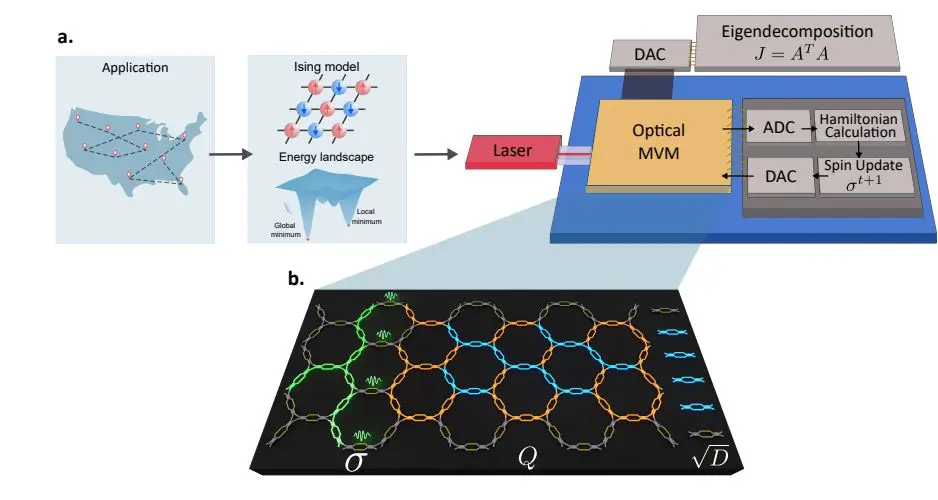
Researchers have engineered a programmable Ising solver using a hexagonal mesh, a general-purpose photonic platform, representing a significant advance in hardware acceleration for solving complex optimization problems. This system leverages high-speed and parallel processing to efficiently search for ground-state solutions, crucial for computationally intensive tasks. The core of the method involves reconfigurable matrix multiplication and iterative Hamiltonian calculations, facilitated by an annealing algorithm. The photonic processor comprises 17 hexagonal cells and 72 programmable unit cells, precisely encoding interaction matrices and spin configurations.
The system performs Hamiltonian calculations by multiplying three matrices, achieved in the optical domain using the processor as a matrix-vector multiplication accelerator, while spin updates occur electronically. Input light is divided into multiple paths, allowing for the encoding of spin values using phase shifts. The team successfully implemented both standard and non-standard matrices directly in the photonic domain, enabling the solution of a broader class of problems. They achieved high fidelity, encoding matrices with accuracies exceeding 98 percent and bit precisions exceeding five bits.
Comparisons between theoretical and measured Hamiltonians confirmed the accuracy and effectiveness of the programmable mesh for Hamiltonian calculation. The researchers experimentally solved benchmark optimization problems, including a three-node problem and a four-node Max-Cut problem, and successfully emulated problems with up to 50 variables, achieving success probabilities exceeding 80 percent. This establishes a pathway toward large-scale problem solving and demonstrates the potential of this approach for tackling complex optimization challenges.
Photonic Ising Solver Achieves High Success Rates
Researchers have developed a programmable photonic Ising solver built on a hexagonal mesh, a general-purpose photonic platform, achieving significant advancements in solving combinatorial optimization problems. The integrated system enables reconfigurable matrix multiplication and iterative Hamiltonian calculations using an annealing algorithm, effectively searching for ground states. Researchers implemented on-chip vector-matrix multiplication to calculate the Hamiltonian, encoding spin vectors and diagonal matrices using components. Matrices of sizes 3×3 and 4×4 were encoded with accuracies exceeding 98 percent and bit precisions exceeding five bits.
Tests with random matrices confirmed the accuracy of the system, with comparisons between theoretical and measured Hamiltonians achieving high correlation. As a proof of concept, the team experimentally solved a three-node problem and a four-node Max-Cut problem, and successfully emulated problems with up to 50 variables, achieving success probabilities exceeding 80 percent. The system consistently maximized the cut value, demonstrating the versatility of the programmable photonic Ising architecture.
Photonic Ising Machine Demonstrates Scalable Optimisation
This work demonstrates a programmable photonic Ising machine built on a hexagonal mesh architecture, offering a reconfigurable platform for solving combinatorial optimization problems. Researchers achieved this by implementing a system that performs matrix-vector multiplications in the optical domain, while electronic components manage spin updates, enabling efficient computation of the Ising Hamiltonian. Experimental validation involved solving benchmark problems, including a three-node problem and a four-node Max-Cut problem, consistently achieving high success rates and near-perfect fidelity between theoretical and experimental results. Furthermore, the team investigated the scalability of this architecture through simulations, successfully emulating problems with up to 50 variables while maintaining a success probability exceeding 80 percent. They also assessed the impact of realistic errors, such as phase noise and fabrication imperfections, demonstrating that the system remains robust within current technological tolerances. Compared to other approaches, including quantum and free-space optical systems, this photonic Ising machine offers advantages such as room-temperature operation, improved energy efficiency, and enhanced stability.
🗞 Programmable photonic Ising machine enabled by a reconfigurable interferometric processor
🧠 ArXiv: https://arxiv.org/abs/2511.13284
See today’s quantum computing news on Quantum Zeitgeist for the latest breakthroughs in qubits, hardware, algorithms, and industry deals.