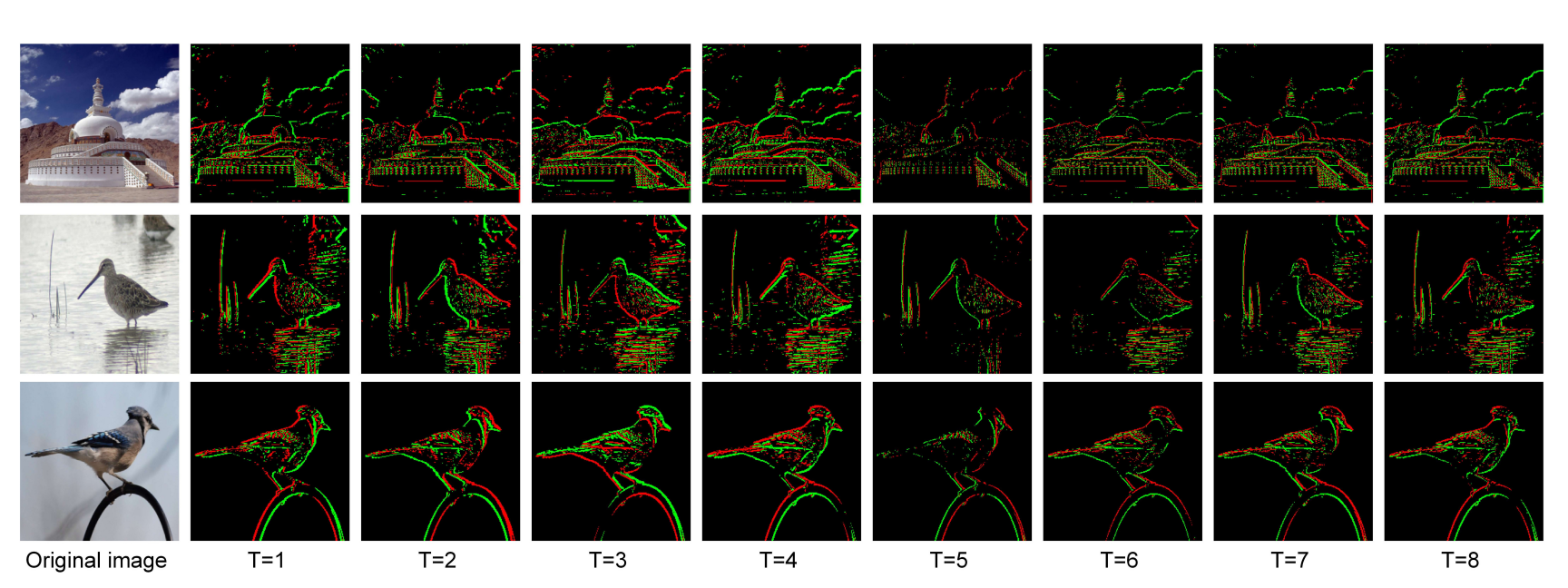
The limited availability of event-stream data currently restricts the potential of energy-efficient spiking neural networks. To address this challenge, Ruichen Ma, Liwei Meng, Guanchao Qiao, and colleagues develop I2E, a novel algorithmic framework that converts standard images into realistic event streams. This innovative approach overcomes a significant bottleneck by achieving conversion speeds over 300times faster than previous methods, allowing for effective data augmentation during SNN training. Demonstrating the framework’s power, the team achieves a state-of-the-art accuracy of 60. 50% on the I2E-ImageNet dataset and, crucially, establishes a robust sim-to-real pipeline where pre-training with synthetic data yields an unprecedented 92. 5% accuracy on real-world sensor data, paving the way for practical, high-performance spiking neural network systems.
Neuromorphic systems, promising highly energy-efficient computing, currently face a critical shortage of event-stream data, limiting their wider adoption. This work introduces I2E, an algorithmic framework designed to resolve this bottleneck by converting static images into high-fidelity event streams. By simulating microsaccadic eye movements with a highly parallelized convolution, I2E achieves a conversion speed over 300times faster than prior methods, uniquely enabling on-the-fly data augmentation for spiking neural network (SNN) training. The framework’s effectiveness is demonstrated on large-scale benchmarks, and an SNN trained on the generated I2E-ImageNet dataset achieves a state-of-the-art accuracy of 60. 50%. This work establishes a new approach to generating the data required for training advanced neuromorphic systems.
Image Stream Generation Boosts Spiking Neural Networks
Scientists have developed a new algorithmic framework, I2E, that addresses a critical limitation in spiking neural network (SNN) research: the scarcity of event-stream data. By efficiently converting static images into high-fidelity event streams, I2E overcomes a significant bottleneck hindering the development of these energy-efficient computing systems. The method achieves a conversion speed exceeding previous approaches by a factor of 300, enabling the practical application of on-the-fly data augmentation for SNN training. Researchers trained a deep spiking neural network on a newly generated dataset, I2E-ImageNet, achieving a state-of-the-art accuracy of 60.
50%, surpassing prior event-based ImageNet results by over 8%. Experiments reveal that models trained with I2E data benefit significantly from standard data augmentation techniques. A crucial finding is the establishment of a powerful “sim-to-real” paradigm, where pre-training on synthetic I2E data followed by fine-tuning on real-world CIFAR10-DVS data yields an unprecedented accuracy of 92. 5%, a remarkable 7. 7% improvement over previous best results.
This demonstrates that I2E-generated event data accurately mimics real sensor data, bridging a long-standing gap in neuromorphic engineering. Further analysis confirms the importance of I2E’s core components, with dynamic thresholding, random selection, and standard augmentations progressively improving performance. Experiments show that even with a reduced number of timesteps, the method maintains competitive accuracy while significantly increasing data compression. These results establish I2E as a foundational toolkit for developing high-performance SNNs and mitigating the data acquisition bottleneck that has long hindered progress in neuromorphic computing.
I2E Generates Event Data for SNN Training
This research introduces I2E, a novel algorithmic framework that addresses a critical limitation in the field of spiking neural networks: the scarcity of event-stream data. By efficiently converting static images into high-fidelity event streams, I2E overcomes a significant bottleneck hindering the development of these energy-efficient computing systems. The method achieves a conversion speed exceeding previous approaches by a factor of 300, enabling the practical application of on-the-fly data augmentation for SNN training. Researchers trained a deep spiking neural network on a newly generated dataset, I2E-ImageNet, achieving a state-of-the-art accuracy of 60. 50%. Crucially, the team established a powerful “sim-to-real” paradigm, successfully pre-training a model using.
🗞 I2E: Real-Time Image-to-Event Conversion for High-Performance Spiking Neural Networks
🧠 ArXiv: https://arxiv.org/abs/2511.08065


See today’s quantum computing news on Quantum Zeitgeist for the latest breakthroughs in qubits, hardware, algorithms, and industry deals.