Quantum algorithms promise to revolutionise computation, yet a complete understanding of why they outperform classical methods remains elusive. Si-Qi Zhou from Sun Yat-sen University, Jin-Min Liang from Beijing Technology and Business University, and Ziheng Ding from Shanghai Jiao Tong University, alongside their colleagues, now decode this advantage by pinpointing the crucial role of initial state properties in random-walk-based search algorithms. The team proposes three distinct search algorithms and develops precise mathematical descriptions of their likelihood of success, revealing that performance hinges on characteristics like coherence. Importantly, the research demonstrates that while greater coherence boosts the first algorithm’s effectiveness, increased levels of other properties actually diminish success in the remaining two, offering fundamental insights into how to design more powerful quantum algorithms and potentially accelerating machine learning applications.
This research centers on variations of the Spatial Quantum Walk (SKW) algorithm, a technique that offers Grover-like speedups in searching unstructured data, and proposes three distinct modifications to analyze its efficiency. Researchers derived precise analytical expressions for the success probabilities of these algorithms, revealing how specific quantum characteristics of the initial state fundamentally determine the outcome of the search. The SKW algorithm combines quantum and classical elements, beginning with a perturbed Grover walk on a hypercube.
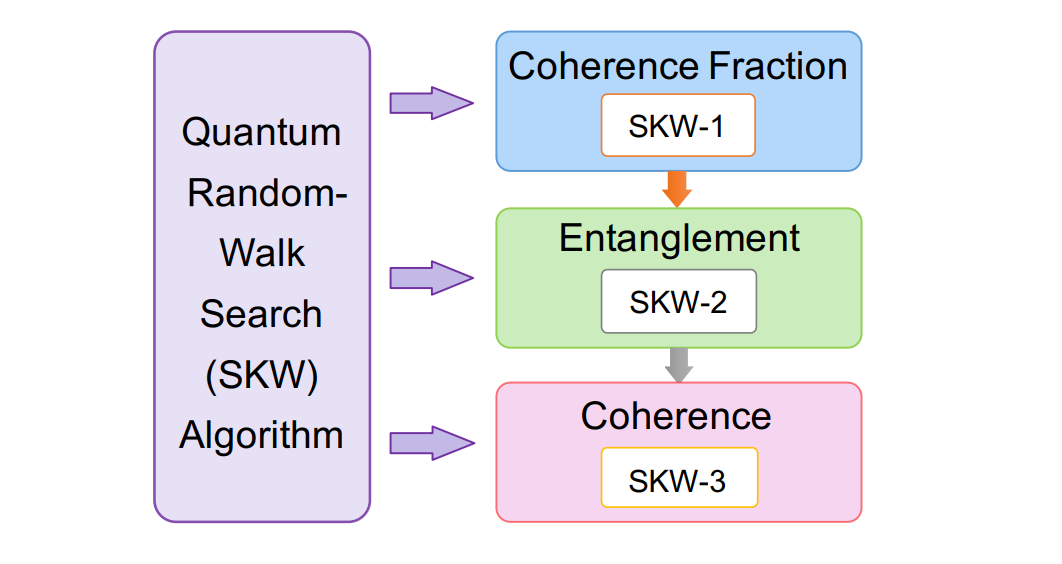
This process starts from an equally weighted superposition of initial states and proceeds for a defined number of steps, culminating in a measurement to identify the target vertex within the search space. The perturbation, introduced by an oracle, imparts position dependence to the coin operator, enabling the algorithm to require a number of oracle queries proportional to the square root of N, where N is the size of the search space. To explore the influence of initial state properties, the team engineered three modified versions of the SKW algorithm, each designed to highlight the connection between success probability and a specific quantum characteristic: coherence fraction, entanglement, and coherence. Researchers precisely defined and measured the coherence fraction of a state using Uhlmann’s fidelity, demonstrating its impact on the first modified algorithm’s performance.
They then analyzed how entanglement and coherence influence the success probabilities of the second and third algorithms, respectively. Initializing the quantum computer to an equal superposition across all states allows for efficient preparation of the node space and subsequent measurement to determine the marked state. Repeating the algorithm allows scientists to achieve arbitrarily small error rates in identifying the target vertex, demonstrating the potential for significant improvements in search efficiency.
Initial State Effects in Quantum Search Algorithms
Scientists have achieved a deeper understanding of how quantum properties influence the speed of search algorithms, revealing critical insights into harnessing quantum advantage. This work investigates the roles of coherence and entanglement in random-walk-based algorithms, demonstrating how specific initial state properties directly impact success probabilities. Researchers developed three distinct search algorithms and derived precise mathematical expressions to quantify their performance. The team discovered that the first algorithm’s success is governed by the coherence fraction of the initial state, with increased coherence enhancing the probability of finding the target.
However, the second algorithm exhibits an inverse relationship, where greater entanglement reduces the success probability. Measurements confirm that the maximal success probability of this algorithm, after a specific number of iterations, is given by 1 minus the square of the Groverian entanglement measure of the initial state, highlighting a paradox where excessive initial entanglement can hinder performance. Further investigation into the third algorithm revealed that its success probability is determined by the coherence present in the initial state. Using a specific set of local operations, scientists found that the maximal success probability is linked to the fidelity of the initial state, demonstrating a clear connection between quantum properties and algorithmic efficiency. These results provide a fundamental framework for optimizing quantum search algorithms and unlocking their full potential in areas such as machine learning. The team’s measurements demonstrate that careful balancing of coherence and entanglement is crucial for maximizing the speed and efficiency of quantum computations.
Coherence and Entanglement Govern Search Algorithm Success
Scientists have deepened our understanding of quantum search algorithms by meticulously investigating the influence of initial state properties on their performance. This research centers on variations of the Spatial Quantum Walk (SKW) algorithm, a technique that offers Grover-like speedups in searching unstructured data, and proposes three distinct modifications to analyze its efficiency. Researchers derived precise analytical expressions for the success probabilities of these algorithms, revealing how specific quantum characteristics of the initial state fundamentally determine the outcome of the search. The team discovered that the first algorithm’s success is governed by the coherence fraction of the initial state, with increased coherence enhancing the probability of finding the target.
However, the second algorithm exhibits an inverse relationship, where greater entanglement reduces the success probability. Measurements confirm that the maximal success probability of this algorithm, after a specific number of iterations, is given by 1 minus the square of the Groverian entanglement measure of the initial state, highlighting a paradox where excessive initial entanglement can hinder performance. Further investigation into the third algorithm revealed that its success probability is determined by the coherence present in the initial state. Using a specific set of local operations, scientists found that the maximal success probability is linked to the fidelity of the initial state, demonstrating a clear connection between quantum properties and algorithmic efficiency. These results provide a fundamental framework for optimizing quantum search algorithms and unlocking their full potential in areas such as machine learning. The team’s measurements demonstrate that careful balancing of coherence and entanglement is crucial for maximizing the speed and efficiency of quantum computations.
Coherence Impacts Random Walk Quantum Search
Scientists have deepened our understanding of quantum search algorithms by meticulously investigating the influence of initial state properties on their performance. This research centers on variations of the Spatial Quantum Walk (SKW) algorithm, a technique that offers Grover-like speedups in searching unstructured data, and proposes three distinct modifications to analyze its efficiency. Researchers derived precise analytical expressions for the success probabilities of these algorithms, revealing how specific quantum characteristics of the initial state fundamentally determine the outcome of the search. The team discovered that the first algorithm’s success is governed by the coherence fraction of the initial state, with increased coherence enhancing the probability of finding the target.
However, the second algorithm exhibits an inverse relationship, where greater entanglement reduces the success probability. Measurements confirm that the maximal success probability of this algorithm, after a specific number of iterations, is given by 1 minus the square of the Groverian entanglement measure of the initial state, highlighting a paradox where excessive initial entanglement can hinder performance. These findings challenge the conventional understanding that quantum coherence always improves computational power, suggesting that, in certain scenarios, controlled decoherence can actually be beneficial. The team’s work shows that the algorithms achieve Grover-like speedups, and the results highlight the importance of coherence optimization in quantum algorithm design, with potential applications for machine learning.
🗞 Decoding Quantum Search Advantage: The Critical Role of State Properties in Random Walks
🧠 ArXiv: https://arxiv.org/abs/2511.06867




See today’s quantum computing news on Quantum Zeitgeist for the latest breakthroughs in qubits, hardware, algorithms, and industry deals.