Identifying effective drug candidates for advanced delivery systems represents a significant challenge in modern therapeutics, and researchers are now applying innovative computational methods to accelerate this process. Chaithanya Purushottam Bhat, Pranav Suryawanshi, Aditya Guneja, and Debashis Bandyopadhyay, all from the Birla Institute of Technology and Science Pilani, present a combined approach using density functional theory and machine learning to investigate how drugs interact with a newly discovered two-dimensional material called Graphsene. Their work demonstrates that Graphsene’s unique structure provides an excellent surface for drug adsorption and strong electronic interactions, and the team successfully trained a machine learning model to predict suitable drug candidates based on these properties. This integrated strategy offers a rapid and cost-effective method for screening drug-nanomaterial combinations, ultimately promising a data-driven pathway towards designing more effective and targeted drug delivery systems.
Machine Learning Accelerates Nanocarrier Materials Discovery
Scientists are leveraging machine learning to accelerate the discovery of new materials for drug delivery. This research combines computational modelling, specifically density functional theory, with machine learning techniques to predict how well different materials will encapsulate and release drugs. By training machine learning models on data generated from detailed quantum mechanical calculations, researchers can rapidly screen a vast number of potential materials, significantly reducing the time and cost associated with traditional methods. This data-driven approach combines the accuracy of quantum mechanical calculations with the speed and efficiency of machine learning, offering a powerful tool for materials discovery. The core of this work lies in computational materials science, using density functional theory to understand and predict material behaviour. Machine learning algorithms learn relationships between a material’s structure and its properties from this data, allowing for quicker prediction of properties for new materials without extensive calculations.
Graphsene Drug Screening via Machine Learning
Researchers have developed a computational framework that combines density functional theory and machine learning to efficiently screen potential drug candidates for delivery using a two-dimensional material called Graphsene. This innovative approach predicts how strongly drugs will bind to Graphsene, a crucial factor in determining its suitability for drug delivery systems. The team represents drug molecules as molecular graphs, capturing their chemical structure and properties, and uses machine learning to predict adsorption energies. This method significantly accelerates the screening process, allowing researchers to identify promising drug-delivery combinations more quickly.
The team employed a transfer learning strategy, initially training a machine learning model on a large dataset of drug-like molecules before fine-tuning it with data specific to Graphsene. This pre-training phase allows the model to learn robust molecular representations, improving its accuracy and efficiency. The final model architecture combines information from both the drug and Graphsene, accurately predicting adsorption energies and providing insights into the underlying interactions. Validation with detailed quantum mechanical calculations confirms the model’s predictive power, demonstrating its potential for accelerating drug delivery system design.
Graphsene Predicts Drug Adsorption with High Accuracy
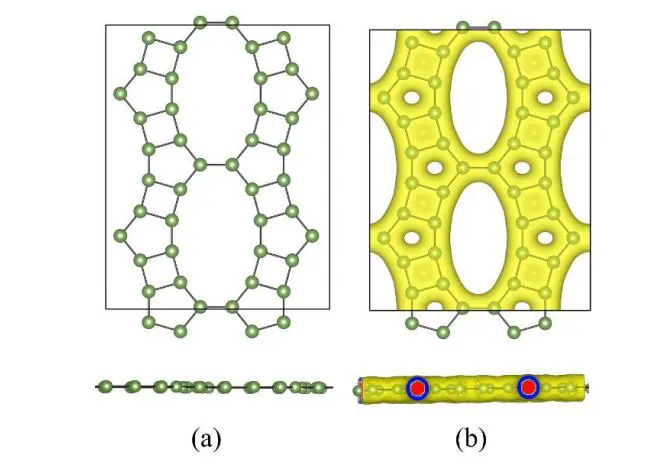
Scientists have demonstrated a new method for investigating how drugs interact with Graphsene, a newly discovered two-dimensional material with potential for drug delivery. This research combines density functional theory and machine learning to predict drug adsorption, revealing Graphsene’s porous structure and large surface area as advantageous for encapsulating and releasing drugs. The team constructed a comprehensive dataset combining data from existing databases with new calculations, enabling the machine learning model to accurately predict adsorption energies. The machine learning model accurately estimates how strongly drugs bind to Graphsene, achieving a high level of agreement with detailed quantum mechanical calculations.
The model represents drug molecules as molecular graphs, capturing key atomic properties and structural features. Detailed quantum mechanical simulations confirm the model’s predictions, revealing significant electronic interactions and charge transfer between the drug molecules and the Graphsene surface. This combined approach offers a rapid and cost-effective method for screening drug-nanomaterial interactions, paving the way for data-driven design of advanced drug delivery systems.
Machine Learning Speeds Drug Adsorption Screening
This study establishes a computational framework that combines machine learning predictions with density functional theory calculations to evaluate how drugs interact with Graphsene, a two-dimensional material. Researchers demonstrate a streamlined workflow that efficiently screens potential drug candidates and confirms promising interactions using first-principles methods, offering an accelerated route for identifying suitable drug-substrate pairings. The machine learning model accurately estimates adsorption energies, providing a reliable tool for predicting drug-material interactions. Detailed quantum mechanical calculations reveal the underlying mechanisms of adsorption, demonstrating strong electronic coupling and charge transfer between the drug molecules and the Graphsene surface. The extent of interaction varies depending on the drug’s electronic structure and functional groups, highlighting the importance of molecular properties in determining binding strength.
🗞 Unveiling the Adsorption and Electronic Interactions of Drugs on 2D Graphsene: Insights from DFT and Machine Learning Approach
🧠 ArXiv: https://arxiv.org/abs/2511.04483
See today’s quantum computing news on Quantum Zeitgeist for the latest breakthroughs in qubits, hardware, algorithms, and industry deals.